


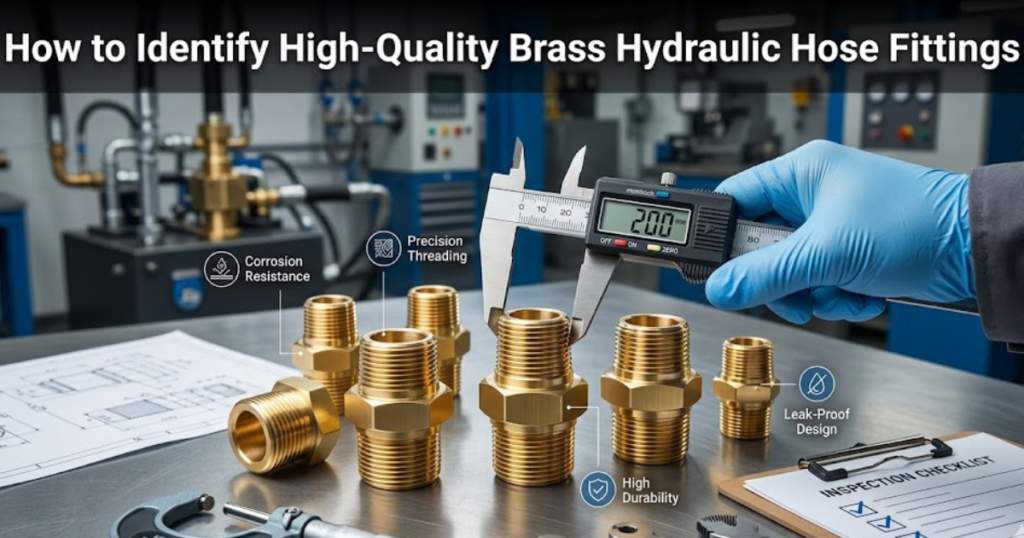
In hydraulic systems, even minor component failures can lead to costly downtime, safety hazards, and equipment damage. Brass Hydraulic Hose Fittings are among the most critical components in these systems — connecting hoses to pumps, cylinders, valves, and other fluid-power equipment under high pressure and dynamic load conditions.
Choosing the right fittings is not simply a matter of finding the lowest-priced supplier. Quality, dimensional accuracy, material integrity, and pressure ratings all determine whether a fitting will perform reliably over its service life. At OK Engineers (Om Kailash Engineers), we have been manufacturing and exporting precision brass hydraulic components for over 60 years from Jamnagar, Gujarat. This guide is designed to help engineers, procurement managers, and industrial buyers make informed decisions when sourcing brass hydraulic hose fittings.
What Are Brass Hydraulic Hose Fittings?
Brass Hydraulic Hose Fittings are precision-machined connectors used to join flexible hydraulic hoses to ports, adapters, valves, pumps, and actuators within hydraulic and fluid-transfer systems. They are manufactured from brass or copper alloy bar stock using CNC turning machines, ensuring consistent dimensional tolerances and thread integrity.
Unlike standard plumbing fittings, hydraulic hose fittings must withstand significantly higher operating pressures — often ranging from 150 bar to 700 bar depending on the application — while maintaining leak-proof sealing under vibration, thermal cycling, and mechanical stress.
Key Functions of Brass Hydraulic Hose Fittings
- Connect flexible hoses to rigid hydraulic components
- Provide leak-proof sealing under high-pressure fluid flow
- Accommodate directional changes in hose routing (elbows, tees, crosses)
- Facilitate quick disconnection for maintenance or equipment changes
- Allow size or thread-type transitions between different system components
Common Types of Brass Hydraulic Hose Fittings
Understanding the various fitting types helps buyers specify the correct component for each application. Incorrect fitting selection is one of the leading causes of hydraulic system failure.
Types of Brass Hydraulic Hose Fittings and Their Applications
| Fitting Type | Description | Typical Application |
| Hose Nipple | Straight connector with barb or compression end for hose attachment | General hydraulic hose connections |
| BSP Male/Female Adapter | British Standard Pipe thread adapter for system connections | UK, European, and Asian hydraulic systems |
| NPT Adapter | National Pipe Taper thread connector for American-standard systems | USA, Canada, and export hydraulic assemblies |
| JIC Flare Fitting (37°) | Flared seat fitting for leak-proof metal-to-metal sealing | High-pressure hydraulic lines |
| Banjo Fitting | Hollow bolt-style connector for transverse connections in tight spaces | Automotive hydraulic brakes, fuel systems |
| Elbow Fitting (45°/90°) | Angled connector for direction changes in hose routing | Space-constrained hydraulic installations |
| Tee Fitting | Three-way connector for branching fluid lines | Manifold assemblies, parallel circuits |
| Bulkhead Fitting | Panel-mount fitting for routing hoses through walls or bulkheads | Mobile equipment, industrial machinery |
| Swaged/Crimp Fitting | Permanently attached fitting crimped onto hose end | High-cycle, high-pressure hose assemblies |
| Quick-Disconnect Coupling | Tool-free connect/disconnect under low or no pressure | Maintenance, test points, mobile equipment |
7 Quality Indicators for Brass Hydraulic Hose Fittings
Whether you are evaluating a new Brass Hydraulic Hose Fittings Supplier or auditing your current supply chain, these seven quality markers will help you distinguish high-performance fittings from substandard alternatives.
Material Composition and Alloy Grade
High-quality hydraulic fittings are machined from free-cutting brass alloys such as CW614N (BS2874 CZ121) or C36000, which offer excellent machinability, corrosion resistance, and pressure-bearing capacity. Request material test certificates (MTCs) confirming the alloy composition. Fittings made from recycled or unspecified brass scrap may have inconsistent zinc content, leading to dezincification and premature failure.
Dimensional Accuracy and Thread Quality
Thread form, pitch, and tolerance directly affect the sealing integrity of hydraulic fittings. Threads must conform to the relevant standard — BSP (ISO 228), NPT (ASME B1.20.1), JIC (SAE J514), or metric (DIN 3852). Use a thread gauge to verify pitch and form. Visual inspection alone is insufficient; check thread engagement length, lead chamfer, and root radius for signs of poor tooling or worn inserts.
Surface Finish and Appearance
A quality fitting will have a uniform, burr-free machined surface. Check for: tool marks or chatter on sealing faces, sharp edges or fins at thread runouts, pitting or porosity on the external surface, and inconsistent bore diameter. Surface finish on sealing faces (for metal-to-metal or cone-seat designs) should be 0.8 Ra or better to ensure leak-free assembly.
Pressure Rating and Wall Thickness
Every hydraulic fitting should carry a declared maximum working pressure (MWP) and a burst pressure rating (typically 4:1 safety factor over MWP). Calculate wall thickness adequacy using the Barlow formula (P = 2St/D) and verify the supplier’s stated ratings are supported by test data, not just catalogue claims.
Plating or Surface Treatment
Many hydraulic fittings are supplied with nickel plating, tin plating, or chrome treatment to enhance corrosion resistance, especially for marine, outdoor, or humid environments. Verify the plating thickness (typically 5–15 microns for nickel) and adhesion quality. Poor plating will peel under assembly torque and contaminate the hydraulic fluid.
Sealing Face Integrity
For cone-seat (JIC 37°, DIN 24°) and parallel-thread (BSP-S, ORFS) fittings, the sealing face geometry is critical. Measure the cone angle with a profile projector or optical comparator. A deviation of more than ±0.5° from the nominal cone angle will result in reduced contact area, higher leak risk, and accelerated fretting wear.
Batch Consistency and Traceability
High-volume procurement requires batch-to-batch consistency. A professional Brass Hydraulic Hose Fittings Manufacturer should provide lot traceability, linking each production batch to raw material MTCs, machine settings, and inspection records. This is a basic requirement for ISO 9001:2015 compliant suppliers and essential for warranty and failure-analysis purposes.
Technical Specifications — Brass Hydraulic Hose Fittings
Technical Reference — Common Brass Hydraulic Hose Fittings Specifications
| Parameter | Specification / Range | Standard / Reference |
| Material | CW614N (CZ121), CW617N, C36000 brass alloy | BS 2874, ASTM B16 |
| Thread Types | BSP (G), NPT, JIC 37°, BSPT, Metric DIN | ISO 228, ASME B1.20.1, SAE J514, DIN 3852 |
| Size Range | 1/8″ to 2″ BSP / NPT; DN6 to DN50 metric | Per system design requirements |
| Working Pressure | Up to 700 bar (depending on size and type) | Per DIN EN 853 / SAE 100R series |
| Burst Pressure | Minimum 4:1 safety factor over MWP | ISO 18752, SAE J517 |
| Temperature Range | -20°C to +120°C (standard) | Application-specific; higher grades available |
| Surface Finish (sealing face) | Ra 0.8 µm or better | ISO 1302 |
| Plating Options | Nickel (5–15 µm), Tin, Chrome, Bare brass | ASTM B689 (nickel), ASTM B545 (tin) |
| Dimensional Tolerance | ±0.02 mm (CNC machined) | Per drawing / ISO 2768 medium |
| Thread Tolerance | 6H (internal) / 6g (external) | ISO 965, ISO 228 |
| Pressure Test | 1.5× MWP hydrostatic test | ISO 19879 |
| RoHS Compliance | Available on request | EU Directive 2011/65/EU |
Brass vs. Alternative Materials — Why Brass Wins for Hydraulic Fittings
While stainless steel, carbon steel, and aluminium fittings are also used in hydraulic systems, brass remains the preferred material for a broad range of applications due to its unique combination of properties. The comparison below helps buyers understand the trade-offs.
You May Also Read – How to Choose the Right Brass Precision Parts Manufacturer in India
Brass vs. Alternative Fitting Materials
| Property | Brass (CW614N) | Stainless Steel (316) | Carbon Steel | Aluminium |
| Machinability | Excellent (~100%) | Moderate (~45%) | Good (~70%) | Good (~300%) |
| Corrosion Resistance | Very Good | Excellent | Poor (needs coating) | Good (anodised) |
| Pressure Capability | High (up to 700 bar) | Very High | Very High | Moderate |
| Cost | Moderate | High | Low | Moderate |
| Weight | Moderate (8.5 g/cm³) | Heavy (8.0 g/cm³) | Heavy (7.8 g/cm³) | Light (2.7 g/cm³) |
| Thread Quality | Excellent (CNC) | Good | Good | Moderate (soft) |
| Temperature Range | -20°C to +120°C | -200°C to +400°C | -20°C to +300°C | -50°C to +150°C |
| Ideal For | General hydraulics, plumbing, OEM | Chemical/marine hydraulics | High-pressure industrial | Lightweight mobile systems |
For the majority of industrial hydraulic applications — including mobile machinery, industrial presses, fluid-transfer systems, and OEM equipment — brass provides the optimal balance of performance, cost, and machinability. This is why Jamnagar-based manufacturers have remained the preferred global source for hydraulic brass fittings for decades.
Thread Standards — Selecting the Right Thread Type
Thread type selection is one of the most common sources of procurement errors in hydraulic fitting orders. Mixing incompatible threads — even those that appear similar — results in leaks, cross-threading, and system failures. The following guide helps buyers specify correctly.
BSP (British Standard Pipe) — Most Common in India, Europe, and Asia
BSP threads are the default standard across most Indian-made hydraulic equipment and are widely used in Europe, Australia, and Southeast Asia. There are two variants: BSPP (parallel, G-thread) and BSPT (tapered, R-thread). BSPP requires a bonded seal or O-ring for sealing; BSPT relies on thread taper for sealing.
NPT (National Pipe Taper) — Standard for USA and Canada
NPT threads are tapered and seal through thread interference with PTFE tape or thread sealant compound. They are not interchangeable with BSP threads despite superficial similarity. NPT is the standard for equipment destined for North American markets.
JIC 37° Flare — High-Pressure Applications
JIC fittings use a 37° flare angle on both the fitting and the mating component to create a metal-to-metal cone seal. They are widely specified for high-pressure hydraulic lines (up to 700 bar) and are common in mobile and agricultural equipment.
Metric DIN / ISO — European Industrial Equipment
DIN 3852 and ISO 9974 metric fittings are used extensively in European industrial machinery. They use straight threads with a 24° cone or an O-ring face seal (ORFS). Buyers importing from or exporting to European markets should verify DIN compliance with their supplier.
How O.K. Engineers Manufactures Brass Hydraulic Hose Fittings
O.K. Engineers produces brass hydraulic hose fittings from their facility at GIDC Phase-2, Dared, Jamnagar, Gujarat, using a fully integrated manufacturing and quality assurance process. Here is an overview of the production workflow:
Raw Material Procurement
All brass bar stock is sourced from approved vendors and subject to incoming inspection. Material test certificates confirming alloy grade, chemical composition, and mechanical properties are verified against purchase specifications before material is released to production.
CNC Turning and Machining
Components are produced on CNC Turning Machines programmed to tight dimensional tolerances. Tool offsets, cutting parameters, and inspection intervals are defined in production control plans. Automatic in-process gauging is used on high-volume runs to detect dimensional drift before it becomes a non-conformance.
Thread Cutting and Verification
Threads are cut using precision threading tools and verified using calibrated thread gauges (GO/NO-GO) for every production batch. Thread pitch, form, tolerance class, and engagement length are all checked against drawing requirements.
Surface Treatment
Where specified, components proceed to plating (nickel, tin, or chrome) at approved plating facilities. Plating thickness is verified by XRF (X-ray fluorescence) or magnetic induction gauging before the batch is accepted.
100% Final Inspection
Every outgoing component undergoes a 100% inspection covering critical dimensions, thread gauging, surface finish, and visual examination. O.K. Engineers’ ISO 9001:2015 quality management system requires full traceability from raw material through to despatch.
Packaging and Export
Components are packed in polybags, boxes, or custom packaging per customer requirements. Export documentation — including packing lists, commercial invoices, certificates of origin, and material certificates — is prepared in compliance with the requirements of destination markets including Spain, Germany, USA, France, Russia, and the UK.
Internal Link Guide — Explore O.K. Engineers’ Related Products
O.K. Engineers manufactures a comprehensive range of brass and copper alloy precision components beyond hydraulic fittings. Explore related product pages and technical resources at okengineers.com:
- Brass Precision Turned Components — Full CNC-turned component range in brass and copper alloys
- Brass Hydraulic Fittings — Complete hydraulic fitting range including adapters, nipples, and connectors
- Brass Plumbing Fittings — Corrosion-resistant plumbing components for water and gas systems
- Brass Electrical Components — Terminal bars, connectors, and moulding inserts
- Related Blog: How to Choose the Right Brass Precision Parts Manufacturer in India
Conclusion
Identifying high-quality Brass Hydraulic Hose Fittings requires a systematic evaluation of material grade, dimensional accuracy, thread conformance, pressure ratings, and supplier quality credentials. Cutting corners at the fitting selection stage invariably leads to system leaks, unplanned downtime, and significant replacement costs.
A certified, experienced Brass Hydraulic Hose Fittings Manufacturer with documented quality processes, CNC production capability, and proven export experience is the right long-term partner for industrial buyers globally. O.K. Engineers, backed by 60+ years of manufacturing excellence and ISO 9001:2015 certification, delivers precisely that — component after component, batch after batch, to clients across India and worldwide.