


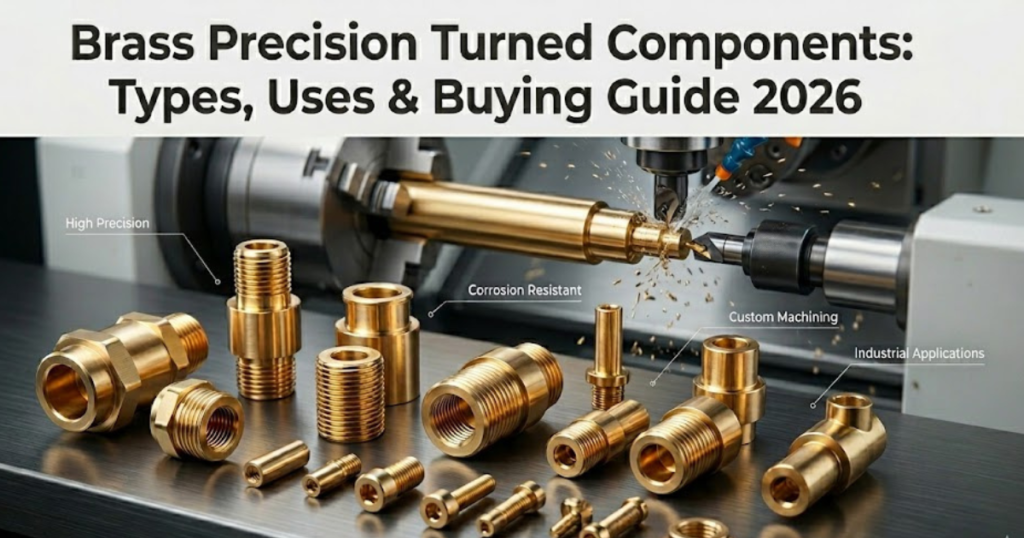
In today’s highly competitive manufacturing environment, the quality of individual components can determine the success or failure of an entire system. Brass Precision Turned Components are at the heart of countless industrial applications — from electrical fittings and plumbing assemblies to hydraulic systems and automotive parts.
These components are manufactured using advanced CNC turning technology, which ensures tight dimensional tolerances, consistent surface finish, and long-term reliability. For procurement managers, engineers, and importers sourcing high-quality brass precision parts globally, choosing the right manufacturer is as important as choosing the right material.
At O.K. Engineers (Om Kailash Engineers), based in Jamnagar, Gujarat, we have been manufacturing and exporting ISO 9001:2015 certified brass precision turned components for over 60 years — serving clients across India, the USA, Germany, Spain, France, Russia, the UK, and beyond.
What Are Brass Precision Turned Components?
Brass precision turned components are machined parts manufactured from brass or copper alloy bar stock using CNC (Computer Numerical Control) turning machines. The turning process rotates the raw material at high speed while a cutting tool removes material to achieve the desired shape, diameter, thread, and surface finish.
The term “precision” refers to the tight tolerances maintained during manufacturing — typically within ±0.01 mm to ±0.05 mm — which ensures that every component fits perfectly in its intended assembly without modification or rework.
Brass is the preferred material for precision turned parts because of its unique combination of properties: excellent machinability, natural corrosion resistance, good electrical and thermal conductivity, and long service life even in demanding environments.
Key properties of Brass that make it Ideal for Precision Turning:
| Property | Value / Characteristic | Benefit |
| Machinability rating | 100% (reference standard) | Fast, clean cuts — lower production cost |
| Tensile strength | 300–500 MPa (depending on alloy) | Handles mechanical stress without failure |
| Corrosion resistance | Excellent in air, water, mild chemicals | Long service life in plumbing & outdoor use |
| Electrical conductivity | ~28% IACS | Suitable for electrical terminals & connectors |
| Thermal conductivity | ~120 W/m·K | Good for heat-transfer applications |
| Density | ~8.5 g/cm³ | Heavier than aluminum but lighter than steel |
Types of Brass Precision Turned Components
The range of brass precision turned components is broad, covering dozens of part geometries and functional categories. Understanding the main types helps buyers specify the right component for their application.
Threaded Components
These include bolts, nuts, studs, nipples, and threaded inserts. Thread forms may be metric (M series), BSP, NPT, or UNC/UNF depending on the end market. Threaded brass parts are widely used in plumbing, gas fittings, and pneumatic assemblies.
Connector & Fitting Components
Brass connectors, couplings, reducers, and adapters form the backbone of fluid and gas distribution systems. These parts require precise bore diameters and sealing surfaces to prevent leaks under pressure.
Electrical & Electronic Components
Cable glands, terminal pins, connectors, contact sleeves, and sealing screws fall in this category. Dimensional accuracy is critical here because poor fit can lead to poor electrical contact or insulation failure.
Inserts for Moulding
Brass threaded inserts are embedded into plastic moulded parts to provide durable metal threads. These are used heavily in electronics, automotive interiors, and consumer appliances.
Valve & Hydraulic Components
Valve bodies, stems, seats, and hydraulic fittings require high dimensional accuracy and smooth bore finish to control fluid flow reliably under pressure.
Automotive & Mechanical Parts
Brass bushings, spacers, standoffs, and specialized turned parts are used in vehicle fuel systems, transmission components, sensors, and instrument clusters.
Types of brass precision turned components at a glance:
| Component Type | Common Thread/Form | Typical Industries |
| Threaded nipples & studs | BSP, NPT, Metric | Plumbing, gas, HVAC |
| Cable glands & connectors | PG, Metric, NPT | Electrical, telecom |
| Inserts for moulding | Metric, UNC | Electronics, auto, appliances |
| Hydraulic fittings | BSP, JIC, NPT | Oil & gas, machinery |
| Valve stems & seats | Custom profiles | Water treatment, chemical |
| Automotive turned parts | Custom | Automotive, aerospace |
| Lamp & lighting parts | E27, B22, custom | Lighting, decorative |
Raw Materials & Brass Grades Used
Not all brass is the same. The alloy composition directly affects machinability, corrosion resistance, strength, and suitability for specific applications. A reliable brass precision parts manufacturer selects the correct grade for each application.
You May Also Read – How to Identify High-Quality Brass Hydraulic Hose Fittings
Common Brass Grades for Precision Turning
CZ121 / CW614N (Free Machining Brass): This is the most widely used grade for precision turned parts globally. It contains approximately 58% copper, 39% zinc, and 3% lead, which acts as a chip-breaker during machining. It offers excellent machinability, good corrosion resistance, and is suitable for most general-purpose components.
CZ122 / CW600N (Low Lead Brass): With reduced lead content (typically below 0.1%), this grade meets RoHS and drinking-water regulations. It is increasingly specified for plumbing fittings, potable water components, and food-grade applications in Europe and North America.
CZ131 / Naval Brass: Contains tin (approximately 1%) for improved resistance to dezincification in seawater and salt-spray environments. It is preferred for marine, offshore, and coastal industrial applications.
Copper Alloys (C110, C122): Pure copper or high-copper alloys are used where maximum electrical or thermal conductivity is required — such as electrical bus bars, terminal strips, and heat exchanger components.
Brass grade selection guide:
| Grade | Cu% | Zn% | Pb% | Key Advantage | Best Application |
| CZ121 / CW614N | ~58 | ~39 | ~3 | Best machinability | General precision parts |
| CZ122 / CW600N | ~58 | ~41 | <0.1 | RoHS / lead-free | Potable water, Europe exports |
| CZ131 / Naval | ~60 | ~39 | ~1 | Dezincification resistant | Marine, offshore |
| C110 Copper | ~99.9 | — | — | Max conductivity | Electrical, bus bars |
Manufacturing Process: CNC Turning at O.K. Engineers
Understanding how brass precision turned components are manufactured helps buyers evaluate supplier capabilities and set realistic quality expectations.
Raw Material Procurement
High-grade brass rods and bars are sourced from certified suppliers and inspected for chemical composition and dimensional consistency before entering production.
CNC Programming & Setup
Component drawings (2D or 3D CAD files) are converted into CNC machine programs. Cutting parameters — spindle speed, feed rate, depth of cut — are optimized for the specific brass grade and component geometry.
CNC Turning & Machining
Single-spindle and multi-spindle CNC turning centers machine the brass bar stock to the required shape, thread form, and surface finish. Secondary operations such as milling, drilling, and knurling are performed in the same setup where possible to minimize handling.
Quality Inspection
Every batch undergoes dimensional inspection using calibrated gauges, micrometers, thread gauges, and CMM (Coordinate Measuring Machines) where applicable. O.K. Engineers follows ISO 9001:2015 quality protocols at every stage.
Surface Treatment (if required)
Components can be supplied with various surface finishes: natural brass, nickel plating, chrome plating, tin plating, or passivation — depending on the application and end-market requirement.
Packaging & Export
Parts are counted, packed, and labeled as per buyer specifications. Export documentation — including material test certificates, packing lists, and certificates of origin — is prepared for international shipments to the USA, Germany, Spain, France, Russia, the UK, and other markets.
Key Industries & Applications
Brass precision turned components serve a wide range of industries. Below is an industry-wise breakdown of how these parts are applied in real-world systems.
Electrical & Electronics Industry
Brass is the standard material for cable glands, terminal connectors, earthing hardware, and switchgear components. Its combination of electrical conductivity, corrosion resistance, and ease of threading makes it irreplaceable in panel boards, junction boxes, and control systems.
Related: Brass Electrical Components— Explore our full range of Brass Electrical Fittings and wiring accessories.
Plumbing & Sanitary Industry
Brass plumbing fittings — including elbows, tees, couplings, valves, and nipples — are the global standard for water supply, drainage, and gas distribution systems. Precision turning ensures leak-free threads and dimensionally accurate sealing surfaces.
Related: Brass Plumbing Fittings— Full Range of precision brass plumbing components.
Hydraulic & Pneumatic Industry
High-pressure hydraulic fittings, valve bodies, and manifold connectors demand tight bore tolerances and smooth internal finishes to prevent leakage and pressure loss. Brass is preferred over plastic in high-temperature or high-pressure applications.
Related: Brass Hydraulic Fittings— precision hydraulic fittings for industrial systems.
Automotive Industry
Precision brass parts are used in fuel system components, sensors, transmission parts, and instrument fittings. CNC turning ensures consistent part-to-part repeatability required for automotive assembly lines.
Lamp & Lighting Industry
Brass lamp holders, lamp caps, lighting connectors, and decorative fittings are manufactured to exact dimensional and surface-finish requirements for both domestic and export markets.
Related: Brass Lamp Parts— precision lamp parts for global lighting manufacturers.
Plastic Moulding Industry
Threaded brass inserts provide durable, reusable metal threads in plastic housings for electronics, appliances, and automotive interiors. Precision turning ensures consistent thread engagement and pull-out strength.
Quality Standards & Certifications
For international buyers, especially in Europe and North America, quality certifications and compliance documentation are non-negotiable requirements when sourcing brass precision parts from India.
ISO 9001:2015 Certification: O.K. Engineers holds ISO 9001:2015 certification, which confirms that our quality management system meets international standards for process control, product consistency, and customer satisfaction. Every shipment is backed by documented quality records.
Dimensional Tolerances: Standard precision turned parts are manufactured to tolerances of ±0.05 mm for general components and ±0.01 mm for high-precision parts, unless otherwise specified by the customer drawing.
Material Compliance: For export to European markets, components can be supplied in RoHS-compliant, lead-free brass grades. Material test certificates (MTCs) are available for each shipment upon request.
Surface Treatment Standards: Nickel plating, chrome plating, and tin plating are performed to ASTM and EN standards. Salt-spray test reports are available for plated components.
Packaging & Labeling: Export-grade packaging — including moisture-proof inner bags, corrugated outer cartons, and pallet wrapping — ensures components arrive in perfect condition regardless of shipping distance or climate.
How to Choose the Right Brass Precision Parts Manufacturer
For procurement managers and importers evaluating suppliers, the following criteria help identify a reliable and capable brass precision parts manufacturer:
1. Experience & Track Record A manufacturer with decades of experience — like O.K. Engineers with 60+ years — has refined processes, built supplier relationships, and solved the quality challenges that younger manufacturers are still encountering.
2. CNC Machine Capability Modern CNC turning centers with tight process control are essential for consistent dimensional accuracy across large production volumes. Ask for machine specifications and production capacity.
3. Quality Management System ISO 9001:2015 certification is the baseline. Look for in-house inspection labs, calibrated measuring instruments, and documented quality control procedures.
4. Material Traceability A reliable manufacturer can provide material test certificates linking each batch of components to the original raw material composition. This is critical for aerospace, automotive, and medical applications.
5. Export Experience Manufacturers with established export operations understand international packaging, documentation, INCOTERMS, and compliance requirements. This reduces risk and administrative burden for the buyer.
6. Customization Capability The ability to manufacture from customer drawings — including unusual thread forms, special alloys, or non-standard dimensions — separates full-service manufacturers from commodity suppliers.
7. Minimum Order Quantities & Lead Times Understand MOQ requirements and standard lead times for both repeat orders and new part development. Flexible MOQs are particularly important for importers testing a new supplier.
Supplier Evaluation Checklist:
| Evaluation Criterion | What to Ask / Check |
| Certifications | ISO 9001:2015 certificate validity |
| Machine capability | Number & type of CNC turning centers |
| Inspection equipment | Gauges, CMM, thread gauges available? |
| Material compliance | RoHS, lead-free options available? |
| Export experience | Which countries supplied? References? |
| Lead time | Standard production lead time for new parts |
| MOQ | Minimum order per part number |
| Sample policy | Pre-production samples available? |
Export Markets & Global Demand for Brass Precision Parts
India — and Jamnagar, Gujarat in particular — has emerged as one of the world’s leading sources of precision brass components. The combination of skilled engineering workforce, competitive raw material costs, and established export infrastructure makes Indian manufacturers a preferred sourcing destination for global buyers.
Why global buyers source brass precision parts from India:
Jamnagar is internationally recognized as the “Brass City of India,” home to hundreds of precision component manufacturers serving export markets across five continents. Buyers from Germany, the USA, Spain, France, and the UK regularly source brass fittings, connectors, and machined components from Jamnagar-based manufacturers because of the price-quality combination that is difficult to match elsewhere.
Key export destinations and typical product categories:
| Export Market | Typical Products Sourced | Key Compliance Requirement |
| Germany / EU | Plumbing fittings, cable glands, inserts | RoHS, REACH, EN standards |
| USA | Hydraulic fittings, NPT threaded parts | ASTM, NSF-61 (potable water) |
| UK | Plumbing fittings, electrical components | BS EN standards, WRAS |
| Spain | Lamp parts, plumbing fittings | CE marking where applicable |
| France | Precision turned parts, connectors | RoHS, REACH compliance |
| Russia | Industrial fittings, valve parts | GOST standards awareness |
OK. Engineers has been serving these export markets for decades, with established logistics networks and documentation processes to ensure smooth customs clearance and on-time delivery.
Conclusion
Brass precision turned components remain one of the most essential categories of industrial hardware — combining material versatility, dimensional accuracy, and long-term reliability across hundreds of applications. Whether you are sourcing cable glands for an electrical panel, hydraulic fittings for a fluid system, threaded inserts for plastic moulding, or custom lamp parts for a lighting manufacturer, the quality of the component starts with the quality of the manufacturer.Choosing a supplier with proven CNC technology, ISO-certified quality management, material traceability, and established export experience protects your supply chain and your end product’s performance. In 2026, as global buyers continue to prioritize quality, compliance, and reliable delivery, partnering with an experienced brass precision turned components manufacturer in India delivers a measurable competitive advantage.