


Brass garden hose fittings remain essential for reliable water flow in gardening, irrigation, and industrial applications. These precision-engineered components connect hoses to taps, sprinklers, and nozzles, offering superior corrosion resistance and durability compared to plastic alternatives. As a leading brass hose fittings manufacturer in India, O.K. Engineers leverages 60+ years of expertise in brass and copper alloy turned components to produce high-quality Brass Garden Hose Fittings.
Based in Jamnagar, Gujarat, our ISO 9001:2015 certified facility uses advanced CNC turning machines for precise production. We export to global markets including Spain, Germany, USA, France, Russia, and UK, serving plumbing, hydraulic, and automotive sectors. This 2026 buying guide covers types, sizes, standards, and selection tips to help procurement managers and engineers make informed B2B decisions. Whether sourcing for manufacturing or resale, understanding these fittings ensures optimal performance and longevity.
What Are Brass Garden Hose Fittings?
Brass garden hose fittings are threaded connectors made from high-grade brass alloys, designed for secure hose attachments in low-to-medium pressure water systems. They excel in outdoor environments due to brass’s natural resistance to rust, UV exposure, and temperature fluctuations from -20°C to 120°C.
These fittings typically feature male or female National Pipe Taper (NPT) or Garden Hose Thread (GHT) profiles, ensuring leak-proof seals. Common alloys include CW617N (63% copper, 36% zinc, 0.2% lead), prized for machinability and strength. Unlike aluminum or steel, brass avoids galvanic corrosion when paired with copper pipes.
Industrial buyers value their 1000+ PSI burst strength and compliance with standards like BS 5200 or ASTM B584. O.K. Engineers performs 100% quality checks on every batch, making them ideal for hydraulic and plumbing applications worldwide.
Types of Brass Garden Hose Fittings
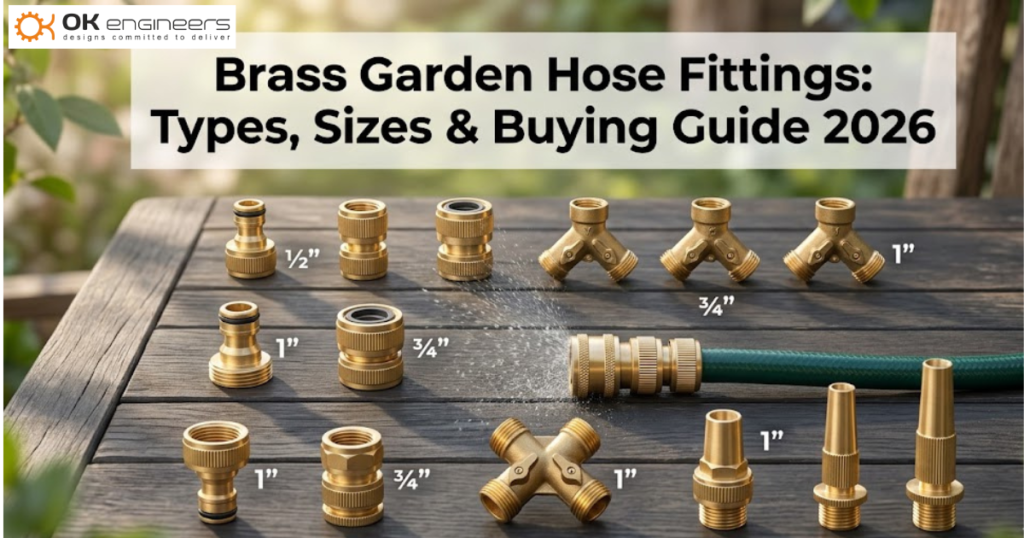
Brass garden hose fittings come in various types to suit specific connection needs. The most common include couplings, adapters, and nozzles, each optimized for pressure handling and flow rates.
- Couplings: Quick-connect male/female pairs for hose-to-hose or hose-to-tap links. Swivel types allow 360° rotation to prevent kinking.
- Adapters: Thread converters, such as 3/4″ GHT to 1/2″ NPT, bridging standard garden hoses to industrial plumbing.
- Y-Splitters: Brass Y-fittings divide one hose into two outlets, perfect for multi-zone irrigation.
- Ball Valves: Integrated shut-off fittings with lever controls for precise flow regulation.
- Nozzles and Spray Guns: Adjustable brass heads for targeted watering in agricultural or landscaping setups.
O.K. Engineers specializes in custom CNC-machined variants, including hydraulic hose fittings, ensuring compatibility across global standards.
| Type | Key Features | Common Applications | Pressure Rating |
| Couplings | Swivel joint, GHT threads | Hose extension, tap connection | Up to 150 PSI |
| Adapters | Multi-thread compatibility | International plumbing integration | 200-500 PSI |
| Y-Splitters | Dual 3/4″ outlets | Irrigation splitting | 100 PSI |
| Ball Valves | Quarter-turn shut-off | Flow control in gardens | 300 PSI |
| Nozzles | Adjustable spray patterns | Watering, cleaning | 80 PSI |
Standard Sizes of Brass Garden Hose Fittings
Sizes for brass garden hose fittings follow global standards, with diameters measured in inches or BSP (British Standard Pipe). Common garden sizes range from 1/2″ to 1″, while industrial variants extend to 2″.
In India and Europe, GHT (3/4″-11.5 NH) dominates for consumer hoses, featuring a 1.0625″ major diameter. NPT sizes like 3/4″ taper from 1.050″ to 0.925″ over six threads per inch. Metric equivalents (e.g., M20x1) serve export markets.
Procurement managers should verify ID/OD tolerances: ±0.05mm for precision fits. Oversized fittings risk leaks; undersized ones cause restrictions.
| Size (Inches) | Thread Type | Inner Diameter (ID) mm | Outer Diameter (OD) mm | Flow Rate (GPM at 50 PSI) |
| 1/2″ | GHT/NPT | 12.7 | 21.3 | 5-8 |
| 3/4″ | GHT/BSP | 19.0 | 26.9 | 10-15 |
| 1″ | BSP/NPT | 25.4 | 33.4 | 20-25 |
| 1-1/2″ | BSP | 38.1 | 47.6 | 35-40 |
| 2″ | Industrial NPT | 50.8 | 60.3 | 50+ |
Jamnagar’s brass ecosystem ensures cost-effective scaling from prototypes to bulk orders.
Materials and Standards for Brass Garden Hose Fittings
Premium brass garden hose fittings use dezincification-resistant alloys like CW617N or C38500, containing 57-63% copper and low lead (≤0.25%) for potable water safety. These outperform cheaper LZ43 (lead-free zinc) in corrosion tests, lasting 10+ years in harsh climates.
Key standards include:
- ISO 9001:2015 for quality management (as at O.K. Engineers).
- ASTM B584 for casting specs.
- BS EN 1254-2 for pressure ratings.
- NSF/ANSI 61 for drinking water compliance.
Surface finishes like nickel-plating enhance wear resistance. Always demand material certificates from suppliers to avoid subpar alloys prone to cracking.
Benefits of Choosing Brass Over Alternatives
Brass garden hose fittings outperform plastic, steel, and aluminum in durability and versatility. Brass withstands 400°F without deforming, versus plastic’s 150°F limit, reducing failure in hot climates.
Key advantages:
- Corrosion Resistance: Forms protective patina; ideal for coastal exports to Spain or UK.
- Machinability: CNC precision yields leak-proof threads.
- Eco-Friendly: 100% recyclable, aligning with EU RoHS directives.
- Longevity: 20-30 year lifespan with proper use.
In hydraulic applications, brass handles vibrations better than steel, minimizing fatigue fractures.
| Material | Corrosion Resistance | Max Temp (°C) | Cost Index | Lifespan (Years) |
| Brass (CW617N) | Excellent | 120 | 1.0 | 20-30 |
| Plastic (PVC) | Poor | 60 | 0.4 | 2-5 |
| Steel (Galvanized) | Fair | 200 | 0.8 | 10-15 |
| Aluminum | Good | 150 | 0.7 | 8-12 |
| Stainless Steel | Superior | 300 | 2.5 | 25+ |
Key Factors in Buying Brass Garden Hose Fittings
Procurement decisions hinge on pressure ratings, thread compatibility, and supplier reliability. Prioritize 150-300 PSI working pressure for garden use; verify burst tests exceed 4x that.
Check for:
- Lead-free certification for food-grade apps.
- RoHS compliance for EU imports.
- Custom options via CNC for OEM needs.
As a trusted brass hose fittings exporter, O.K. Engineers offers samples and fast prototyping. Factor in total cost: brass’s upfront premium saves on replacements.
You May Also Read – Brass Lamp Parts Manufacturer in India: Complete Product Guide
Maintenance and Installation Tips
Proper installation extends brass garden hose fittings life. Use PTFE tape on male NPT threads (3 wraps clockwise) for airtight seals. Hand-tighten plus 1/2 turn; avoid overtightening to prevent galling.
Maintenance routine:
- Inspect annually for cracks or zinc leaching.
- Clean with vinegar solution to remove scale.
- Lubricate O-rings with silicone grease.
- Store indoors during winter to dodge freeze damage.
For bulk installs in automotive or sanitary systems, torque to 20-30 Nm using calibrated tools.
Common Applications Across Industries
Brass garden hose fittings serve diverse B2B sectors beyond gardening. In plumbing, they connect municipal lines; hydraulics use them for low-pressure circuits; automotive for radiator flushing.
Global exporters like those in Gujarat supply to irrigation in USA farms, pressure washing in Germany factories, and marine rinsing in UK ports. Precision variants fit inserts for moulding in manufacturing.
O.K. Engineers’ 4th-generation expertise ensures fittings for electrical, auto parts, and terminal bars too.
Conclusion
Brass garden hose fittings deliver unmatched reliability for 2026 applications, from residential irrigation to industrial hydraulics. With precise sizing, corrosion-resistant alloys, and adherence to global standards, they minimize downtime and costs for B2B buyers worldwide. O.K. Engineers, with 60+ years as a brass hose fittings supplier and manufacturer in Jamnagar, Gujarat, upholds 100% quality checks via CNC technology and ISO 9001:2015 certification. Our exports to Spain, Germany, USA, France, Russia, UK, and beyond prove our commitment to excellence.
FAQ
What are the most common sizes for brass garden hose fittings?
Standard sizes include 3/4″ GHT for gardens and 1/2″-1″ NPT for industrial use. O.K. Engineers offers custom sizes from 1/2″ to 2″ with ±0.05mm tolerances.
Why choose brass over plastic for hose fittings as a B2B buyer?
Brass provides superior durability, 120°C heat resistance, and corrosion protection, ideal for long-term plumbing and hydraulic projects. Plastic fails faster in UV or pressure.
Are O.K. Engineers’ brass garden hose fittings ISO certified?
Yes, our Jamnagar facility holds ISO 9001:2015 certification, with 100% quality inspections on all brass hose fittings exporter products.
What standards do brass garden hose fittings from India meet?
They comply with ASTM B584, BS EN 1254-2, and NSF/ANSI 61. As a brass hose fittings manufacturer, we ensure RoHS for EU markets.
Can brass garden hose fittings handle high-pressure hydraulic systems?
Garden variants suit 150 PSI; industrial ones reach 500+ PSI. Contact O.K. Engineers for custom hydraulic fittings specs.
How to identify a quality brass hose fittings supplier in Gujarat?
Look for CNC machining, 60+ years experience, and global exports like O.K. Engineers. Demand material certs for CW617N alloy.
What is the lead time for bulk orders of brass garden hose fittings?
O.K. Engineers delivers 10,000+ units in 4-6 weeks, with prototyping in 7-10 days for importers worldwide.
Do you export brass garden hose fittings to USA and Australia?
Yes, we ship to USA, Germany, Spain, France, UK, Russia, UK, US, Australia, and more, fully compliant with local standards