


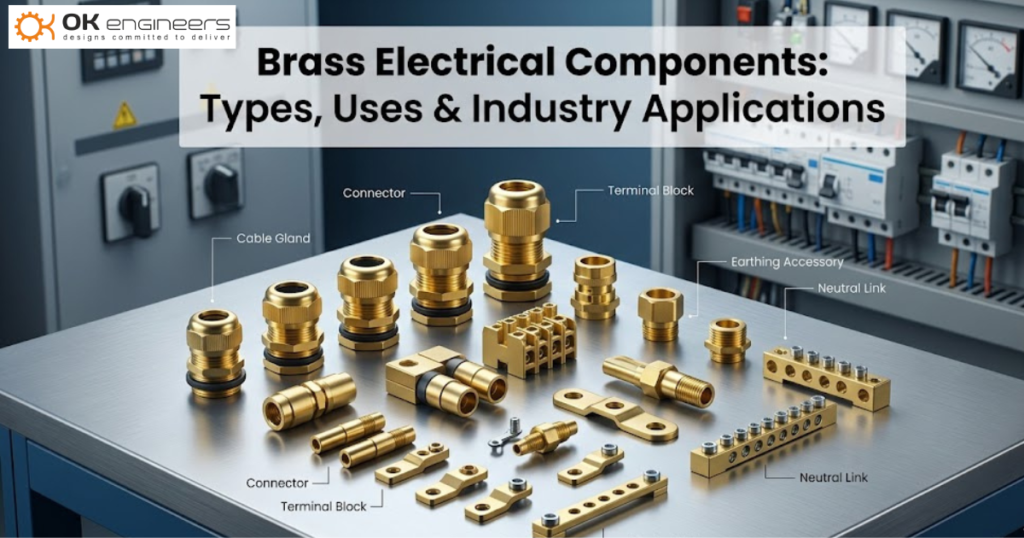
Brass electrical components play a vital role in modern electrical systems, offering superior conductivity, corrosion resistance, and durability. These precision-engineered parts, made from copper-zinc alloys, ensure reliable performance in demanding environments. From terminal blocks to connectors, they outperform alternatives like plastic or aluminum in high-current applications.
O.K. Engineers, an ISO 9001:2015 certified Brass Electrical Components manufacturer based in Jamnagar, Gujarat, leverages 60+ years of experience and CNC turning machines to produce these components. As a leading brass electrical components supplier and exporter, we serve global markets including Spain, Germany, USA, France, Russia, and the UK. This post explores types, uses, and applications to help industrial buyers, procurement managers, and engineers select the right solutions.
With 100% quality checks in our 4th generation family business, we deliver precision brass and copper alloy parts tailored for electrical, automotive, and hydraulic industries. Whether you’re sourcing from India or worldwide, understanding these components empowers better procurement decisions.
What Are Brass Electrical Components?
Brass electrical components are precision-machined parts crafted from brass alloys, primarily copper (60-70%) and zinc (30-40%), with optional elements like lead for machinability. These alloys exhibit excellent electrical conductivity—around 28-40% IACS (International Annealed Copper Standard)—making them ideal for current-carrying applications.
Unlike steel or plastic, brass resists oxidation and galvanic corrosion, thriving in humid or saline conditions. O.K. Engineers uses CNC turning for tight tolerances (±0.01mm) on parts like terminals and sockets. Key properties include:
- Tensile strength: 300-500 MPa
- Elongation: 20-40%
- Melting point: 900-940°C
- Density: 8.4-8.7 g/cm³
These specs ensure longevity in electrical assemblies. As a trusted brass electrical components exporter from Gujarat, we prioritize alloys like C36000 (free-cutting brass) for high-volume production.
Types of Brass Electrical Components
Brass electrical components come in diverse forms, each designed for specific functions. Common types include terminals, connectors, sockets, and bushes, machined to exact specs.
Here’s a comparison table of popular types:
| Type | Alloy Grade | Key Dimensions (Typical) | Machining Tolerance | Primary Feature |
| Terminal Blocks | C36000 | 5-50mm length | ±0.01mm | High current capacity (up to 100A) |
| Cable Glands | C38500 | M12-M63 thread | ±0.05mm | IP68 waterproof sealing |
| Electrical Connectors | Cz121 | 3-20mm dia | ±0.005mm | Quick-connect mechanism |
| Socket Contacts | C27200 | 4-12mm dia | ±0.02mm | Spring-loaded for firm grip |
| Terminal Bars | C38500 | 10-100mm length | ±0.01mm | Multi-hole for busbar assembly |
This variety allows customization. At O.K. Engineers, our brass electrical components manufacturer expertise covers all these, with CNC precision for seamless integration.
Key Properties of Brass for Electrical Use
Brass excels in electrical applications due to its unique metallurgical properties. Its conductivity stems from the face-centered cubic structure of copper, enhanced by zinc for cost-efficiency.
Technical advantages include:
- Conductivity: 15-30% better than steel; suitable for low-voltage circuits.
- Corrosion Resistance: Forms a passive ZnO layer, ideal for outdoor use.
- Machinability: Free-machining grades like C36000 reduce tool wear by 50%.
- Thermal Stability: Low coefficient of thermal expansion (18-20 × 10^-6/°C).
Compared to alternatives:
| Property | Brass (C36000) | Aluminum | Steel (Stainless) |
| Electrical Conductivity (% IACS) | 28 | 61 | 2-4 |
| Corrosion Resistance (Salt Spray Test) | 1000+ hrs | 500 hrs | 2000 hrs |
| Cost per kg (USD) | 6-8 | 2-3 | 3-5 |
| Tensile Strength (MPa) | 350-450 | 200-300 | 500-700 |
Brass balances performance and economy, making it a go-to for brass electrical components suppliers like us in Jamnagar.
Uses of Brass Electrical Components
Brass electrical components serve critical roles in power distribution and connectivity. They handle arcing, vibration, and thermal cycling without failure.
Primary uses:
- Power Distribution: Terminal bars and blocks secure wiring in panels.
- Connectors: Ensure low-resistance joints in switches and outlets.
- Grounding: Bushes and clamps provide safe earth paths.
- Enclosures: Glands protect cables from dust and moisture.
In high-vibration settings, brass’s fatigue resistance (10^6 cycles at 200 MPa) outperforms plastics. Procurement managers value their RoHS compliance for global exports.
You May Also Read – Brass Garden Hose Fittings: Types, Sizes & Buying Guide 2026
Industry Applications of Brass Electrical Components
Brass electrical components span multiple sectors, driven by reliability needs.
Electrical Industry
In switchgear and panels, terminal blocks and connectors manage 10-500A loads. They reduce contact resistance to <1 mΩ, minimizing heat buildup.
Automotive Sector
Engine compartments use brass sockets for sensors and ECUs, enduring 150°C and oil exposure. Exports to USA and Germany highlight their role in EV charging connectors.
Plumbing and Hydraulic Systems
Cable glands seal conduits in wet environments, maintaining IP67 ratings. [Link to O.K. Engineers Hydraulic Fittings page].
Manufacturing and Appliances
Inserts and bars in white goods ensure grounded operation, complying with UL standards.
Global demand grows at 5% CAGR, per industry reports.
Brass Electrical Components in Global Markets
As a premier brass electrical components exporter, O.K. Engineers ships to Spain, Germany, USA, France, Russia, and UK. European buyers prioritize CE marking; US clients seek UL equivalents.
India’s Jamnagar cluster supplies 40% of global brass exports, thanks to GIDC Phase-2 facilities like ours. We adapt to standards:
| Market | Key Requirement | Brass Spec Used |
| USA | UL 486A-B | C38000 |
| Germany | DIN EN 60998 | Cz121 |
| UK | BS 7671 | C38500 |
| Russia | GOST 10434 | C36000 |
This ensures seamless integration for importers.
Manufacturing Process at O.K. Engineers
Our ISO 9001:2015 certified process starts with alloy selection, followed by CNC turning on multi-axis machines. Steps include:
- Bar stock feeding (dia 5-80mm).
- Turning to ±0.005mm.
- Threading/milling.
- Plating (nickel/silver for conductivity).
- 100% inspection via CMM and gauges.
60+ years as a family business yield defect rates <0.1%. [Link to O.K. Engineers CNC Turning Services page].
Why Choose O.K. Engineers as Your Brass Electrical Components Supplier?
Select O.K. Engineers for unmatched expertise. Plot No-776, GIDC Phase-2, Dared, Jamnagar-361004, Gujarat, positions us in India’s brass hub. Benefits:
- 4th generation precision.
- Global exports with on-time delivery.
- Custom alloys for automotive/electrical needs.
- Competitive MOQs from 1,000 pcs.
Table of capabilities:
| Capability | Specification |
| Max Part Size | Dia 80mm, Length 200mm |
| Production Volume | 10,000+ pcs/month |
| Lead Time | 4-6 weeks |
| Testing | Salt spray, tensile, conductivity |
Trust us for your supply chain.
Conclusion
Brass electrical components deliver unmatched reliability across electrical, automotive, and hydraulic applications, thanks to superior conductivity and durability. From terminal blocks to cable glands, these precision parts from top brass electrical components manufacturers like OK. Engineers meet global standards.
With 60+ years in Jamnagar, Gujarat, we export high-quality, CNC-turned brass and copper alloy components to US, Spain, Germany, USA, France, Russia, UK, and beyond. Our ISO 9001:2015 certification and 100% quality checks ensure every order excels.
FAQ
What are brass electrical components used for?
Brass electrical components like terminals, connectors, and glands distribute power, seal cables, and ensure grounding in electrical panels, automotive systems, and appliances. Their corrosion resistance suits harsh environments.
Who is the best brass electrical components manufacturer in India?
O.K. Engineers, an ISO 9001:2015 certified brass electrical components manufacturer in Jamnagar, Gujarat, offers 60+ years of expertise in CNC-turned parts for global B2B clients.
What industries use brass electrical components?
Key sectors include electrical (switchgear), automotive (sensors), plumbing (fittings), hydraulics (adapters), and manufacturing. They handle high currents and vibrations reliably.
How does brass compare to copper for electrical components?
Brass costs 30-50% less than pure copper while offering 28% IACS conductivity. It’s more machinable and corrosion-resistant in mixed-metal assemblies.
Can O.K. Engineers export brass electrical components worldwide?
Yes, as a leading brass electrical components exporter, we ship to Spain, Germany, USA, France, Russia, UK, and more, with compliance to UL, CE, and GOST standards.
What is the typical lead time for custom brass electrical components?
From our Jamnagar facility, standard orders take 4-6 weeks; prototypes in 2 weeks. High-volume runs exceed 10,000 pcs/month with 100% quality checks.
Are brass electrical components RoHS compliant?
Yes, O.K. Engineers produces lead-free options like C27200 for RoHS compliance, ideal for EU and US markets in automotive and electrical applications.
What alloys does a brass electrical components supplier like O.K. Engineers use?
We specialize in C36000 (free-cutting), C38500 (architectural), Cz121 (EN grade), and C27200 (yellow brass) for optimal conductivity and machinability.