


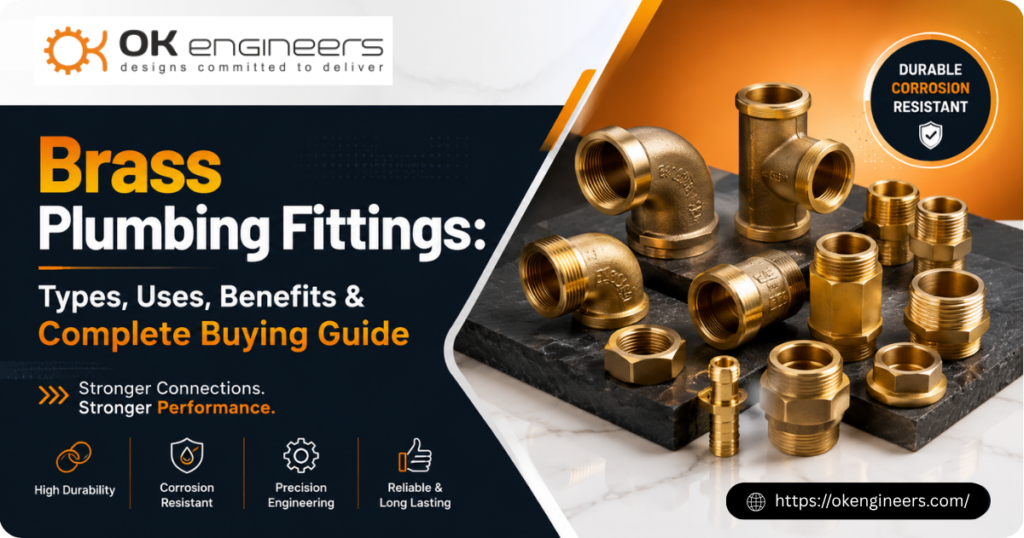
What Are Brass Plumbing Fittings?
Brass plumbing fittings are specialized connectors made from a copper-zinc alloy, engineered to join, redirect, adapt, or terminate the flow of water, gas, or other fluids within a piping system. Typically composed of 60–70% copper and 30–40% zinc, brass achieves a remarkable balance of strength, machinability, and corrosion resistance — qualities that no single-element metal can fully replicate at the same cost.
In both residential bathrooms and large-scale industrial facilities, Brass Plumbing Fittings act as the silent workhorses of modern infrastructure. From the elbow under your kitchen sink to the high-pressure reducer in an HVAC chiller system, brass fittings ensure leak-proof, long-lasting connections that require minimal maintenance.
The global pipe fittings market was valued at USD 16.75 billion in 2024 and is projected to reach USD 41.02 billion by 2035, growing at a CAGR of 8.48% — with brass maintaining a dominant position due to its superior mechanical properties.
Complete Types of Brass Plumbing Fittings Explained
Understanding the full range of brass plumbing fittings types is essential before purchasing or specifying components for any system. Each fitting serves a distinct hydraulic or mechanical purpose, and using the wrong type can cause leaks, pressure drops, or premature failure.
1. Brass Threaded Fittings (NPT / BSP)
The most common category, brass threaded fittings use National Pipe Thread (NPT) or British Standard Pipe (BSP) threads to create a secure, pressure-tight connection. Male threads (external) screw into female threads (internal), often sealed with PTFE tape or thread sealant compound. These are ideal for gas lines, water mains, and industrial process lines.
2. Brass Compression Fittings
Brass compression fittings consist of a body, a compression nut, and a ferrule (olive ring). When the nut is tightened, the ferrule compresses around the pipe to create a leak-free seal — without soldering. They are widely used in domestic water supply, refrigeration lines, and natural gas systems. Rated from 150 PSI to 1,200 PSI depending on size and application.
3. Brass Push-Fit (Push-to-Connect) Fittings
The fastest installation method, push-fit brass pipe fittings require no tools, solder, or clamps. Simply push the pipe into the fitting body and internal stainless teeth grip and seal automatically. Perfect for copper, PEX, and CPVC pipe — widely used in retrofit plumbing and tight spaces.
4. Brass Elbow Fittings (45° & 90°)
Brass elbows change the direction of a pipe run by 45° or 90°. Available in male-to-female and female-to-female configurations, they are used wherever a piping run must change direction due to structural or space constraints.
5. Brass Tee Fittings
T-shaped brass tee fittings split a single pipe into two branches or merge two branches into one. Available in equal tee (all three openings the same size) and reducing tee (branch differs in diameter) configurations.
6. Brass Union Fittings
Unions allow a pipe section to be disconnected and reconnected without disturbing the rest of the system — invaluable for maintenance-heavy applications like water heaters, pumps, and filtration equipment.
7. Brass Reducer / Reducing Couplings
These adapt between different pipe diameters, allowing a larger-diameter line to step down to a smaller one within the same system. Essential for balancing flow rates and pressure across branching networks.
8. Brass Barb Fittings
Barbed brass connectors feature ridged barbs that grip flexible tubing (rubber, silicone, PVC) when pushed over them. Commonly used in irrigation systems, pneumatic tubing, and laboratory fluid lines.
9. Brass Flare Fittings
Used primarily with copper tubing in HVAC and refrigeration systems. The tube end is flared outward at 45°, then compressed between the fitting body and flare nut for a high-pressure seal without solder.
10. Brass Caps & Plugs
Used to seal the open end of a pipe or fitting — caps fit over the outside (female), while plugs insert into the opening (male). Essential for pressure testing, maintenance closures, and future expansion points.
| Fitting Type | Function | Common Application | Connection Method |
|---|---|---|---|
| Threaded (NPT/BSP) | Connect pipes securely | Gas lines, water mains | Thread + PTFE tape |
| Compression | Leak-free pipe join without solder | Domestic water, refrigeration | Ferrule compression |
| Push-Fit | Fast tool-free connection | PEX, copper, CPVC retrofit | Push-to-connect |
| Elbow (45° / 90°) | Change pipe direction | Wall/floor pipe routing | Threaded or soldered |
| Tee (Equal / Reducing) | Split or merge flow | Branch lines, manifolds | Threaded or soldered |
| Union | Disconnect without disturbing run | Pump/heater maintenance | Threaded union nut |
| Reducer / Coupling | Adapt between pipe sizes | Flow balancing, repiping | Threaded or soldered |
| Barb | Connect flexible tubing | Irrigation, pneumatics | Push + hose clamp |
| Flare | High-pressure seal on copper | HVAC, refrigeration | Flare nut |
| Cap / Plug | Seal pipe ends | Pressure testing, closures | Thread or push-on |
Key Benefits of Brass Plumbing Fittings
The widespread use of brass pipe fittings across residential, commercial, and industrial plumbing is no accident. Their combination of physical properties makes them the best all-round material choice in most piping environments.
Superior Corrosion Resistance
Brass does not rust and resists corrosion from both hard and soft water, chemicals, and external moisture exposure. This makes brass fittings for water lines the preferred choice over iron or carbon steel, especially in humid coastal or industrial environments.
Outstanding Durability & Longevity
With proper installation, quality Brass Plumbing Fittings deliver a service life of 40 to 70 years. They resist cracking, becoming brittle, and dimensional distortion under repeated thermal cycling — a key advantage in hot water and steam line applications.
High Temperature & Pressure Tolerance
Brass fittings perform reliably within a temperature range of -65°F to 250°F (-54°C to 121°C) for standard designs, and up to 300°F (149°C) with reinforced alloy grades. Their working pressure range spans 150 PSI (residential) to over 3,000 PSI (industrial precision-machined).
Excellent Machinability & Versatility
Brass is one of the most machinable metals on earth, allowing for precise thread cutting and complex geometries at lower production costs. This means brass pipe connectors are available in more shapes, sizes, and configurations than any competing material.
Compatibility with Multiple Pipe Materials
A single range of brass fittings can work across copper, PEX, PVC, CPVC, and even galvanized steel pipes (with dielectric unions), making them the universal solution for mixed-material plumbing systems.
Lead-Free Safety Compliance
Modern lead-free brass fittings replace lead with bismuth, selenium, or silicon while maintaining the same machinability and strength. Since January 2014, US federal law requires lead-free fittings for potable water lines — and leading manufacturers like OK Engineers supply fully compliant, certified lead-free options.
Looking for Premium Brass Plumbing Fittings?
OK Engineers supplies a complete range of certified brass plumbing fittings for residential, commercial, and industrial applications — available in bulk with custom specifications.
Brass Plumbing Fittings: Pressure & Temperature Ratings
Selecting the right brass plumbing fittings requires matching the fitting’s pressure and temperature ratings to your system’s operating conditions. Undersized ratings cause leaks or catastrophic failures; over-specified fittings increase unnecessary costs.
As a general rule, pressure ratings decrease as operating temperature increases. A fitting rated at 300 PSI at 70°F (21°C) may safely handle only 150–200 PSI at 200°F (93°C). Always apply a safety factor of at least 1.5× when specifying fittings for continuous-service applications.
| Application | Typical Pressure Rating | Temperature Range | Recommended Fitting Type |
|---|---|---|---|
| Residential Cold Water (Domestic) | Up to 300 PSI | 32°F – 140°F (0°C – 60°C) | Compression or Threaded |
| Residential Hot Water Lines | Up to 200 PSI | 140°F – 210°F (60°C – 99°C) | Threaded or Solder (Sweat) |
| Natural Gas / Propane Lines | Up to 300 PSI | -20°F – 150°F | Flare or Threaded NPT |
| HVAC Refrigerant Lines | 400 – 600 PSI | -65°F – 250°F | Flare Fittings |
| Commercial / Industrial Process | 600 – 1,000 PSI | Up to 250°F | Forged Brass Threaded |
| Hydraulic & Pneumatic Systems | 1,000 – 3,000 PSI | -65°F – 300°F | Precision-Machined Brass |
Brass vs. PVC, Copper & Stainless Steel Fittings: Full Comparison
When specifying fittings for a plumbing project, the material choice significantly affects cost, longevity, compatibility, and installation method. Here is a comprehensive comparison of brass plumbing fittings against three commonly used alternatives.
| Parameter | Brass Fittings | PVC Fittings | Copper Fittings | Stainless Steel |
|---|---|---|---|---|
| Corrosion Resistance | Excellent | Excellent | Good | Excellent |
| Max Temperature | 250°F+ (121°C+) | 140°F (60°C) | 400°F (204°C) | 1,200°F+ (649°C+) |
| Pressure Tolerance | Up to 3,000 PSI | Up to 400 PSI | Up to 1,000 PSI | Up to 10,000 PSI |
| Installation Ease | Very Easy | Easy | Moderate (solder) | Difficult |
| Cost (relative) | Moderate | Low | High | Very High |
| Potable Water Safe | Yes (lead-free) | Yes | Yes | Yes |
| Lifespan | 40–70 years | 25–40 years | 50–70 years | 50–100 years |
| Best For | All-round plumbing, gas, HVAC | Cold water, drainage | Hot water, steam | Industrial, food-grade |
For most residential and commercial plumbing projects, brass pipe fittings deliver the optimal balance of performance, cost, and versatility. Copper edges ahead in extreme heat applications, while stainless steel is reserved for food processing or pharmaceutical environments where absolute purity is required.
How to Choose the Right Brass Plumbing Fittings
Selecting the correct brass pipe fittings for your project involves more than just matching the pipe diameter. Follow this systematic selection process to ensure safe, compliant, and long-lasting performance:
Step 1: Identify the Fluid or Gas Type
Different media require different brass grades. Potable drinking water demands lead-free brass fittings certified to NSF/ANSI 61. Natural gas and propane lines require fittings rated to ASME B16.15 or BS EN 10226 standards. Chemical transfer may require dezincification-resistant (DZR) brass.
Step 2: Determine Operating Pressure & Temperature
Always specify fittings rated at least 1.5× the maximum system pressure. Check the system’s peak temperature — particularly critical in hot water heating, steam, and industrial process lines. Refer to Table 3 above for a quick reference on ratings by application.
Step 3: Match Thread Type and Pipe Material
Verify whether your system uses NPT (tapered, common in the US and India), BSP (parallel or tapered, common in Europe and the UK), or metric threads. Mismatched thread standards are a leading cause of installation leaks. For plastic pipes, always use a brass-to-plastic transition fitting to avoid galvanic corrosion or thermal stress cracking.
Step 4: Choose the Right Connection Method
Select threaded fittings for permanent high-pressure connections, brass compression fittings where soldering isn’t practical, push-fit for fast retrofit work, and flare for refrigerant or high-pressure gas lines. Union fittings should be installed wherever future disconnection is anticipated.
Step 5: Verify Certifications & Standards Compliance
Quality brass plumbing fittings should carry recognized certifications including ISO 228, ASTM B16.15, NSF/ANSI 61 (potable water), and Bureau of Indian Standards (BIS) IS 778 / IS 1879 for the Indian market. Buying from a certified supplier like OK Engineers ensures all regulatory compliance is handled by the manufacturer.
Brass Plumbing Fittings Installation: Tips & Common Mistakes
Even the highest quality brass pipe fittings will fail prematurely if improperly installed. The following best practices and common mistake warnings will help both DIY homeowners and professional plumbers achieve leak-free, code-compliant results.
Best Practice: Seal Threaded Connections Correctly
Apply high-quality PTFE (Teflon) tape clockwise in 2–3 wraps on male threads before assembly, or use an approved thread sealant compound. Never reuse old tape on reconditioned fittings. Over-tightening threaded brass plumbing fittings can crack female sockets — brass is strong but not immune to splitting when over-torqued.
Common Mistake: Using Steel Tools Directly on Brass
Always use smooth-jaw or padded pipe wrenches on polished or chrome-plated brass fittings. Steel teeth cause gouging that creates corrosion initiation points and weakens thread integrity over time.
Best Practice: Check for Galvanic Compatibility
When connecting brass fittings to galvanized steel pipe, always install a dielectric union between the two metals. Direct contact between brass and galvanized steel creates a galvanic cell that accelerates corrosion of the zinc coating. This is one of the most overlooked causes of premature pipe failure in renovation projects.
Common Mistake: Ignoring Flow Direction on Valves
Certain brass plumbing fittings such as check valves, pressure reducing valves (PRVs), and flow control valves are directional. Always follow the arrow marking on the fitting body to ensure correct flow orientation. Reversed installation can cause water hammer, pressure loss, or complete valve failure.
Best Practice: Pressure Test Before Concealing
Always pressure test newly installed brass pipe fittings to at least 1.5× the rated working pressure before covering with drywall, insulation, or flooring. Even a single missed leak behind a wall can cause thousands of dollars in water damage. Use a calibrated pressure gauge and leave pressurized for a minimum of 30 minutes.
For professional installation support, project specification assistance, or bulk supply of quality brass plumbing fittings, visit OK Engineers — your trusted partner in precision plumbing components.
You May Also Read – Brass Pipe Fittings in India: Reliable Supplier, Manufacturer & Exporter
Where Are Brass Plumbing Fittings Used? Key Applications
The versatility of brass pipe fittings makes them the go-to solution across a remarkably wide range of industries and project types:
Residential Plumbing Systems
From under-sink shut-off valves to bathroom shower arms and kitchen tap connectors, brass plumbing fittings are used throughout every room of a home. Their compatibility with both hot and cold water lines, combined with lead-free safety compliance, makes them the standard specification for all new residential builds.
Commercial & Industrial Buildings
Hotels, hospitals, shopping malls, and office towers rely on heavy-duty brass pipe fittings for their hot water circulation systems, fire suppression connections, HVAC chilled water networks, and compressed air distribution lines. The ability to handle higher pressures and temperature cycling without degradation is critical in commercial-grade installations.
Gas Distribution Systems
Natural gas and LPG distribution networks — from city mains connections to residential meters and kitchen appliances — use brass threaded fittings and flare connectors extensively. Their excellent sealing under pressure fluctuation and resistance to gas permeation make them the material of choice over plastic alternatives.
HVAC & Refrigeration
Brass flare fittings and compression tees are standard components in air conditioning refrigerant circuits, chilled water coil connections, and hydronic heating manifolds. Their ability to maintain leak-proof seals under repeated thermal expansion and contraction cycles is unmatched by cheaper alternatives.
Industrial & Manufacturing
From pneumatic control systems and hydraulic power units to chemical dosing lines and process instrumentation, brass fittings for industrial applications serve as reliable, corrosion-resistant connectors in environments where failures have significant operational consequences.
Need Brass Fittings for Your Next Project?
Whether you need residential compression fittings, commercial threaded brass pipe fittings, or industrial-grade precision components — OK Engineers has the complete range in stock and available for bulk order.
Why Choose OK Engineers for Brass Plumbing Fittings?
When it comes to sourcing high-quality brass plumbing fittings in India, OK Engineers stands out as a trusted manufacturer and supplier with a proven track record across residential, commercial, and industrial sectors.
Complete Product Range
OK Engineers offers the full spectrum of brass pipe fittings — from standard NPT threaded elbows and tees to precision compression fittings, push-fit connectors, and custom-machined components. Whether you need a single unit or a large bulk consignment, they supply to your exact specification.
Certified Quality Standards
All brass plumbing fittings from OK Engineers are manufactured to meet IS, ISO, ASTM, and BSP standards, with lead-free options certified for potable water and food-grade applications. Quality checks are conducted at every stage of production — from raw alloy composition to finished thread tolerance.
Custom Manufacturing Capability
Require non-standard sizes, specialty alloys (DZR brass, CW617N), or OEM-branded components? OK Engineers offers custom machining and forging services for project-specific requirements, including prototype runs and volume production.
Competitive Pricing & Fast Delivery
By manufacturing in-house and maintaining a comprehensive stock of standard brass pipe fittings, OK Engineers delivers competitive pricing without compromising quality — with rapid dispatch for urgent orders.
Conclusion
Brass Plumbing Fittings have earned their place as the industry standard across more than a century of plumbing evolution — and for good reason. Their unique combination of corrosion resistance, high pressure and temperature tolerance, outstanding machinability, long service life, and universal compatibility makes them the most versatile and reliable fitting material available to plumbers, contractors, and engineers worldwide.
Whether you are installing a new residential water supply, specifying fittings for a commercial HVAC system, or sourcing components for an industrial process line, brass pipe fittings deliver the performance, safety, and longevity your project demands — particularly when specified from a quality-certified supplier.
Key takeaways from this guide:
- Brass fittings outperform PVC in temperature and pressure; match copper in longevity at lower cost
- Lead-free brass is mandatory for potable water in most jurisdictions — always verify certification
- Pressure ratings range from 150 PSI (residential) to 3,000 PSI (industrial precision) — always spec with a 1.5× safety factor
- Correct installation (proper sealing, torque, galvanic isolation) is as important as the fitting quality itself
- Sourcing from a certified manufacturer eliminates guesswork on standards compliance
For all your brass plumbing fittings requirements — from standard stock items to custom-engineered solutions — trust the expertise and quality assurance of OK Engineers.
Frequently Asked Questions: Brass Plumbing Fittings
What are brass plumbing fittings made of?
Brass plumbing fittings are manufactured from an alloy of copper (60–70%) and zinc (30–40%). Modern lead-free brass grades also incorporate small amounts of bismuth, selenium, or silicon as replacements for lead, maintaining excellent machinability while meeting international potable water safety standards including NSF/ANSI 61.
What pressure can brass plumbing fittings safely handle?
Residential brass pipe fittings are typically rated to 150–300 PSI, which easily covers standard municipal water supply pressures. Industrial and precision-machined brass fittings can handle up to 3,000 PSI. Always apply a 1.5× safety factor when selecting fittings for continuous-service systems. Pressure ratings also decrease as operating temperature rises.
Are brass fittings better than PVC or plastic fittings?
For most residential plumbing applications, brass plumbing fittings significantly outperform PVC in temperature tolerance (brass handles up to 250°F vs. PVC’s 140°F), pressure capacity, and long-term durability. Brass fittings also resist UV degradation and do not become brittle with age. However, PVC is a lower-cost option suitable for cold-water drainage and low-pressure applications.
How long do brass plumbing fittings last?
Quality brass pipe fittings installed correctly in a residential system can last 40 to 70 years — often outlasting the pipes they connect. Their corrosion resistance, structural integrity under thermal cycling, and dimensional stability make them one of the most durable fitting materials available.
Where can I buy certified brass plumbing fittings in India?
OK Engineers is a leading manufacturer and supplier of premium, certified brass plumbing fittings in India. They supply a complete range of threaded, compression, push-fit, elbow, tee, and custom brass fittings for residential, commercial, and industrial projects, with fast delivery and competitive pricing.
Do brass fittings require PTFE tape or sealant?
Yes — threaded brass plumbing fittings require either PTFE (Teflon) tape applied clockwise on the male thread (2–3 wraps), or an approved thread sealant compound. Compression fittings do not require tape as the ferrule provides the seal. Push-fit and flare fittings also have integrated sealing mechanisms that don’t need additional sealants.