


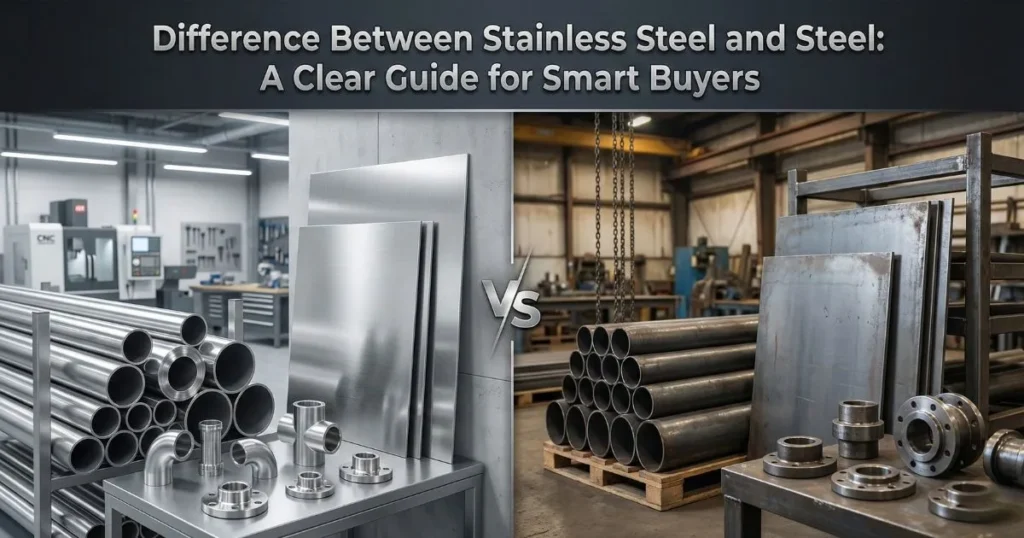
Buying metal products sounds simple—until you’re stuck choosing. Pipes, sheets, utensils, machinery, construction parts. The choice matters more than people think. If you’re confused, you’re not alone.
At OK Engineers, we often meet buyers who ask the same question: What is the real difference between them, and which one should I buy? This guide breaks it down in plain English, no jargon, no confusion—just clarity.
Whether you’re a manufacturer, contractor, engineer, or first-time buyer, this article will help you make a smart, cost-effective decision.
Understanding the Basics
Before diving deep into grades, chemistry, and performance, let’s clear the air. Bothl are related—but not the same. Think of them as cousins in the metal family.
The difference between stainless steel and steel comes down to composition, performance, cost, and usage.
What Is Steel?
Composition
Steel is an alloy mainly made from:
- Iron
- Carbon (up to 2%)
- Small amounts of other elements
The higher the carbon content, the stronger—but more brittle—the steel becomes.
Common Types of Steel
- Carbon Steel
- Mild Steel
- Alloy Steel
- Tool Steel
Steel is everywhere—from bridges to car frames—and for good reason.
What Is Stainless Steel?
Chromium’s Role – This contains at least 10.5% chromium, which forms a protective layer on the surface. This invisible shield is what makes it “stainless.”
Main Grades
- 304 (most common)
- 316 (marine & chemical use)
- Ferritic
- Martensitic
This is where the difference stainless steel and steel becomes obvious.
Difference Between Stainless Steel and Steel in Table
| Feature | Steel | Stainless Steel |
| Corrosion Resistance | Low | Very High |
| Chromium Content | Minimal | 10.5%+ |
| Maintenance | High | Low |
| Cost | Lower | Higher |
| Appearance | Dull | Shiny |
| Lifespan | Moderate | Long |
Difference Between Stainless Steel and Steel in Composition
The biggest technical stainless steel and steel difference is alloy content.
- Steel = Iron + Carbon
- Stainless Steel = Iron + Carbon + Chromium + Nickel (sometimes)
That chromium is the game-changer.
Corrosion Resistance: The Biggest Divider
If rust is your enemy, This is your hero.
Steel reacts with oxygen and moisture—hello rust. This forms a passive chromium oxide layer that self-heals when scratched.
For buyers at OK Engineers, this is often the deciding factor when choosing materials for humid, outdoor, or chemical environments.
You May Also Like This – How Brass Lighting Parts Elevate Any Space Instantly
Strength and Durability Compared
Contrary to popular belief:
- Steel is often stronger in raw tensile strength
- This is tougher and more impact-resistant
So, the difference between stainless steel and steel isn’t about which is “better,” but better for what.
Cost Comparison: Initial vs Long-Term
Upfront Cost – Steel is cheaper while the other one is expensive.
Lifetime Cost – Steel takes Maintenance, coating, replacement while the other one remains in Minimal upkeep.
Smart buyers think long-term—and that’s why this often wins despite higher prices.
Appearance and Finish
Steel usually needs paint or coating to look good, But What about other?
- Naturally glossy
- Modern look
- Hygienic surface
That visual appeal matters in kitchens, hospitals, and architectural designs.
Maintenance and Lifespan
Steel requires:
- Painting
- Rust protection
- Regular inspection
But the other one:
- Just clean with water
- No coatings needed
This practical difference between stainless steel and steel saves time and money.
Heat and Temperature Resistance
This performs better in:
- High heat
- Cryogenic temperatures
- Fire-resistant applications
That’s why it’s used in boilers, exhausts, and industrial furnaces.
Weight and Fabrication
Steel is easier to:
- Weld
- Cut
- Shape
This needs skilled fabrication—but modern methods used by OK Engineers ensure precision without compromise.
Common Applications of Steel
- Construction beams
- Automotive frames
- Machinery parts
- Industrial tools
Steel is strong, reliable, and economical.
Common Applications
- Food processing equipment
- Medical tools
- Chemical plants
- Water pipelines
- Kitchenware
Here, the difference stainless steel and steel becomes practical.
Which Should You Choose? Buyer Scenarios
Choose Steel If:
- Budget is tight
- Indoor use
- No exposure to moisture
Choose Stainless Steel If:
- Outdoor or marine use
- Hygiene is critical
- Long-term durability matters
At OK Engineers, we help buyers assess real-world usage—not just specs.
Industry Insights from OK Engineers
With years of experience supplying industrial-grade materials, OK Engineers has seen a shift. Buyers are moving from short-term savings to long-term value.
Case Study – A food-processing client switched from steel to stainless steel equipment in 2024. Maintenance costs dropped by 38% within one year.
That’s not theory—it’s practice.
Environmental Impact and Sustainability
This is:
- 100% recyclable
- Longer life cycle
- Lower environmental cost over time
Steel is also recyclable, but frequent replacement increases emissions.
Future Trends in Steel Materials (2026 Update)
- Growth in corrosion-resistant alloys
- Increased demand for sustainable metals
- Their usage is also rising in infrastructure
According to global industry reports (World Steel Association, 2025),Their demand is growing at 6% annually.
Conclusion
The difference between stainless steel and steel isn’t about superiority—it’s about suitability. Steel offers strength at low cost. but other offers durability, hygiene, and peace of mind.
For smart buyers who think long-term, This is often the wiser investment. For budget-driven, short-term projects, steel still holds strong.
At OK Engineers, we don’t just sell materials—we guide you to the right decision. Choose wisely. Build smarter.
FAQs
1. What is the main difference between stainless steel and steel?
Ans. The main difference is chromium content, which gives the other one corrosion resistance.
2. Is stainless steel stronger than steel?
Ans. Steel can be stronger, but the other one is more durable and corrosion-resistant.
3. Why is other type more expensive?
Ans. Due to added alloy elements like chromium and nickel.
4. Which is better for outdoor use?
Ans. Other type performs better outdoors.
5. Can OK Engineers help choose the right material?
Ans. Yes, OK Engineers provides expert guidance and quality materials.