


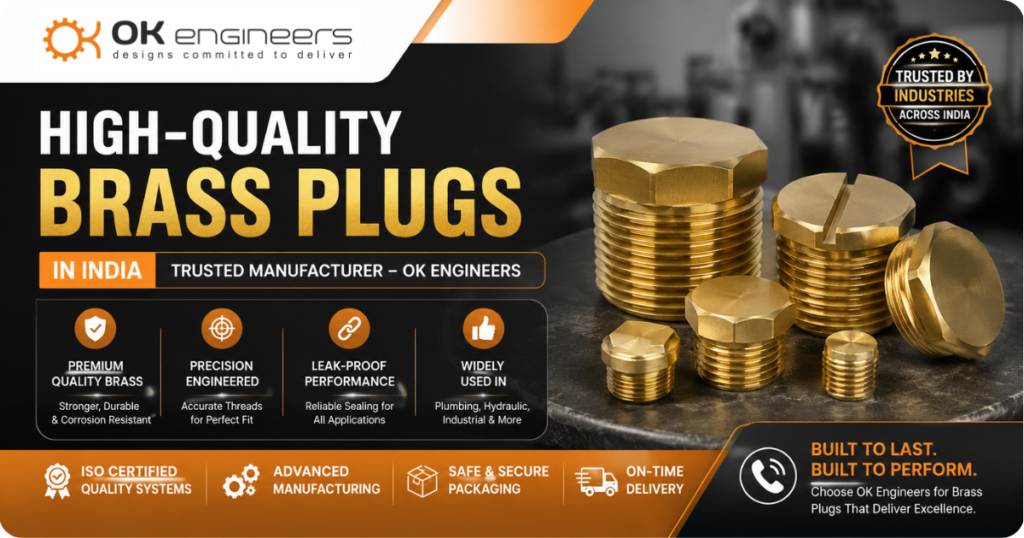
Brass plugs are now a critical sealing solution across industrial, plumbing, hydraulic, and electrical systems, especially in high‑pressure and corrosive environments. For procurement managers and engineering teams, choosing the right Brass Plugs in India means balancing corrosion resistance, dimensional accuracy, and long‑term reliability.
O.K. Engineers (Om Kailash Engineers), based in Plot No‑776, GIDC Phase‑2, Dared, Jamnagar–361004, Gujarat, offers precision‑turned brass components with 60+ years of experience and ISO 9001:2015 certification. The company exports to markets such as Spain, Germany, USA, France, Russia, and the UK, positioning itself as a trusted global partner for Brass Plugs in India and other brass/copper‑alloy components.
Why Brass Plugs in India Are Essential for Industrial Systems
Role of brass plugs in sealing integrity
Brass plugs, also known as brass sealing plugs or threaded plugs, are used to close the ends of threaded ports in pipes, valves, pumps, cylinders, and hydraulic manifolds. Their primary function is to prevent leakage of liquids or gases while maintaining the design integrity of the system. In industrial equipment, even a small leak at a plug point can lead to pressure loss, contamination, and potential safety hazards, especially in hydraulic and pneumatic circuits.
Because of their mechanical and chemical properties, brass plugs are preferred over many other metals in applications where moderate pressure, temperature, and corrosion come into play.
Advantages of brass over other materials
Brass (a copper–zinc alloy) offers several advantages that make it suitable for industrial plugs:
- Corrosion resistance: Properly selected brass alloys resist corrosion from water, many oils, and mild chemicals, making them ideal for hydraulic and plumbing systems.
- Machinability and dimensional accuracy: Brass is easy to machine, which allows for tight thread tolerances and consistent plug geometry.
- Moderate strength and pressure handling: Brass can handle typical working pressures found in industrial and commercial plumbing and hydraulic circuits.
- Electrical conductivity and EMI shielding: In certain electrical and instrumentation applications, brass plugs help maintain grounding continuity and reduce electromagnetic interference.
These properties have made Brass Plugs in India a standard choice for OEMs in manufacturing, plumbing, hydraulics, and electrical equipment.
Why Brass Plugs in India Are a Strategic Choice for Procurement Teams
Build quality and reliability
For industrial buyers, the biggest concern is component reliability over time. Substandard plugs can crack, leak, or seize in the threaded port, leading to machine downtime, warranty claims, and costly maintenance. High‑quality Brass Plugs in India sourced from ISO‑certified manufacturers ensure that every plug meets defined standards for material, thread geometry, and surface finish. This reduces field failures and improves the reputation of the OEM or contractor using them.
O.K. Engineers, with its ISO 9001:2015 quality system, applies strict process controls on material selection, CNC turning, inspection, and packaging, ensuring that every batch of brass plugs is consistent and traceable. For procurement managers, this means lower risk and easier compliance with internal quality requirements.
Cost‑effectiveness and total lifecycle value
While brass is more expensive than some alternative metals, the total lifecycle cost is often lower due to:
- Longer service life under normal operating conditions.
- Reduced need for rework or replacement in the field.
- Easier maintenance and thread engagement, thanks to good machinability.
For companies sourcing Brass Plugs in India, balancing initial unit price with long‑term reliability and maintenance burden is key. A reputable manufacturer such as O.K. Engineers focuses on precision engineering and quality control, which helps buyers optimize their total cost of ownership.
Export‑ready manufacturing standards
For importers and global buyers, the ability of an Indian manufacturer to meet international standards is critical. Brass plugs for industrial applications must comply with global thread standards (BSP, NPT, ISO metric), dimensional tolerances, and material specifications. Manufacturers in Jamnagar and across Gujarat that follow standardized processes and documentation are better positioned to serve export markets in Europe, North America, and other regions.
O.K. Engineers aligns its brass‑plug production with recognized international practices, enabling industrial buyers worldwide to treat its products as equivalent to those from established European or American suppliers.
Technical Features of High‑Quality Brass Plugs in India
Material and alloy selection
Most industrial brass plugs are made from leaded or unleaded brass alloys such as C36000, C37700, or equivalent copper–zinc alloys. The choice of alloy depends on:
- Required strength and pressure rating.
- Corrosion resistance needs (e.g., water, oil, or slightly aggressive chemicals).
- Environmental regulations (e.g., low‑lead or lead‑free requirements in some plumbing and potable‑water applications).
Domestic and export‑oriented manufacturers in India typically specify the alloy grade and mechanical properties in their technical datasheets, allowing engineering teams to match the plug to the system’s operating conditions.
Thread types and dimensional standards
Brass plugs are commonly offered with the following thread types:
- BSP (British Standard Pipe): Widely used in Europe, UK, and many Commonwealth countries for hydraulic and pneumatic systems.
- NPT (National Pipe Thread): Predominant in North America for threaded pipe connections.
- Metric (ISO‑metric threads): Common in machinery and equipment manufactured to European/Japanese standards.
Manufacturers producing Brass Plugs in India typically provide plug dimensions in accordance with ISO 228, ISO 7, or equivalent standards, ensuring interchangeability with other components.
| Key thread type | Typical region / application | Common use in brass plugs |
|---|---|---|
| BSP (parallel/taper) | Europe, UK, many industrial systems | Hydraulic manifolds, valves, pumps |
| NPT | North America | Pipe and fitting connections |
| ISO metric | Global machinery sector | Equipment from Asian and European OEMs |
Pressure and temperature considerations
Industrial brass plugs are generally designed for moderate pressure ranges, typically up to a few hundred bars depending on alloy, wall thickness, and thread engagement. Applications involving higher pressures or extreme temperatures may require alternative materials such as stainless steel or specialized alloys.
For procurement managers, the technical datasheet should clearly indicate:
- Maximum working pressure.
- Recommended tightening torque.
- Suitable temperature range.
This helps in selecting the correct Brass Plugs in India for each application, avoiding over‑specification or under‑specification.
Surface finish and plating options
Brass plugs are often supplied in a natural brass finish, which is sufficient for many industrial applications. However, for enhanced corrosion resistance or aesthetic reasons, manufacturers may offer:
- Nickel plating
- Chrome plating
- Zinc plating (for specific environments)
These finishes can improve resistance to moisture, salt spray, and certain chemicals, extending the life of the plug in harsher environments.
How O.K. Engineers Delivers Precision Brass Plugs in India
60+ years of engineering expertise
O.K. Engineers (Om Kailash Engineers) has been serving the brass and copper‑alloy components market since the 1960s, making it a fourth‑generation family‑run business with deep engineering know‑how. The company has evolved from basic machining to advanced CNC turning, enabling it to produce high‑precision Brass Plugs in India with consistent quality and repeatability.
This experience is particularly valuable for global buyers who need a supplier that understands both Indian manufacturing practices and international quality expectations.
ISO 9001:2015‑certified manufacturing
Operating from its facility in Jamnagar, Gujarat, O.K. Engineers holds ISO 9001:2015 certification, which covers its design, production, inspection, and export processes. This certification signals that the company follows documented quality procedures, maintains equipment calibration, and performs regular internal audits.
For procurement teams, this means:
- Clear traceability of material and process records.
- Standardized inspection and testing protocols.
- A structured approach to non‑conformance and corrective actions.
These practices are especially important when sourcing Brass Plugs in India for critical applications in automotive, hydraulic, and electrical equipment.
CNC turning and precision engineering
O.K. Engineers uses CNC turning machines to produce brass plugs and other precision‑turned components. CNC machining offers several advantages:
- High repeatability and tight dimensional tolerances.
- Consistent thread geometry and surface finish.
- Ability to handle complex geometries and small batch sizes.
For industrial buyers, this translates into fewer rejections, better fit‑and‑function, and easier integration into automated assembly lines.
Global export capabilities
O.K. Engineers exports Brass Plugs in India and other brass components to countries such as Spain, Germany, USA, France, Russia, and the UK. This export experience demonstrates its capability to meet:
- International standards for documentation and labeling.
- Packaging and shipping requirements for different regions.
- Customs and regulatory expectations of foreign buyers.
For importers and OEMs outside India, partnering with a manufacturer like O.K. Engineers combines the cost advantages of Indian manufacturing with the quality and reliability of an export‑oriented supplier.
Quality control and 100% inspection
A key differentiator for O.K. Engineers is its focus on 100% quality checks on critical dimensions, thread conformity, and surface defects. Typical inspection activities include:
- Dimensional checks using calibrated gauges and measuring instruments.
- Thread gauge verification.
- Visual inspection for scratches, burrs, or plating defects.
This proactive approach helps in minimizing in‑field failures and supports long‑term customer satisfaction.
You May Also Read – Brass Plumbing Fittings: Types, Uses & Top Picks 2026
Application Areas of Brass Plugs in India
Plumbing and sanitary systems
In plumbing and sanitary applications, brass plugs are used to seal unused ports on valves, manifolds, and pipe fittings. They help maintain system integrity during installation and commissioning, and they are often left in place as permanent caps. For potable‑water applications, material selection (e.g., lead‑free or low‑lead brass) becomes critical to meet local health and safety regulations.
Hydraulic and pneumatic systems
Hydraulic and pneumatic equipment such as cylinders, pumps, and directional control valves often feature multiple threaded ports. Unused ports are sealed with brass plugs to prevent contamination and leakage. Because hydraulic systems operate at high pressures, the quality of the plug and thread engagement is essential. Brass Plugs in India from precision manufacturers are designed to handle these typical operating conditions without cracking or leaking.
Electrical and instrumentation enclosures
In electrical and instrumentation applications, brass plugs are used to seal conduit entries, unused gland ports, and cable entries on control panels. Their conductivity and corrosion resistance make them suitable for grounding purposes and for protecting internal wiring from moisture and dust.
Automotive and industrial machinery
Automotive and industrial OEMs use brass plugs in engine blocks, transmission housings, and hydraulic manifolds to close casting or machining ports. These plugs must withstand vibration, temperature cycles, and lubricating fluids over the lifetime of the equipment. High‑quality Brass Plugs in India sourced from a reputable manufacturer such as O.K. Engineers help automotive and industrial buyers maintain product reliability and reduce warranty claims.
Choosing the Right Brass Plugs in India: A Buyer’s Checklist
When procurement teams or engineers evaluate suppliers for Brass Plugs in India, the following checklist can help ensure a reliable sourcing decision:
- Material and alloy specification
- Confirm the brass alloy grade (e.g., C36000, C37700, or equivalent).
- Verify compliance with any lead‑free or environmental regulations applicable to your market.
- Thread type and standards
- Ensure the manufacturer offers the correct thread standard (BSP, NPT, ISO metric).
- Request dimensional drawings and thread‑gauge verification data.
- Pressure and temperature ratings
- Check the manufacturer’s stated maximum working pressure and recommended tightening torque.
- Confirm suitability for the intended media (water, oil, air, etc.).
- Quality certifications and processes
- Prefer ISO 9001:2015‑certified manufacturers.
- Ask about inspection procedures, sampling plans, and documentation.
- Manufacturing capability and lead time
- Confirm CNC turning capability and batch‑size flexibility.
- Evaluate lead times and export experience if you are sourcing from Jamnagar for international delivery.
- Packaging and logistics support
- Check packaging methods (individual protection, labeling, export‑ready cartons).
- Confirm experience in shipping to your target region (Europe, USA, Russia, etc.).
Using this checklist, industrial buyers can systematically compare suppliers and select the most suitable partner for Brass Plugs in India.
Typical Brass Plugs in India: Product Specifications Table
The following table outlines typical technical specifications for Brass Plugs in India from a manufacturer such as O.K. Engineers. Note that exact values may vary by design and application.
| Parameter | Typical specification |
|---|---|
| Material | Brass alloy (e.g., C36000, C37700, or equivalent copper‑zinc alloy) |
| Thread standard | BSP, NPT, ISO metric (custom options available) |
| Pressure rating | Up to several hundred bar (varies by plug size and wall thickness) |
| Operating temperature | Typically −20°C to +120°C (depends on alloy and media) |
| Surface finish | Natural brass; optional nickel, chrome, or zinc plating |
| Dimensional tolerance | IT7–IT8 or better, per ISO standards |
| Inspection | 100% dimensional and thread check, visual inspection |
Buyers should always request the latest datasheet or technical drawing from the manufacturer for project‑specific requirements.
Application‑Specific Brass Plug Options
Depending on the industry and use case, manufacturers may offer slightly different variants of Brass Plugs in India. The following table summarizes common application‑specific options:
| Application | Typical plug features |
|---|---|
| Plumbing & sanitary | Lead‑reduced or lead‑free brass, natural or plated finish, BSP threads |
| Hydraulic systems | High‑strength brass, tight thread tolerances, NPT or BSP threads |
| Electrical enclosures | Conductive brass, corrosion‑resistant finish, metric threads |
| Automotive components | High‑dimensional accuracy, vibration‑resistant thread engagement |
Such application‑specific variants help OEMs and contractors select the right Brass Plugs in India for each system without over‑engineering the component.
Quality and Compliance: Why Jamnagar‑Based Manufacturers Matter
Jamnagar and the broader Gujarat region have emerged as a hub for precision engineering and brass‑component manufacturing. The concentration of experienced foundries, CNC shops, and quality‑oriented exporters in this area benefits both Indian and international buyers.
Manufacturers in Jamnagar that focus on precision brass components, such as O.K. Engineers, typically invest in:
- Modern CNC turning and machining centers.
- Skilled operators and quality‑control staff.
- Export‑oriented documentation and logistics support.
For global buyers, sourcing Brass Plugs in India from Jamnagar combines the advantages of a mature industrial ecosystem with competitive pricing and strong engineering capabilities.
Conclusion
Brass Plugs in India have become a standard sealing solution across industrial, hydraulic, plumbing, electrical, and automotive systems due to their corrosion resistance, machinability, and reliability. For procurement teams and engineers, selecting high‑quality plugs from a manufacturer that follows ISO‑certified processes and exports to global markets is essential to ensure long‑term performance and customer satisfaction.
OK. Engineers, based in Jamnagar, Gujarat, has built a strong reputation for precision‑turned brass and copper‑alloy components over more than 60 years. With ISO 9001:2015 certification, CNC turning technology, and a global export footprint, the company offers reliable Brass Plugs in India that meet the needs of industrial buyers worldwide.
Looking for a reliable Brass Plugs in India manufacturer and exporter in India? O.K. Engineers, based in Jamnagar, Gujarat, delivers precision brass and copper alloy components to clients across India and worldwide. Request a free quote today at info@okengineers.com or call +91 98985 94765.
FAQ: Brass Plugs in India
1. What are Brass Plugs in India typically made from?
Brass Plugs in India are usually made from copper–zinc brass alloys such as C36000, C37700, or equivalent grades. The exact alloy is selected based on strength, corrosion resistance, and regulatory requirements.
2. Which thread types are available for Brass Plugs in India?
Common thread types include BSP (British Standard Pipe), NPT (National Pipe Thread), and ISO metric threads. Many manufacturers in Jamnagar and Gujarat can also supply custom thread designs upon request.
3. Are Brass Plugs in India suitable for high‑pressure hydraulic systems?
Brass plugs are suitable for moderate‑pressure hydraulic systems, typically up to several hundred bar depending on the plug size and wall thickness. For higher‑pressure applications, manufacturers can advise on alternative materials or designs.
4. Do Brass Plugs in India meet international quality standards?
Reputable manufacturers of Brass Plugs in India, such as ISO 9001:2015‑certified companies, follow process controls and inspection procedures that align with international standards. Buyers should request test reports and drawings where needed.
5. Can I get customized sizes and finishes for Brass Plugs in India?
Yes, many precision‑engineering manufacturers in Jamnagar and Gujarat can produce custom sizes, thread types, and surface finishes (such as nickel or chrome plating) to meet specific OEM or project requirements.
6. How are Brass Plugs in India packaged for export?
Export‑oriented manufacturers typically pack Brass Plugs in India in labeled cartons with protective internal layers to prevent damage during transit. Individual components may be separated or bagged, depending on the order volume.