


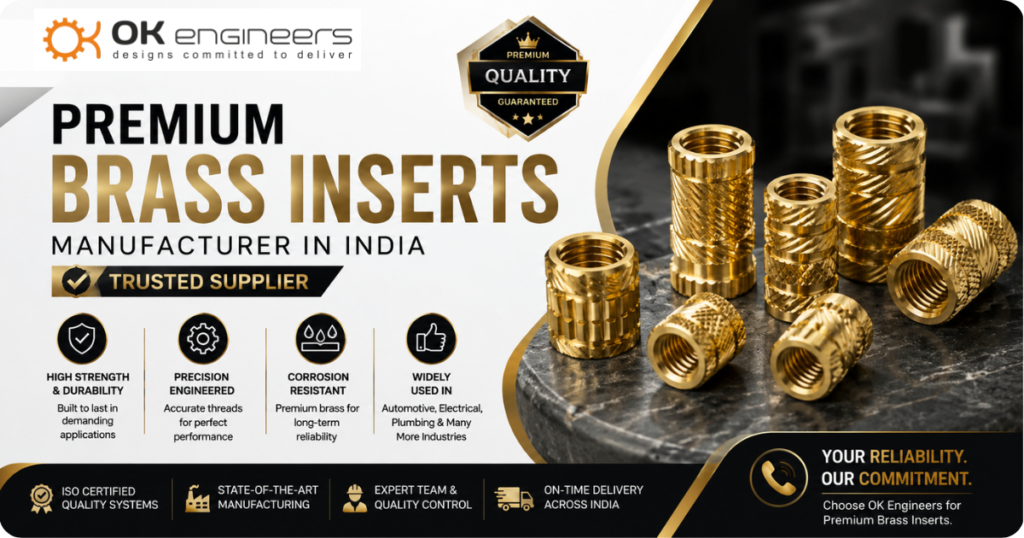
Brass inserts are precision components embedded into plastics, molds, and composites during manufacturing, providing durable threaded anchors for fastening.
As a leading Brass Inserts Manufacturer, O.K. Engineers in Jamnagar, Gujarat, India, delivers CNC-turned solutions for Moulding, Electrical, and automotive uses. With ISO 9001:2015 certification and 60+ years of expertise, we export to Spain, Germany, USA, France, Russia, and UK.
Brass insert fundamentals—from types and materials to installation and industry applications. Procurement managers and engineers will gain insights on selecting high-quality brass inserts in India for reliable performance in high-vibration environments. Discover why brass excels and how to source from trusted suppliers.
Why Choose Brass Inserts?
Brass inserts offer superior strength and compatibility with thermoplastic moulding processes like injection and overmoulding.
Their copper-zinc alloy provides excellent thread strength (up to 500 Nm torque) and corrosion resistance, outperforming steel in humid or chemical-exposed plastics.
Brass expands minimally during moulding (thermal coefficient ~18×10^-6/°C), preventing cracks in polymer matrices.
Benefits include:
- Vibration Resistance: Ideal for automotive and electronics.
- Electrical Conductivity: 15-28% IACS for grounding.
- Cost Efficiency: 30-40% cheaper than stainless for medium loads.
In India’s plastics industry (valued at $32B+), brass inserts enable strong assemblies for exports. (138 words)
Types of Brass Inserts
Brass inserts vary by design for specific moulding and installation methods.
Common types: self-tapping for soft plastics, ultrasonic for thermoplastics, and heat-set for high-volume production.
| Type | Installation Method | Material Thickness Suitability | Torque Rating (Nm) |
|---|---|---|---|
| Self-Tapping | Screw-in | 1-5mm plastics | 5-20 |
| Ultrasonic | Vibration welding | 2-8mm thermoplastics | 10-30 |
| Heat-Set/Expansion | Heat insertion | 3-10mm | 15-50 |
| Press-Fit | Hydraulic press | Composites, 1-6mm | 8-25 |
| Molded-In | Injection during moulding | Any thickness | 20-100+ |
Choose based on plastic type (e.g., nylon, ABS) and load. CNC precision ensures M3-M12 threads.
Material Specifications and Standards
Standard brass grades for inserts include C36000 (high machinability) and C38500 (leaded for corrosion resistance).
O.K. Engineers adheres to ASTM B16 and IS 319 for alloys.
| Brass Grade | Cu/Zn Ratio | Hardness (HB) | Yield Strength (MPa) | Applications |
|---|---|---|---|---|
| C36000 | 60/40 | 65-90 | 124-276 | General threading, electronics |
| C38500 | 58/40 + Pb | 55-75 | 138-241 | Moulding, automotive |
| C37700 | 58/40 + Pb | 70-95 | 172-310 | High-torque inserts |
| Lead-Free C360 | 60/40 | 75-100 | 200-300 | Potable/food contact |
Density: 8.4-8.7 g/cm³. Plating options (zinc/nickel) extend life in harsh conditions.
Applications in Key Industries
Brass inserts secure assemblies in high-stress environments.
Plastics Moulding: Anchor screws in housings, preventing strip-out.
Automotive: Fasten panels and sensors, enduring vibrations.
Electronics use them for PCB mounting; hydraulics for manifold connections.
| Industry | Application Example | Insert Type | Load Capacity |
|---|---|---|---|
| Plastics | Housing threads | Molded-In | 50-200 kg |
| Automotive | Dashboard fasteners | Ultrasonic | 100-500 Nm |
| Electronics | Enclosure grounding | Self-Tapping | Electrical |
| Furniture | Leg assemblies | Press-Fit | 20-100 kg |
Jamnagar supplies 60% of India’s brass inserts for global chains.
Benefits Over Alternative Materials
Brass inserts surpass plastic, steel, and aluminum in moulding compatibility.
Steel corrodes in polymers; aluminum deforms under heat. Brass bonds well without delamination.
| Property | Brass | Steel | Plastic | Aluminum |
|---|---|---|---|---|
| Corrosion Resistance | Excellent | Fair (rusts) | Good | Moderate |
| Moulding Compatibility | High (no cracking) | Low | N/A | Medium |
| Cost (per 1000 pcs, USD) | 50-80 | 40-60 | 20-40 | 30-50 |
| Torque Retention | 90% after cycles | 70% | N/A | 80% |
| Weight | Medium | Heavy | Light | Light |
Manufacturing Process for Precision Brass Inserts
Production involves CNC turning from bar stock.
In Jamnagar facilities, processes ensure ±0.01mm accuracy.
Steps:
- Bar Stock Cutting: Brass rods to length.
- CNC Turning: Threads, knurls formed.
- Slitting/Grooving: For expansion types.
- Surface Treatment: Passivation or plating.
- Testing: Pull-out force (up to 5000N), torque.
ISO 9001:2015 ensures traceability.
You May Also Read – High‑Quality Brass Plugs in India | Trusted Manufacturer – Ok Engineers
Why O.K. Engineers is the Leading Brass Inserts Manufacturer in India
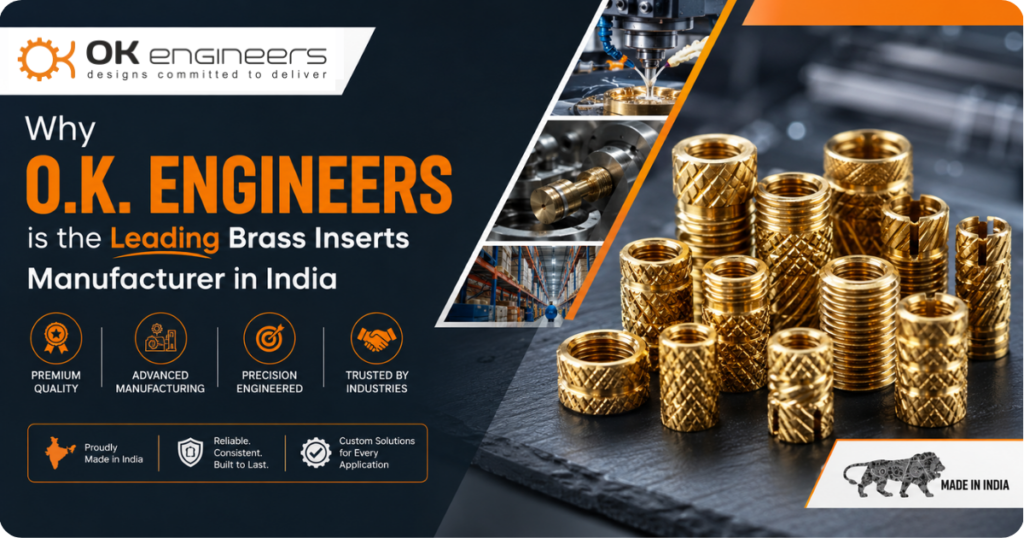
O.K. Engineers excels as a brass inserts manufacturer with 60+ years as a 4th-generation Jamnagar business.
At Plot No-776, GIDC Phase-2, Dared, Jamnagar-361004, Gujarat, our CNC tech produces inserts for moulding, auto, and electrical needs.
ISO 9001:2015 certified, we perform 100% inspections and export to Spain, Germany, USA, France, Russia, UK.
Key strengths: Low MOQ (1000 pcs), custom knurling, 2-4 week delivery. Brass inserts in India from us meet global specs reliably.
Global Export and Sourcing Tips for Brass Inserts
We comply with REACH, UL, and BIS for seamless exports.
Sourcing advice: Specify thread pitch, pull-out force in RFQs. Jamnagar’s ecosystem cuts costs 15-20%.
High demand in EU automotive (30% growth).
Conclusion
Brass inserts provide essential strength for plastic assemblies, with types like ultrasonic and heat-set suiting diverse moulding needs. Their material properties—high torque retention and corrosion resistance—make them ideal for automotive, electronics, and manufacturing.
As a premier brass inserts manufacturer in India, OK. Engineers offers precision solutions from Jamnagar, Gujarat, backed by decades of expertise and global exports.
Looking for a reliable brass inserts manufacturer and exporter in India? O.K. Engineers, based in Jamnagar, Gujarat, delivers precision brass and copper alloy components to clients across India and worldwide. Request a free quote today at info@okengineers.com or call +91 98985 94765. (112 words)
FAQ
What is a brass insert used for?
Brass inserts create strong threaded holes in plastics for screws, used in moulding, automotive, and electronics for vibration-resistant fastening.
Why choose O.K. Engineers as brass inserts manufacturer in India?
60+ years, ISO 9001:2015, CNC precision in Jamnagar, Gujarat, with exports to USA, Germany, UK and 100% quality checks.
What brass grades are used for inserts?
C36000 for machinability (HB 65-90) and C38500 for corrosion resistance, per ASTM B16.
How are brass inserts installed in plastics?
Via ultrasonic welding, heat-set, press-fit, or moulding-in, with torque up to 100 Nm.
What tolerances can brass inserts achieve?
±0.01mm via CNC turning, including M3-M12 threads for precise fits.
Are your inserts RoHS compliant?
Yes, all brass inserts from O.K. Engineers meet RoHS, REACH for EU/USA exports.
What is the MOQ for custom brass inserts?
Starts at 1000 pcs, with prototypes in 1-2 weeks from Jamnagar.
How to test brass insert pull-out strength?
Apply 5000N+ force per ISO standards; our 100% tested inserts exceed specs.