


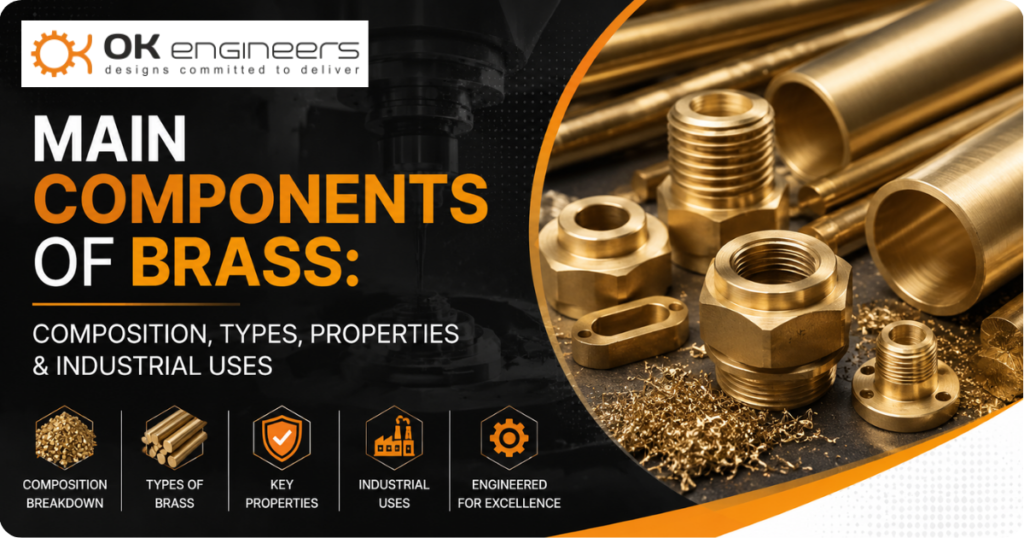
The main components of brass — copper and zinc — form one of the most versatile and widely used metal alloys in industrial manufacturing today. Whether you are an engineer sourcing precision parts, a procurement officer comparing alloy specifications, or a student studying metallurgy, understanding the composition and properties of brass is fundamental. Brass adapts to hundreds of applications, from plumbing fittings and electrical connectors to automotive parts and decorative hardware — largely because its composition can be fine-tuned with trace elements for specific performance outcomes.
In this comprehensive guide, we break down every component found in brass alloys, explain how each element influences performance, and show you why working with a trusted precision manufacturer like Ok Engineers — Jamnagar, Gujarat’s ISO 9001:2015 certified brass components specialist — guarantees you get the exact alloy grade your application demands.
What Is Brass? A Metallurgical Overview
Brass is a copper-zinc alloy that has been used by human civilisations for over 2,000 years. The Romans first produced brass objects around 20 BCE, and by the 11th century, large-scale brass manufacturing had spread across Western Europe. Today, brass remains one of the most important engineering alloys globally — valued for its excellent corrosion resistance, machinability, electrical conductivity, and attractive appearance.
The fundamental definition of brass: any alloy in which copper is the primary metal and zinc is the principal alloying element, with copper content ranging from 55% to 95% by weight. Optional secondary elements — lead, tin, aluminium, nickel, iron, manganese, arsenic, and phosphorus — are added in small quantities to tailor specific properties.
Main Components of Brass: A Detailed Breakdown
1. Copper (Cu) — The Primary Component
Copper is the dominant and defining component of brass, typically comprising 55% to 95% of the alloy by weight. The exact copper content determines the colour, ductility, electrical conductivity, and corrosion resistance of the final alloy.
- High copper content (80–95%): Produces red brass, with superior corrosion resistance and excellent electrical conductivity. Ideal for electrical components and plumbing fittings.
- Medium copper content (67–80%): Creates yellow brass — the most common commercial grade — offering the best balance of strength, machinability, and workability.
- Lower copper content (55–65%): Results in alpha-beta (duplex) brass, suitable for hot forging, extrusion, and high-strength applications.
Copper’s natural antimicrobial properties also make brass components a preferred choice in healthcare equipment, water systems, and food-grade fittings.
2. Zinc (Zn) — The Secondary Component
Zinc is the second primary component and the element that most dramatically changes brass’s mechanical characteristics. Zinc content in brass typically ranges from 5% to 45% by weight.
- Zinc increases tensile strength and hardness while reducing the material cost compared to pure copper.
- Optimal ductility in brass is achieved at approximately 30% zinc content — the composition used in cartridge brass (C26000), the standard for ammunition casings and deep-drawn components.
- Beyond 36–37% zinc, beta-phase crystals form, making the alloy harder but less cold-workable and better suited for hot working processes.
The copper-to-zinc ratio is the single most critical factor a brass components manufacturer adjusts to meet different engineering requirements.
3. Lead (Pb) — Machinability Enhancer
Lead is added to brass in concentrations of 0.5% to 3.5%, primarily to improve machinability. Lead creates tiny inclusions in the microstructure that act as chip-breakers during CNC turning and milling operations, significantly reducing tool wear and cycle time.
Free-cutting brass (C36000) contains approximately 3% lead and is the most widely machined brass grade in the world, used extensively for:
- Precision turned components
- Valve bodies and fittings
- Fasteners and nuts
- Hydraulic fittings
⚠️ Regulatory Note: The RoHS Directive (EU) and the Safe Drinking Water Act (USA) impose limits on lead in plumbing and drinking water contact applications. Low-lead and lead-free brass grades are now standard for such uses across the UK, Australia, India, and USA.
4. Tin (Sn) — Corrosion & Strength Improver
Tin is added at levels of 0.5% to 2% to improve resistance to dezincification — a corrosion process that selectively leaches zinc from the alloy in certain water chemistries. Naval brass (C46400), used in marine and offshore environments, contains approximately 1% tin for this reason.
Tin also contributes to:
- Higher tensile strength
- Better resistance to seawater and brine
- Improved performance in high-pressure hydraulic systems
5. Aluminium (Al) — Strength & Oxidation Resistance
Aluminium additions of 1% to 6% produce aluminium brass grades characterised by:
- A hard, protective aluminium oxide surface layer that resists oxidation
- Significantly higher yield and tensile strength
- Good resistance to impingement corrosion in high-velocity fluid systems
- Suitability for heat exchanger tubes, condenser tubing, and marine hardware
6. Nickel (Ni) — High-Temperature Performance
Nickel additions of 0.5% to 2.5% are used in nickel-silver brass grades. Nickel improves:
- High-temperature strength and oxidation resistance
- A silvery-white finish with excellent aesthetic appeal
- Corrosion resistance in acidic and alkaline environments
- Performance in precision springs, optical frames, and musical instruments
7. Iron (Fe), Manganese (Mn) & Phosphorus (P) — Grain Refiners
These trace elements, typically present at under 1%, serve as grain refiners and deoxidisers:
- Iron and manganese improve tensile strength and grain structure in high-strength brass alloys used in structural applications.
- Phosphorus deoxidises the melt and improves weldability.
- Arsenic (As) in concentrations of 0.02–0.06% is added alongside tin to inhibit dezincification in arsenical brass grades specified for UK water systems (BS EN 12165).
Main Components of Brass — Composition, Percentage & Function
| Component | Symbol | Typical % Range | Primary Function |
|---|---|---|---|
| Copper | Cu | 55% – 95% | Base metal; conductivity, corrosion resistance, colour |
| Zinc | Zn | 5% – 45% | Strength, hardness, cost reduction |
| Lead | Pb | 0.5% – 3.5% | Machinability, chip-breaking |
| Tin | Sn | 0.5% – 2% | Dezincification resistance, strength |
| Aluminium | Al | 1% – 6% | Oxidation resistance, high strength |
| Nickel | Ni | 0.5% – 2.5% | High-temp strength, aesthetic finish |
| Iron | Fe | 0.1% – 0.5% | Grain refinement |
| Manganese | Mn | 0.1% – 0.5% | Strength, grain structure |
| Phosphorus | P | 0.01% – 0.05% | Deoxidisation, weldability |
You May Also Read – Who is the Manufacturer of Precision Brass Components in India
Types of Brass Alloys and Their Compositions
Understanding the main components of brass is most useful when you connect them to the specific alloy grades used in industry.
Alpha Brass (Single-Phase)
- Composition: >65% copper, <35% zinc
- Properties: Highly ductile, cold-workable, excellent for deep drawing and pressing
- Applications: Cartridge cases, coins, jewellery, electrical connectors
Alpha-Beta (Duplex) Brass
- Composition: 55–65% copper, 35–45% zinc
- Properties: Higher strength, less ductile, ideal for hot working
- Applications: Hot-forged valves, pipe fittings, complex structural shapes
Beta Brass
- Composition: <55% copper, >45% zinc
- Properties: Hard and brittle at room temperature, workable only when hot
- Applications: Specialised die-casting applications
Free-Cutting Brass (C36000)
- Composition: ~61.5% Cu, ~35.5% Zn, ~3% Pb
- Applications: CNC precision turned components — the most common grade used at facilities like Ok Engineers
Naval Brass (C46400)
- Composition: ~60% Cu, ~39% Zn, ~1% Sn
- Applications: Marine hardware, propeller shafts, heat exchanger tubes
Common Brass Grades, Standards & Industrial Applications
| Brass Grade | Standard | Key Components | Primary Applications |
|---|---|---|---|
| Cartridge Brass | C26000 / CZ106 | 70% Cu, 30% Zn | Ammunition, deep drawing, radiator cores |
| Free-Cutting Brass | C36000 / CZ121 | 61.5% Cu, 35.5% Zn, 3% Pb | Precision turned parts, valves, fasteners |
| Naval Brass | C46400 / CZ112 | 60% Cu, 39% Zn, 1% Sn | Marine hardware, pump shafts |
| Aluminium Brass | C68700 | 77% Cu, 21% Zn, 2% Al | Heat exchangers, condenser tubes |
| Red Brass | C23000 | 85% Cu, 15% Zn | Plumbing, architecture, electrical |
| Muntz Metal | C28000 | 60% Cu, 40% Zn | Ship hull sheathing, heat exchanger plates |
Why Brass Component Composition Matters in Manufacturing
The composition of brass directly determines the quality, lifespan, and performance of finished parts. Specifying the wrong alloy grade can result in:
- Premature corrosion in humid, marine, or chlorinated environments
- Poor machinability, increasing production costs and tool consumption
- Dimensional inaccuracy due to incorrect thermal expansion coefficients
- Regulatory non-compliance (e.g., lead content in drinking water fittings)
This is why partnering with a knowledgeable brass components manufacturer — one that understands alloy metallurgy from raw material to finished part — is a critical procurement decision.
Ok Engineers: Your Trusted Partner for Precision Brass Components
Ok Engineers (Om Kailash Engineers), based at Plot No-776, GIDC Phase-2, Dared, Jamnagar-361004, Gujarat, India, is an ISO 9001:2015 certified manufacturer, supplier, and exporter of precision brass turned components with over 60 years of industry experience.
Jamnagar — often called the “Brass City of India” — is home to the world’s most concentrated ecosystem of brass manufacturing expertise. Ok Engineers sits at the heart of this hub, combining:
- Full CNC machining facility with multi-spindle turning capability
- Raw material traceability — sourcing verified, composition-certified copper and zinc alloy rods
- Strict quality control at every production stage
- Global export experience to USA, UK, Germany, France, Switzerland, Middle East, and Spain
Products Manufactured by Ok Engineers
Ok Engineers produces precision brass components across multiple industries:
- Electrical & Wiring: Brass cable glands, terminal bars, electrical connectors, brass inserts for moulding
- Plumbing & Hydraulics: Brass plumbing fittings, hydraulic fittings, pneumatic connectors
- Automotive: Brass automotive components, CNC turned parts, fasteners
- Lighting: Brass lamp parts, decorative lighting components
- Industrial: Brass screws, brass reducers, lock nuts, nickel-plated brass components
For procurement teams, engineers, and OEM buyers in India, UK, USA, and Australia, Ok Engineers delivers competitive pricing, ISO-certified quality, and reliable global logistics — all backed by six decades of metallurgical expertise.
📧 Contact: info@okengineers.com 🌐 Website: okengineers.com 📍 Address: Plot No-776, GIDC Phase-2, Dared, Jamnagar-361004, Gujarat, India
Properties of Brass Determined by Its Components
The main components of brass collectively produce the alloy’s signature performance characteristics:
Mechanical Properties
- Tensile strength: 300–800 MPa (varies by grade)
- Yield strength: 100–700 MPa
- Elongation: 5–65%
- Hardness: 55–185 HB
Physical Properties
- Density: ~8.4–8.7 g/cm³
- Melting point: ~900–940°C
- Thermal conductivity: 100–120 W/(m·K)
- Electrical conductivity: 23–44% IACS
Key Performance Benefits
- Excellent corrosion resistance in air, water, and many chemicals
- Good electrical and thermal conductivity
- High machinability (especially free-cutting grades)
- 100% recyclable — a key advantage for sustainable manufacturing
- Attractive, gold-like appearance without surface treatment
Conclusion: Understanding Brass Composition Drives Better Engineering Decisions
The main components of brass — copper, zinc, and a carefully selected set of alloying additions — are what make this alloy one of the most adaptable and enduring materials in modern manufacturing. By understanding how each element contributes to brass’s properties, engineers and procurement professionals can specify the right alloy grade for every application, avoiding costly failures and compliance issues.
Whether your requirements call for free-cutting brass for precision CNC components, naval brass for marine hardware, or aluminium brass for heat exchanger tubes, composition is everything. And when it comes to translating that composition into flawlessly machined parts at scale, the expertise of a seasoned manufacturer is indispensable.
Ok Engineers — with over 60 years of brass precision manufacturing experience, ISO 9001:2015 certification, and a proven global export track record spanning the USA, UK, Germany, Australia, and the Middle East — is your ideal manufacturing partner. From raw material selection through CNC machining to quality verification and global shipment, Ok Engineers brings the metallurgical knowledge and manufacturing precision your projects demand.
Frequently Asked Questions (FAQs) About the Main Components of Brass
Q1. What are the main components of brass?
The main components of brass are copper (Cu) and zinc (Zn). Copper typically ranges from 55% to 95% by weight, and zinc from 5% to 45%. Additional trace elements — including lead, tin, aluminium, nickel, iron, and manganese — are added in specific brass grades to enhance machinability, corrosion resistance, strength, and other properties.
Q2. What percentage of copper and zinc is in standard brass?
Modern yellow brass (the most common commercial grade) typically contains 67% copper and 33% zinc. Free-cutting brass (C36000) — the most machined grade — contains approximately 61.5% copper, 35.5% zinc, and 3% lead. The precise ratio is adjusted by the manufacturer based on application requirements.
Q3. Why is lead added to brass components?
Lead is added to brass at concentrations of 0.5–3.5% to improve machinability. Lead forms tiny inclusions in the brass microstructure that act as chip-breakers during CNC turning, reducing tool wear and enabling faster, more accurate machining of complex shapes. Lead-free alternatives are available for applications involving drinking water or RoHS-regulated environments.
Q4. What is the difference between brass and bronze?
Both are copper-based alloys, but brass uses zinc as the primary alloying element while bronze uses tin. Brass is generally more machinable, less expensive, and better suited for electrical applications and plumbing. Bronze offers superior wear resistance and is preferred for bearings, bushings, and marine applications. Learn more about copper alloy differences at resources like ASM International.
Q5. Which brass grade is best for precision CNC turned components?
Free-cutting brass (C36000 / CZ121) is the industry standard for precision CNC turning due to its exceptional machinability rating of ~100 (compared to steel at ~20). Manufacturers like Ok Engineers use this grade — along with other application-specific grades — to produce cable glands, fittings, inserts, and custom turned components to exact dimensional tolerances.