


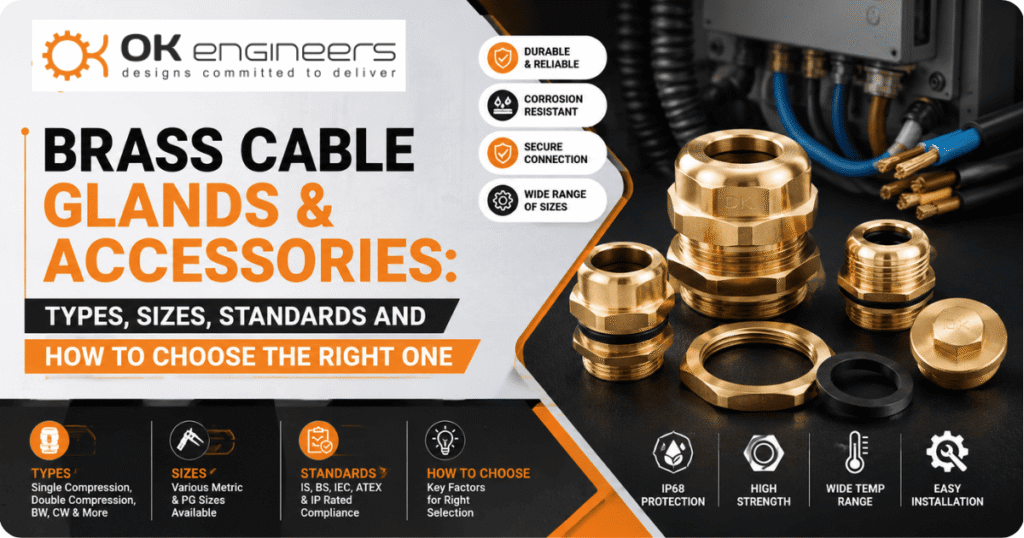
Brass cable glands and accessories are among the most critical components in any electrical installation — yet choosing the wrong type, size, or thread standard can compromise the safety, sealing performance, and compliance of your entire system. At O.K. Engineers, a leading brass cable gland manufacturer based in Jamnagar, Gujarat, India, we have produced precision brass cable glands and accessories for over 60 years, exporting to customers in the UK, USA, Australia, Germany, Spain, France, and Russia. This comprehensive buyer guide covers every cable gland type — BW, CW, E1W, A1/A2 — along with IP ratings, PG vs Metric thread standards, cable gland size charts, and a step-by-step selection guide to help procurement managers, electrical engineers, and distributors make the right choice every time.
Whether you are sourcing brass cable glands for industrial panel boards in India, SWA cable terminations in the UK, marine installations in Australia, or control cabinet systems in the USA, this guide gives you the technical specifications and buying confidence you need.
What Are Brass Cable Glands and Why Do They Matter?
A brass cable gland — also called a cable connector, cord grip, or cable fitting — is a precision-machined mechanical device that secures and seals a cable where it enters an electrical enclosure, panel board, junction box, or industrial equipment. Brass cable gland accessories include the locknuts, earth tags, PVC shrouds, reducing adaptors, and sealing washers that form a complete installation kit.
Brass is the preferred material for cable gland manufacturing because it offers:
- Superior corrosion resistance compared to standard steel
- High mechanical strength to withstand vibration and physical impact
- Excellent electrical conductivity for reliable earthing continuity
- Wide operating temperature range from -40°C to +300°C
- Compatibility with international thread standards (Metric, PG, NPT)
- Compliance with IEC 62444, BS 6121, and IS standards for electrical fittings
At O.K. Engineers, we manufacture brass cable glands using CNC precision turning machines with tolerance levels of ±0.05mm, ensuring dimensional accuracy across every batch. Our ISO 9001:2015 certified facility in Jamnagar — India’s brass manufacturing capital — produces over 2,000 product variations including all standard and custom gland configurations for the electrical, marine, oil & gas, and industrial automation sectors.
Types of Brass Cable Glands: BW, CW, E1W, A1/A2 and More
Selecting the correct brass cable gland type is the first and most important decision in the procurement process. The type determines the level of environmental sealing, the cable construction it is designed for, and the IP protection rating it can achieve. Below is a complete comparison of all major brass cable gland types.
Brass Cable Gland Types — Complete Comparison
| Gland Type | Cable Construction | Sealing Points | IP Rating Achievable | Primary Application | Thread Standard |
| BW (Brass — Indoor) | SWA (Steel Wire Armoured) | Armour clamp only — no outer seal | IP2X (armour earth only) | Indoor industrial panels, switchrooms, dry environments | BS/Metric |
| CW (Brass — Outdoor) | SWA (Steel Wire Armoured) | Armour clamp + outer sheath seal | IP54 to IP66 | Outdoor cable terminations, weatherproof enclosures, industrial installations | BS/Metric |
| E1W (Double Compression) | SWA / XLPE / Armoured | Inner seal on bedding + outer seal on sheath | IP66 to IP68 | Hazardous areas, corrosive environments, chemical plants, food processing | BS/Metric |
| A1/A2 (Industrial) | Unarmoured / Multi-core | Outer sheath grip + compression seal | IP54 to IP68 | Control panels, automation systems, general industrial | Metric/PG |
| PG Type | Unarmoured / Light duty | Compression seal on outer sheath | IP54 to IP65 | Legacy European machinery, control cabinets, older equipment | PG Thread (DIN 40430) |
| Metric Type | Unarmoured / Multi-core | O-ring + compression seal | IP65 to IP68 | Modern international equipment, automation, new installations | M Thread (IEC 62444) |
| Marine / JIS Gland | Unarmoured / Armoured | Double seal for marine environment | IP66 to IP68 | Marine vessels, offshore platforms, shipboard electrical | JIS C 8364 |
BW Cable Gland — Indoor Brass Armoured Gland
The BW cable gland is designed specifically for steel wire armoured (SWA) cables installed in dry, indoor environments. It features a two-part brass body that clamps the steel wire armour between an armour cone and clamping ring, providing reliable electrical continuity and earthing for the armour. The BW gland does not provide an outer sheath seal, which is why it is limited to indoor or sheltered installations. A standard BW installation kit includes the brass gland body, armour cone, clamping ring, brass locknut, earth tag (banjo washer), and a PVC shroud.
CW Cable Gland — Outdoor Weatherproof Brass Gland
The CW cable gland adds an outer compression seal to the BW design, creating a weatherproof termination suitable for outdoor and exposed environments. The outer seal compresses against the cable’s outer PVC or thermoplastic sheath, providing ingress protection against rain, humidity, and dust. CW glands are the standard choice for outdoor distribution boards, street lighting panels, and industrial plant installations exposed to the elements. They achieve IP54 to IP66 ratings depending on the seal quality and installation method.
E1W Cable Gland — Double Compression for Corrosive Environments
The E1W double compression cable gland is the highest-specification brass gland for standard armoured cables. It incorporates two independent seals: an inner seal that compresses against the cable bedding (inner insulation layer below the armour) and an outer seal against the cable sheath. This dual-sealing design prevents moisture from wicking through the armour interstices — a critical requirement in corrosive environments, food processing plants, chemical facilities, and any location where temporary water immersion is possible. E1W glands achieve IP66 to IP68 ratings and are the correct choice wherever water ingress through the armour is a risk.
PG Thread vs Metric Thread vs NPT: Cable Gland Thread Standards Explained
Thread type is one of the most common sources of procurement errors in cable gland selection. Ordering a brass cable gland with the wrong thread standard results in a gland that physically cannot be installed in the enclosure knockout, causing project delays and increased cost. There are three main thread standards used in brass cable glands manufactured in India for global export markets.
Cable Gland Thread Standards Comparison — PG vs Metric vs NPT
| Thread Standard | Identification | Flank Angle | Thread Profile | Standard/Specification | Primary Market | Common Sizes |
| Metric (M Thread) | Prefix ‘M’ + diameter + pitch (e.g. M20 x 1.5) | 60° | Straight (Parallel) | IEC 62444 / DIN EN 60423 | Europe, Asia, Australia, India (New Equipment) | M12, M16, M20, M25, M32, M40, M50, M63 |
| PG Thread (Panzergewinde) | Prefix ‘PG’ + number (e.g. PG16, PG21) | 80° | Straight (Parallel), coarser pitch | DIN 40430 | Legacy European equipment, older installations | PG7, PG9, PG11, PG13.5, PG16, PG21, PG29, PG36, PG42, PG48 |
| NPT Thread (National Pipe Taper) | Fractional inch (e.g. 1/2″ NPT, 3/4″ NPT) | 60° | Tapered (self-sealing) | ANSI/ASME B1.20.1 | USA, Canada, North America | 1/8″, 1/4″, 3/8″, 1/2″, 3/4″, 1″, 1-1/4″ |
| BSP Thread (British Standard Pipe) | Prefix ‘G’ or ‘R’ + size (e.g. G1/2, G3/4) | 55° | Parallel (G) or Tapered (R) | BS EN ISO 228 | UK, Australia, South Asia | G1/4, G3/8, G1/2, G3/4, G1, G1-1/4 |
For India: Cable glands for IS-standard electrical installations typically use Metric thread (M-series) in line with IEC 62444, which has been adopted as the standard for new installations.
For the UK: Both Metric and BSP (G thread) cable glands are in use. SWA glands (BW/CW/E1W) typically use BS sizes (20S, 25S, 32S, 40S, 50S, 63S), which are broadly Metric-compatible.
For the USA: NPT thread is the standard for conduit and cable entry. Metric glands require an adaptor for US enclosures. Ensure your supplier specifies thread type when ordering for North American markets.
For Australia: AS/NZS 3000 (Wiring Rules) installations use Metric cable glands aligned with IEC standards. M-thread glands are the correct specification for Australian electrical work.
At O.K. Engineers, we manufacture and export brass cable glands in all four thread standards — Metric, PG, NPT, and BSP/G — to meet the specific requirements of our customers in India, the UK, USA, Australia, Germany, France, Spain, and Russia. All thread profiles are machined to international standards with go/no-go gauge verification on every production batch.
Brass Cable Gland Size Chart — Metric, PG, and SWA Sizes
Correct cable gland sizing is determined by matching the gland’s cable entry diameter range to the outer diameter (OD) of the cable being terminated. Using a gland that is too large will fail to create a reliable seal; a gland that is too small cannot accommodate the cable. Always measure the actual cable OD with a vernier calliper before selecting a gland size, as cable ODs vary by manufacturer, voltage grade, and insulation type.
Brass Cable Gland Size Chart — Metric Thread (M-Series)
| Gland Size (Metric) | Thread Size | Entry Hole Diameter (mm) | Cable OD Range (mm) | Typical Cable Cross-Section | IP Rating (with seal) |
| M12 | M12 x 1.5 | 12mm | 3 – 7 mm | 0.5 – 2.5 mm² | IP65 |
| M16 | M16 x 1.5 | 16mm | 4 – 10 mm | 1.5 – 4 mm² | IP65 |
| M20 | M20 x 1.5 | 20mm | 7 – 13 mm | 1.5 – 16 mm² | IP65–IP68 |
| M25 | M25 x 1.5 | 25mm | 11 – 17 mm | 6 – 35 mm² | IP65–IP68 |
| M32 | M32 x 1.5 | 32mm | 15 – 21 mm | 16 – 70 mm² | IP65–IP68 |
| M40 | M40 x 1.5 | 40mm | 19 – 28 mm | 35 – 120 mm² | IP65–IP68 |
| M50 | M50 x 1.5 | 50mm | 27 – 35 mm | 70 – 185 mm² | IP65–IP68 |
| M63 | M63 x 1.5 | 63mm | 34 – 44 mm | 120 – 300 mm² | IP65–IP68 |
PG Thread Cable Gland Size Chart
| Gland Size (PG) | Thread OD (mm) | Cable OD Range (mm) | Typical Application |
| PG 7 | 12.5 mm | 3 – 6.5 mm | Small control cables, sensor cables |
| PG 9 | 15.2 mm | 4 – 8 mm | Instrument cables, signal cables |
| PG 11 | 18.6 mm | 5 – 10 mm | Light control and communication cables |
| PG 13.5 | 20.4 mm | 6 – 12 mm | Standard control cables |
| PG 16 | 22.5 mm | 10 – 14 mm | Medium power cables, multi-core cables |
| PG 21 | 28.3 mm | 13 – 18 mm | Heavy control cables, armoured cables |
| PG 29 | 37.0 mm | 18 – 25 mm | Power distribution cables |
| PG 36 | 47.0 mm | 22 – 32 mm | Large power cables, transformer connections |
| PG 42 | 54.0 mm | 32 – 38 mm | Heavy industrial power cables |
| PG 48 | 60.0 mm | 36 – 44 mm | High-voltage industrial applications |
Note: PG thread glands are primarily required for retrofitting or maintaining legacy European equipment. For all new installations, IEC 62444-compliant Metric thread cable glands are strongly recommended. Contact the O.K. Engineers technical team if you require guidance on PG-to-Metric adaptor specifications for your application.
You May Also Read – Main Components of Brass: Composition, Types, Properties & Industrial Uses
IP Ratings for Brass Cable Glands: What Each Rating Means and How to Choose
IP (Ingress Protection) ratings, defined by IEC 60529, classify the degree of protection provided by a cable gland’s enclosure against solid particles (dust, debris) and liquids (water, moisture). The two-digit IP code tells you exactly how protected the cable entry point is in service. Selecting the correct IP rating is critical for compliance with local electrical installation standards in India (IS 13947), the UK (BS 7671 / IET Wiring Regulations), the USA (NEC), and Australia (AS/NZS 3000).
IP Rating Guide for Brass Cable Gland Selection
| IP Rating | Solid Particle Protection | Liquid Protection | Recommended Cable Gland Type | Typical Application |
| IP20 | Protected against objects >12.5mm | No water protection | BW (indoor, no seal) | Indoor dry switchroom, electrical cupboards |
| IP44 | Protected against objects >1mm | Protection against water splashing | A1 gland, basic sealing | Indoor industrial panels, light splash environments |
| IP54 | Dust protected (no total ingress) | Protection against water from all directions | CW, A2 with seal | Outdoor weatherproof panels, industrial machinery |
| IP65 | Dust tight (total protection) | Protection against low-pressure water jets | CW, Metric gland with O-ring | Outdoor enclosures, marine weatherdecks, HVAC units |
| IP66 | Dust tight | Protection against powerful water jets | CW/E1W, Metric IP66 gland | Offshore installations, outdoor substations, wash-down areas |
| IP67 | Dust tight | Protection against temporary immersion (30min, 1m depth) | E1W, Metric IP67 gland | Buried cable entries, flood-prone areas, food processing |
| IP68 | Dust tight | Protection against continuous immersion (specified by manufacturer) | E1W (double compression), IP68 Metric gland | Underwater cable entries, submersible equipment, marine below-waterline |
| IP69K | Dust tight | Protection against high-pressure steam cleaning | Stainless steel or special brass glands | Food & beverage, pharmaceutical, steam-clean environments |
When selecting brass cable glands for outdoor installations in India, the minimum recommended IP rating is IP65. For applications near the sea, in industrial chemical environments, or in areas subject to flooding, specify IP66 or IP67 glands with E1W double compression design. O.K. Engineers manufactures brass cable glands rated from IP20 through to IP68, with all IP test certificates available upon request.
How to Choose the Right Brass Cable Gland: Step-by-Step Selection Guide
Choosing the correct Brass Cable Gland and Accessories requires matching five key parameters: cable construction, cable outer diameter, installation environment, enclosure thread type, and required certification. Follow this step-by-step process to select the right gland for your application.
Step 1: Identify the Cable Construction
Determine whether your cable is armoured (steel wire armoured — SWA) or unarmoured. Armoured cables require BW, CW, or E1W type glands that can clamp the steel wire armour for mechanical retention and earthing continuity. Unarmoured, multi-core, or flexible cables require A1/A2 type glands or Metric/PG compression glands that grip the outer sheath only.
Step 2: Measure the Cable Outer Diameter
Use a vernier calliper to measure the actual outer diameter of the cable including the outer sheath. Do not rely on catalogue nominal sizes alone, as cable OD varies by manufacturer by up to ±5%. Match the measured OD to the cable entry range column in the size chart tables above. Always choose the gland size whose entry range fully encompasses your cable OD.
Step 3: Determine the Installation Environment
Classify your installation environment: indoor dry (IP20), indoor splash-risk (IP44), outdoor weatherproof (IP54–IP65), outdoor severe weather or corrosive (IP66–IP67), or immersed/submersible (IP67–IP68). This classification directly determines whether you need a BW, CW, or E1W gland, and what IP-rated seal kit is required.
Step 4: Identify the Thread Type Required
Check the enclosure or equipment specification for the cable entry hole thread type: Metric (M-series), PG, NPT, or BSP. The gland body thread must match the enclosure entry thread exactly. If the thread type is unknown, measure the entry hole diameter and thread pitch to identify the standard. O.K. Engineers supplies all thread types and can provide adaptors for mixed-standard installations.
Step 5: Check Certification Requirements
Confirm whether the installation requires certified cable glands. Industrial and hazardous area installations may require ATEX certified glands (Europe/UK), IECEx certified glands (global), UL listed glands (USA), or C-Tick/RCM compliant glands (Australia). General commercial installations in India require IS 6947-compliant brass fittings. O.K. Engineers’ ISO 9001:2015 certified manufacturing process ensures consistent quality across all export specifications.
Step 6: Select the Complete Accessory Kit
A properly installed brass cable gland requires the complete accessory kit: locknut (for mechanical fixing to enclosure), earth tag or earth bond tag (for armour earthing), PVC shroud (for outer protection of armour wires), and sealing washer or O-ring (for IP rating compliance). At O.K. Engineers, we supply complete cable gland kits with all accessories as a single part number for each gland size and type, reducing procurement complexity and ensuring all components are dimensionally matched.
Brass Cable Gland Accessories: Complete Range from O.K. Engineers
O.K. Engineers manufactures the complete range of brass cable gland accessories required for professional electrical installations. All accessories are manufactured from high-grade CW614N brass alloy, CNC-machined to dimensional tolerances of ±0.05mm, and available in standard and custom specifications to meet project-specific requirements.
Brass Cable Gland Accessories Range
| Accessory | Description | Materials Available | Thread Compatibility | Application |
| Brass Locknuts | Hexagonal locknut for securing gland body to enclosure wall | CW614N Brass, Nickel-Plated Brass | Metric (M12–M63), PG (PG7–PG48), BSP, NPT | All cable gland installations — indoor and outdoor |
| Earth Tags (Banjo Washers) | Flat earth tag with hole for earth lead connection, placed between gland body and locknut | High-conductivity brass / tinned brass | Universal fit — sized to match gland locknut | SWA cable gland installations requiring armour earthing (BW/CW/E1W) |
| PVC Shrouds | Protective PVC sleeve over armour cone to prevent corrosion of exposed armour wires | PVC — UV stabilised, flame retardant | Sized to match gland body — snap fit or friction fit | CW and E1W outdoor glands — protects armour exposure |
| Reducing Adaptors / Reducers | Reduces a larger gland entry hole to a smaller thread size | CW614N Brass | Metric-to-Metric, PG-to-Metric, NPT-to-Metric | Enclosure reuse, retrofit applications, mixed-thread installations |
| Enlargers | Increases a smaller gland entry hole to a larger thread size | CW614N Brass | Metric, PG, NPT combinations | Enclosure modification, cable upgrade applications |
| Blanking Plugs | Seals unused cable entry holes in enclosures | CW614N Brass, PVC | Metric, PG, NPT | Sealing spare cable entries — maintains enclosure IP rating |
| Sealing Washers / O-Rings | Rubber or EPDM seal between gland body and enclosure face | EPDM, Neoprene, Silicone | Sized to match each gland size | IP-rated sealing — essential for IP65 and above |
| Cable Gland Plates | Drilled plate for multiple cable entries — replaces individual enclosure knockouts | Mild steel, stainless steel, aluminium | Accepts M, PG, or NPT glands | Multiple cable entry points in panels and enclosures |
We manufacture and supply all accessories in both standard stock sizes and custom configurations to customer drawings. Export orders ship with complete packing lists, REACH/RoHS compliance certificates, and ISO 9001:2015 quality documentation. Contact our Jamnagar facility directly for bulk order pricing for India, UK, USA, or Australia supply.
Why O.K. Engineers for Brass Cable Glands and Accessories?
O.K. Engineers — known as Om Kailash Engineers — is a 4th-generation family business established over 60 years ago in Jamnagar, Gujarat, India. Jamnagar is recognised globally as the brass manufacturing capital of the world, producing approximately 80% of India’s brass components and precision turned parts. Our ISO 9001:2015 certified facility operates CNC turning machines that produce cable glands and accessories to dimensional tolerances of ±0.05mm, with 100% inspection using go/no-go gauges on every production batch.
We manufacture brass cable glands in all standard types — BW, CW, E1W, A1/A2, PG, Metric, Marine/JIS — and export to customers in the UK, USA, Australia, Germany, Spain, France, Russia, and across the Middle East and Southeast Asia. Our cable gland range covers over 2,000 product variations, with custom specifications available to customer drawings and samples.
For our complete range of brass electrical accessories, visit our Electrical Components page. For a broader introduction to all the electrical accessories we manufacture and export, read our Complete Guide to Brass Electrical Accessories.
Frequently Asked Questions — Brass Cable Glands & Accessories
The following frequently asked questions are based on the most common queries received from electrical engineers, procurement managers, and distributors in India, the UK, the USA, and Australia. Each answer is formatted for direct extraction by search engine featured snippets and AI platforms including ChatGPT, Perplexity, and Gemini.
Q 1: What is a brass cable gland used for?
A brass cable gland is a mechanical fitting used to secure and seal a cable where it enters an electrical enclosure, panel board, or junction box. It provides cable strain relief, prevents cable pull-out, maintains the enclosure’s IP (Ingress Protection) rating by sealing against dust and water, and — for armoured cables — ensures electrical continuity of the cable armour to earth. Brass cable glands are used in industrial panel boards, distribution boards, marine installations, oil & gas facilities, and commercial electrical systems worldwide.
Q 2: What is the difference between BW, CW, and E1W cable glands?
BW cable glands are indoor brass glands for steel wire armoured (SWA) cables — they clamp the armour for earthing but do not seal the outer sheath, making them suitable for dry indoor environments only. CW cable glands add an outer seal against the cable sheath for weatherproof outdoor installations, achieving IP54 to IP66. E1W cable glands are double compression glands with an inner seal on the cable bedding and an outer seal on the sheath, providing IP66 to IP68 protection for corrosive or wet environments. Choose BW for indoor, CW for outdoor, and E1W for harsh or corrosive environments.
Q 3: What is the difference between PG and Metric cable glands?
PG (Panzergewinde) cable glands use an older German thread standard (DIN 40430) with an 80° flank angle and coarser thread pitch. They are still required for legacy European industrial equipment. Metric cable glands follow the modern international standard IEC 62444, with a 60° flank angle and fine thread pitch, and are the correct choice for all new equipment and international projects. For new installations in India, the UK, USA, or Australia, always specify Metric (M-thread) cable glands unless the equipment specifically requires PG threads.
Q 4: How do I choose the right cable gland size?
To choose the right cable gland size, measure the outer diameter (OD) of the cable with a vernier calliper and match it to the cable entry range in the gland size chart. The gland’s cable entry range must fully cover the cable OD. Do not rely on nominal cable sizes — actual ODs vary by manufacturer. For Metric glands, common sizes are M20 (for cables 7–13mm OD), M25 (11–17mm), M32 (15–21mm), and M40 (19–28mm). Always verify against the manufacturer’s dimensional datasheet.
Q 5: What IP rating do I need for outdoor cable gland installations in India?
For outdoor electrical installations in India — including panel boards, street lighting columns, industrial machinery, and substations — the minimum recommended IP rating for brass cable glands is IP65, which provides full dust protection and resistance to low-pressure water jets. For coastal areas, industrial chemical environments, or locations subject to flooding, specify IP66 (powerful water jets) or IP67 (temporary immersion). E1W double compression brass cable glands are the recommended product for IP66 and IP67 applications in India.
Conclusion: Choosing the Right Brass Cable Gland for Every Application
Brass Cable Glands and Accessories are precision-engineered components that directly determine the safety, compliance, and longevity of electrical installations. Whether you are specifying BW indoor glands for panel boards, CW weatherproof glands for outdoor enclosures, E1W double compression glands for hazardous environments, or selecting PG and Metric thread types for legacy and new equipment — understanding the technical differences between each type ensures you make the right procurement decision the first time.
At O.K. Engineers, we manufacture the complete range of brass cable glands — BW, CW, E1W, A1/A2, PG, Metric, NPT, BSP, and JIS Marine types — along with all accessories including locknuts, earth tags, PVC shrouds, reducers, enlargers, and blanking plugs, from our ISO 9001:2015 certified CNC facility in Jamnagar, Gujarat, India. We export to customers in the UK, USA, Australia, Germany, Spain, France, Russia, and globally, with full compliance documentation and quality certifications for each shipment. For detailed product specifications, custom configurations, or bulk order pricing, contact our technical sales team or visit our Electrical Components page. To understand how brass cable glands fit into the broader category of brass electrical accessories we manufacture and export, read our Complete Guide to Brass Electrical Accessories.