


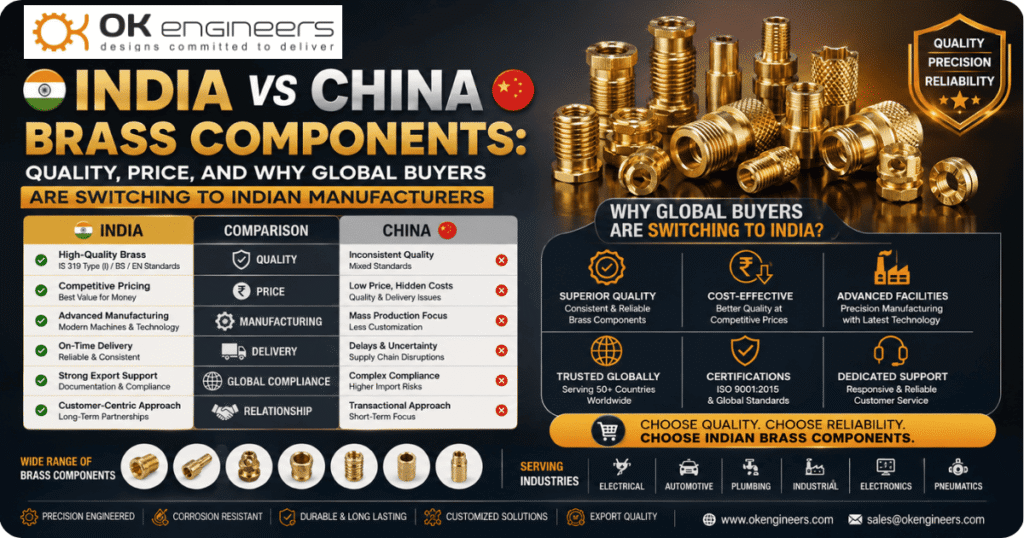
For over a decade, China dominated global brass components supply — and for good reason. Scale, speed, and price made Chinese brass manufacturers the default choice for procurement managers sourcing cable glands, fittings, inserts, valves, and precision turned parts at volume. But the sourcing landscape for brass components has shifted significantly since 2020, and exporters of brass components from India are winning orders from buyers in the UK, USA, Germany, Australia, France, Spain, and Russia who previously sourced exclusively from China. At O.K. Engineers, a 4th-generation, ISO 9001:2015 certified brass components manufacturer and exporter based in Jamnagar, Gujarat — India’s brass manufacturing capital — we have seen a measurable increase in enquiries from buyers actively diversifying away from single-source China supply chains. This article provides the data-driven comparison that procurement managers, supply chain directors, and engineering buyers need to make an informed decision: comparing India and China on price, quality, lead time, compliance, tariff advantage, and supply chain resilience for brass components in 2026.
India vs China Brass Components: Master Comparison Table (2026)
The table below provides a structured, data-referenced comparison across the seven dimensions most important to international B2B buyers sourcing brass components from Asia. Data sources include India’s DGCI&S foreign trade statistics, Volza global shipment data (2024–2025), published manufacturer credentials, and O.K. Engineers’ direct export experience across 15+ destination markets.
India vs China Brass Components — 2026 Buyer Comparison
| Comparison Factor | India (Jamnagar Cluster) | China | Winner for Most Buyers | Notes |
| Unit Price (Standard turned parts, M4–M20 thread range) | USD 0.08–0.45 per piece (high-volume, standard alloy) 15–30% lower than China for precision turned parts at 5,000–50,000 pcs MOQ | USD 0.10–0.60 per piece (similar volume range) Pricing under pressure from rising labour and energy costs | 🇮🇳 India (for standard precision turned parts at volume) | India’s labour cost advantage persists for CNC turning. China’s advantage narrows significantly for parts requiring high machining content. |
| Quality Certification Level | ISO 9001:2015 standard for established exporters. IATF 16949 available from automotive-focused facilities. RoHS, REACH, BIS/IS compliance standard. | ISO 9001:2015 standard. IATF 16949 widely available. CE marking experience stronger. Some facilities hold TS 16949 (predecessor to IATF). | Comparable (established exporters in both countries) | For ISO 9001:2015 + RoHS + REACH — both countries have qualified suppliers. China has broader IATF 16949 coverage currently; India’s IATF adoption is growing. |
| CNC Dimensional Tolerance | ±0.05mm standard for Jamnagar CNC facilities. ±0.02–0.03mm achievable with advanced CNC setups. | ±0.01–0.02mm achievable at advanced Chinese CNC machining centres for high-precision components. | 🇨🇳 China (for ultra-tight tolerances <±0.02mm) | For standard brass fittings and inserts (±0.05mm adequate): India is fully competitive. For aerospace-grade tolerances: China has broader advanced CNC coverage currently. |
| Lead Time (Standard production, 10,000–50,000 pcs) | 15–20 working days production + 18–25 days ocean transit = 33–45 days to UK/USA/AU | 10–20 working days production + 25–35 days ocean transit (Ningbo/Shanghai to UK/USA) = 35–55 days to UK/USA/AU | 🇮🇳 India (Mundra Port advantage for ocean transit) | Mundra Port (Jamnagar hub) has shorter transit times to UK and Australia than eastern China ports. Lead times are broadly comparable for production; India has slight ocean transit edge. |
| Alloy Compliance (RoHS / REACH / Lead-free) | CW614N (IS 319) standard. CW508L low-lead available. RoHS Annex III Exemption 6(c) for standard brass. Full RoHS/REACH documentation as standard export docs. | C36000 (equivalent to CW614N) standard. Lead-free C69300 widely available. RoHS/REACH documentation available but consistency varies by facility. | 🇮🇳 India (documentation consistency advantage) | Indian exporters with ISO 9001:2015 typically provide more consistent and audit-ready documentation packages. Verify documentation from both countries. |
| Import Tariff Advantage (UK, USA, Australia, EU) | UK: India DCTS (Developing Countries Trading Scheme) — 0–4% duty on most brass components. EU: India GSP — reduced rates. USA: MFN rates apply (no GSP as of 2019). Australia: AIFTA — reduced rates. | UK: China MFN rate + potential anti-dumping duties on some categories. USA: Section 301 tariffs on Chinese goods (7.5–25% on many categories). Australia: Full MFN rate. | 🇮🇳 India (significant advantage in UK and Australia) | UK buyers sourcing brass from India pay 0–4% duty vs full MFN for China. USA buyers: India and China both at MFN rate, but China faces additional Section 301 tariffs on some categories. Australia: AIFTA gives India an advantage. |
| Supply Chain Resilience / Risk | Multiple independent Jamnagar manufacturers — no single-port concentration risk. Geopolitical risk: low. | Single geography dependence. Port concentration (Ningbo/Shanghai). Geopolitical risk: elevated (Taiwan Strait, US-China tensions, COVID lockdown precedent). | 🇮🇳 India (lower geopolitical and concentration risk) | China+1 diversification strategy driving many global buyers to add India as a second source. India’s political stability and diversified port access reduce supply chain concentration risk. |
| Language and Communication | English is the primary business language for export enquiries and documentation. No translation delays. | English capability varies by facility. Communication delays common for technical specifications and non-standard enquiries. | 🇮🇳 India (English language advantage) | For UK, USA, and Australian buyers: English-language technical discussions, dimensional specifications, and contract negotiation proceed faster with Indian suppliers. Reduces misspecification risk. |
| Customisation / OEM Capability | Strong capability for custom drawings, 2D/3D CAD, and sample-based production for turned parts under 10,000 pieces MOQ. | Very strong for complex custom parts at high volume. Higher minimum viable production quantities for customisation at some facilities. | Comparable (different strengths) | India: better for low-MOQ custom turned parts. China: better for complex geometries requiring advanced multi-axis machining or die-casting. Know your application. |
The Price Advantage: Why India Offers 15–30% Lower Cost Than China for Most Brass Turned Parts
The most common misconception about Indian brass manufacturers is that cost competitiveness has eroded as India’s economy has grown. The reality for precision CNC-turned brass components — which represent the majority of Jamnagar’s export volume — is the opposite: India’s cost advantage over China for this specific product category has actually strengthened since 2022.
Why India’s Brass Component Pricing Remains Competitive
- Labour cost — CNC machine operator wages in Jamnagar remain significantly below equivalent wages in eastern China’s manufacturing provinces. For brass turned parts where machining time (CNC cycle time) is the primary cost driver, this difference directly translates to unit cost advantage.
- Energy cost — Gujarat benefits from competitive industrial electricity tariffs and growing renewable energy supply from Kutch and Rajkot wind and solar installations, reducing energy cost per unit produced.
- Raw material proximity — Jamnagar imports copper and zinc alloy inputs via Mundra and Kandla ports and processes them within a highly concentrated geographic cluster, eliminating the logistics costs that burden manufacturers in inland Chinese provinces.
- Ecosystem concentration — 5,000+ brass manufacturers in Jamnagar compete intensely for international orders, creating market pricing that is structurally competitive. Suppliers who cannot price competitively lose orders to Jamnagar neighbours within the same postcode.
- Currency — the Indian Rupee’s managed exchange rate with USD provides pricing predictability for US dollar-denominated contracts. For UK buyers, the INR-GBP rate has been stable within a predictable band, enabling reliable forward pricing.
For UK buyers: sourcing brass components from India via DCTS tariff preference reduces import duty to 0–4% — vs the full MFN rate for Chinese-origin goods. On a USD 100,000 order, this tariff differential alone can represent USD 4,000–15,000 in duty savings depending on the product category. When combined with India’s 15–30% unit price advantage for standard turned parts, the total cost of ownership advantage of Indian-origin brass components over Chinese-origin equivalents is significant.
At O.K. Engineers, our pricing for standard precision brass components — cable glands (M16–M40 range), moulding inserts (M3–M12), neutral links, and plumbing fittings (½” to 1½”) — is consistently within 15–25% of equivalent quotes from established Chinese manufacturers for comparable specifications and volumes. We encourage buyers to request parallel quotes for direct comparison.
Quality and Certification: India vs China Brass Components
The quality gap between Indian and Chinese brass manufacturers that existed a decade ago — when Chinese factories had stronger CNC infrastructure and ISO certification rates — has largely closed for established Indian exporters. For the brass component categories most commonly sourced from Jamnagar (turned parts, fittings, inserts, cable glands), the quality infrastructure of ISO-certified Indian manufacturers is fully competitive with equivalent Chinese facilities.
Quality Certification Comparison — India vs China Brass Manufacturers
| Quality Dimension | India (Established ISO-Certified Exporters) | China (Established Exporters) | Buyer Action Required |
| ISO 9001:2015 | Standard for established exporters. Verify: current certificate, correct scope (manufacturing), UKAS/IAF-accredited certifying body. | Standard for established exporters. Same verification required. | Verify ISO cert with certifying body for BOTH countries. Do not accept certificate alone. |
| Material Traceability (XRF Spectrometer) | Available from ISO-certified Jamnagar facilities. IS 319 Type I (CW614N) standard alloy — spectrometer-verified batch MTC available. | C36000 standard alloy — spectrometer MTC available from established facilities. Consistency varies. | Request XRF spectrometer MTC (per batch, not per grade) from any supplier — Indian or Chinese. |
| Dimensional Inspection (Go/No-Go Gauge) | 100% go/no-go gauge inspection standard at ISO-certified CNC facilities. ±0.05mm tolerance documented. | Available at certified facilities. Ultra-tight tolerances (±0.01mm) achievable at advanced facilities. | Request dimensional inspection report for first order. Specify tolerance requirements explicitly. |
| RoHS Declaration | ISO-certified Indian exporters provide signed RoHS DoC (UK RoHS 2012 / EU RoHS 2) as standard. CW614N exempt under Annex III 6(c). | RoHS DoC available from established Chinese exporters. Quality of documentation varies. | Specify RoHS DoC as a mandatory purchase order requirement. Verify format (must name specific Directive). |
| REACH SVHC Declaration | Available from ISO-certified Indian exporters as standard export document. | Available from established Chinese exporters. Less universally standardised. | Specify REACH declaration as mandatory PO requirement for UK, EU, Australia shipments. |
| Third-Party Inspection (SGS / Bureau Veritas / TÜV) | Available — third-party inspection services (SGS, BV, QIMA) operate in Jamnagar and can inspect at factory before shipment. | Available — major inspection firms operate in all Chinese manufacturing cities. | For first orders or high-value shipments: commission third-party pre-shipment inspection. Available in both countries. |
| IATF 16949 (Automotive Quality) | Available from automotive-focused Jamnagar facilities. Less universal than in China currently. | Widely available — China has strong IATF 16949 adoption for automotive supply. | For IATF-required automotive supply chains: verify individual facility certification status — do not assume. |
The practical quality conclusion for most brass component categories: an ISO 9001:2015 certified Jamnagar manufacturer with documented XRF spectrometer alloy verification and go/no-go gauge inspection provides a quality output equivalent to a similarly certified Chinese facility for standard precision turned parts, fittings, and inserts. The quality gap exists in ultra-tight tolerance machining (<±0.02mm) and complex multi-axis geometries — categories that represent a small fraction of total brass component procurement volume for most industrial buyers.
Supply Chain Resilience: Why China+1 Buyers Are Choosing India for Brass Components
The COVID-19 pandemic exposed a fundamental vulnerability in global supply chains that were concentrated in single-country, single-port sourcing relationships. For brass components, the disruption was acute: the closure of Ningbo and Shanghai ports in 2021, rolling lockdowns in Chinese manufacturing provinces in 2022, and the persistent shipping container shortage created 6–18 month lead time extensions and inventory shortfalls for buyers with 100% China-sourced brass component supply chains. The response from procurement directors and supply chain managers in the UK, USA, Germany, and Australia has been systematic: add a second-source supply in a geographically and politically distinct manufacturing hub. For brass components specifically, Jamnagar, India has emerged as the primary China+1 destination.
Why Jamnagar Is the Primary China+1 Destination for Brass Components
- Geographic independence — Jamnagar is 5,000+ km from eastern China. A port closure, typhoon, or pandemic restriction affecting Shanghai or Ningbo has zero impact on Jamnagar production or Mundra/Kandla port operations.
- Political stability — India’s political relationship with the UK, USA, EU, and Australia is stable and trade-positive. The India-UK Free Trade Agreement negotiations, India-Australia ECTA (in force since December 2022), and India-EU FTA discussions all point toward improving rather than deteriorating trade terms.
- Tariff trajectory — while US Section 301 tariffs on Chinese goods (7.5–25% on many manufactured goods categories) have persisted or increased since 2018, India faces standard MFN treatment from the USA and preferential rates from the UK (DCTS) and Australia (AIFTA). India’s tariff position is structurally improving relative to China.
- Manufacturing ecosystem depth — Jamnagar’s 5,000+ brass manufacturers means buyers can qualify multiple alternative suppliers within a few kilometres of each other, providing built-in redundancy that single-city Chinese sourcing cannot match.
- English language — all business communication, technical specifications, contracts, and compliance documentation with Indian exporters proceeds in English. This removes the translation layer that adds misspecification risk, slows technical discussion, and creates contract ambiguity in China sourcing relationships.
The data supports the trend: India exported USD 1,122.53 million worth of brass between April and July 2023–2024 — a 30.99% increase year-on-year. While China remains the world’s largest brass components exporter by volume, India’s growth rate far exceeds China’s in the same period, driven by the China+1 diversification strategy of buyers across Europe, North America, and the Asia-Pacific region.
Import Tariff Comparison: India-Origin vs China-Origin Brass Components by Market
Import duty is a significant and often underestimated factor in the total cost of ownership of brass components from Asia. For UK and Australian buyers in particular, India’s preferential tariff status provides a structural cost advantage that compounds the unit price advantage documented above.
Import Duty — India vs China Origin Brass Components by Destination Market
| Market | India-Origin Duty Rate | China-Origin Duty Rate | Tariff Preference Scheme (India) | Net Tariff Advantage (India vs China) | Notes |
| United Kingdom | 0–4% (most brass components under DCTS Enhanced Framework) | 4–6.5% (UK Global Tariff / MFN rate) No preferential access | UK DCTS (Developing Countries Trading Scheme) — Enhanced Preferences for India | 4–10.5% lower tariff for India-origin | UK DCTS replaced UK GSP in June 2023. India qualifies for Enhanced Preferences. Confirm specific HS code duty rate with HMRC Trade Tariff tool. |
| Australia | 0–5% (AIFTA — India-Australia ECTA, in force Dec 2022) | 5–6.5% (Australia MFN tariff rate for brass components) | AIFTA (Australia-India Economic Cooperation and Trade Agreement) | 5–11.5% lower tariff for India-origin | ECTA in force since December 2022 — many brass component HS codes now at 0% duty from India. Chinese origin at full MFN rate. |
| USA | 3.7% (Standard MFN for Chapter 74 brass articles under HTS 7419/7415) | 3.7% MFN +7.5–25% Section 301 tariff on many categories (List 1–4B depending on HS code) | USA: India’s GSP suspended in 2019 (no preferential access currently) | Net: India at 3.7% vs China at 3.7–28.7% = 0–25% advantage depending on product | USA Section 301 tariffs on China goods remain in force in 2026. Verify specific product’s Section 301 status with US CBP / USITC. Many brass fitting/insert categories face 7.5–25% extra duty from China. |
| European Union | Standard GSP rates (India qualifies as GSP country for most Chapter 74 products) ~3.5% or 0% for some HS codes | 4.2%–6.5% (EU MFN tariff + potential anti-dumping duties on some Chinese brass categories) | EU GSP — Standard Preferences (India not in Enhanced GSP for industrial goods) | Modest advantage (0–3% depending on HS code and AD duties) | Check EU TARIC for specific Chapter 74 HS codes. Some Chinese brass fittings subject to anti-dumping investigation / duties in EU. |
| Germany / France (within EU) | Same as EU above | Same as EU above + potential anti-dumping on specific Chinese brass categories | Same as EU above | Same as EU above + anti-dumping risk for China-origin | Anti-dumping duties on specific Chinese brass categories are a significant additional risk for EU buyers — monitor OJEU (Official Journal of the EU) for current investigations. |
For a UK procurement manager sourcing GBP 500,000 of brass cable glands and fittings annually: switching from China-origin to India-origin under DCTS preferential rates can save GBP 20,000–52,500 per year in import duty alone — before accounting for the 15–30% unit price advantage. The combined effect makes India-sourced brass components the lower total-cost option for most UK and Australian buyers in 2026.
You May Also Read – Brass Inserts Exporter from India: Export Process, Compliance (RoHS, REACH) and Packaging Standards
Where India Wins and Where China Retains an Advantage: An Honest Assessment
A credible comparison must acknowledge where China retains genuine advantages — and be clear about the application categories where Indian manufacturers are the superior choice. Procurement managers who need both a realistic assessment and a clear sourcing recommendation will find the following framework directly applicable.
Application Categories — India vs China: Honest Verdict
| Brass Component Category | India Verdict | China Verdict | Recommended Source for Most Buyers | Reasoning |
| Precision CNC turned parts (M3–M20, standard tolerances ±0.05mm) Cable glands, inserts, fittings, connectors | Strong — competitive pricing, ISO 9001, 15–30% cost advantage | Comparable quality but higher cost + tariff disadvantage in UK/AU | 🇮🇳 India | India’s strongest category. Volume economics, English communication, tariff advantage, and unit price all favour India for standard precision turning. |
| Plumbing fittings (CPVC/PPR/UPVC pipe fitting inserts, BSP/NPT connectors, valve bodies) | Dominant — Jamnagar is the world’s largest producer of these specific components | Available but less concentrated expertise in this specific category | 🇮🇳 India | Jamnagar’s concentration in plumbing insert and fitting manufacturing is unmatched globally. Lower cost, deeper expertise, shorter lead time. |
| Electrical accessories (cable glands, neutral links, plug pins, earth bars, switchgear parts) | Strong — full product range, ISO + RoHS compliance, tariff advantage | Available but unit price advantage is reduced for complex electrical assemblies | 🇮🇳 India | O.K. Engineers’ category. 60+ year track record, full electrical accessories range, RoHS/REACH documentation standard. |
| Ultra-high precision machining (<±0.02mm, complex multi-axis geometry) | Achievable at advanced facilities but limited Jamnagar coverage | Strong — broad CNC advanced machining infrastructure | 🇨🇳 China | Honest assessment: China’s advanced CNC machining ecosystem for ultra-tight tolerances is broader than India’s currently. For aerospace or medical precision brass: qualify Chinese or European specialist. |
| Large die-cast or forged brass assemblies (valves >DN50, large housings) | Available but less developed for large die-cast at volume | Strong — large die-cast brass production at volume | 🇨🇳 China | Large-scale die-casting and brass forging at volume: China retains scale advantage for large complex castings. India competes for smaller turned and insert components. |
| Lead-free brass (CW508L / C69300 / eco-brass) | Available — CW508L stocked by Jamnagar suppliers, RoHS compliant | Available — C69300 widely available in China | Comparable — verify per supplier | Both countries have lead-free brass capability. India has advantage in tariff and communication. Verify CW508L availability and pricing from specific Jamnagar supplier. |
O.K. Engineers: A Trusted Exporter of Brass Components from India with 60+ Years Experience
O.K. Engineers is a 4th-generation, ISO 9001:2015 certified brass components manufacturer and exporter based in Jamnagar, Gujarat, India. For over 60 years, we have manufactured and exported precision brass components — cable glands, moulding inserts, plumbing fittings, neutral links, earth bars, plug pins, switchgear parts, and precision turned components — to customers in the UK, USA, Australia, Germany, France, Spain, Russia, UAE, and globally.
Our Jamnagar facility operates CNC turning machines to dimensional tolerances of ±0.05mm, with 100% go/no-go gauge inspection on all threaded components, spectrometer-verified CW614N alloy on every batch, and a complete export documentation package (RoHS DoC, REACH declaration, MTC, COO, ISO 9001:2015 certificate) provided as standard with every international shipment. We are a DGFT-registered exporter with a current IE Code and established freight forwarding relationships at Mundra Port for reliable ocean freight to UK, USA, and Australian destinations.
For buyers evaluating Indian sources to complement or replace China supply: we offer trial orders from 1,000 pieces with sample approval, comparative pricing on request, and a direct comparison of our dimensional inspection reports and compliance documentation against your current supplier’s package. For the complete guide to sourcing brass components from India, visit our Exporters of Brass Components from India guide. For export compliance and HS code guidance specific to brass inserts, see our Brass Inserts Exporter guide.
Conclusion
The India vs China brass components decision in 2026 is not a binary choice — it is a portfolio allocation decision for procurement managers building resilient, cost-efficient supply chains. For the dominant brass component categories — precision CNC-turned parts, plumbing fittings, moulding inserts, cable glands, and electrical accessories — India offers a compelling combination of 15–30% lower unit cost, preferential tariff access in key markets, supply chain resilience, English-language communication, and quality infrastructure that is fully competitive with equivalent Chinese facilities.
The honest caveat: for ultra-tight tolerance machining (<±0.02mm), complex multi-axis die-cast components, and applications requiring IATF 16949 automotive certification, Chinese manufacturers currently offer broader infrastructure. Buyers should qualify sources in both countries and allocate volumes based on application requirements — not a blanket preference for either geography. At OK Engineers, we have manufactured and exported precision brass components from Jamnagar, India for over 60 years — supplying customers who have made exactly this sourcing decision. We welcome the comparison, support trial orders with full documentation, and have the export infrastructure to serve as a reliable India-origin supply partner for buyers in the UK, USA, Australia, Germany, France, Spain, Russia, and globally. For the complete sourcing guide for brass components from India, visit our Exporters of Brass Components from India guide. For export-specific compliance guidance, see our Brass Inserts Exporter guide.
Frequently Asked Questions
Q 1: Is Indian brass quality as good as Chinese brass?
For the most commonly traded brass component categories — precision CNC-turned parts, plumbing fittings, moulding inserts, cable glands, and electrical accessories — the quality output of ISO 9001:2015 certified Indian manufacturers in Jamnagar is fully comparable to equivalent Chinese facilities. Both countries use similar CNC turning technology, both use CW614N (C36000) free-machining brass alloy, and both can provide ISO 9001, RoHS, and REACH documentation. The quality gap that previously existed has closed for established Indian exporters with documented quality management systems, XRF spectrometer alloy verification, and go/no-go gauge dimensional inspection. China retains an advantage in ultra-high precision machining (tolerances tighter than ±0.02mm) and complex multi-axis geometries, but these represent a small fraction of typical brass component procurement volume.
Q 2: Is India cheaper than China for brass components?
For standard precision CNC-turned brass components in the M3–M20 thread range — the dominant category for cable glands, moulding inserts, plumbing fittings, and electrical accessories — India is typically 15–30% cheaper than China on a unit price basis for comparable specifications and volumes. This cost advantage is driven by India’s lower CNC machine operator wages, competitive energy costs in Gujarat, and the intense market competition among Jamnagar’s 5,000+ brass manufacturers. For UK and Australian buyers, India’s unit price advantage is compounded by preferential tariff access (UK DCTS at 0–4%; Australia AIFTA at 0–5%) compared to China’s full MFN rate and the additional US Section 301 tariffs (7.5–25%) that apply to many Chinese brass component categories imported into the USA.
Q 3: Why are buyers switching from China to India for brass components?
Global buyers are switching from China to India for brass components for four primary reasons: cost (India is 15–30% cheaper for standard CNC-turned brass parts), tariff advantage (UK and Australian buyers pay significantly lower import duty on India-origin brass under DCTS and AIFTA preferences), supply chain resilience (India reduces dependence on a single-country, single-port supply chain that proved vulnerable during COVID and remains subject to geopolitical uncertainty), and communication (English is the default business language for Indian exporters, reducing the misspecification risk and negotiation delays common in China sourcing). India’s brass export growth of 30.99% year-on-year (April–July 2023–2024) reflects this buyer-driven shift, with Jamnagar establishing itself as the primary China+1 destination for brass precision components.
Q 4: What is the lead time for brass components from India compared to China?
Total lead time for brass components from India — production plus ocean transit to the UK, USA, or Australia — is broadly comparable to China and in some cases faster. Standard production lead time in Jamnagar is 15–20 working days for catalogue products, equivalent to most Chinese facilities. Ocean transit time from Mundra Port (Jamnagar’s primary export port) to the UK (Felixstowe/Southampton) is 18–22 days — marginally faster than eastern China ports (25–35 days for Ningbo to Felixstowe). For Australian buyers, Mundra to Melbourne is 18–22 days, comparable to Ningbo to Melbourne at 18–25 days. Total India-to-UK lead time (production + transit) is typically 35–45 days — comparable to China’s 35–55 days and with lower supply chain disruption risk.
Q 5: How do I start sourcing brass components from India to replace or supplement China supply?
The recommended approach is to start with a trial order before switching volumes: request a product sample (50–200 pieces) with a full dimensional inspection report, material test certificate (XRF spectrometer analysis), RoHS Declaration of Conformity, and REACH SVHC Declaration to verify the manufacturer’s documentation quality before placing a production order. Use FOB Mundra as your Incoterm for the first order to maintain freight cost control and compare landed costs directly with your China supply. Place a parallel trial with your China supplier on the same specification to enable direct comparison on dimensions, surface finish, thread accuracy, and documentation completeness. At O.K. Engineers, we support trial orders from 1,000 pieces with full quality documentation and 48-hour technical quotation response for all standard brass component specifications.