


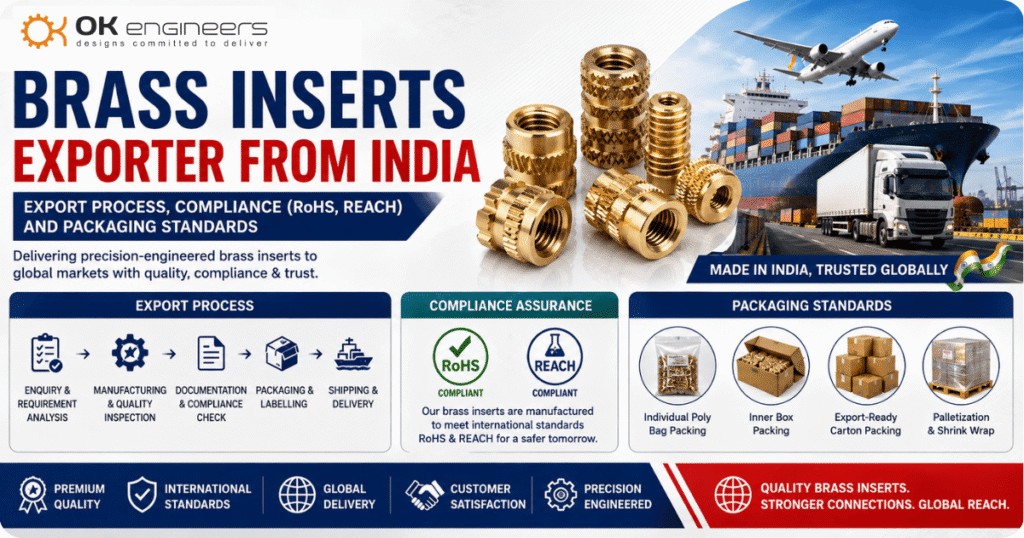
As a brass inserts exporter based in Jamnagar, Gujarat, India, O.K. Engineers has shipped precision brass moulding inserts — CPVC pipe fitting inserts, PPR pipe fitting inserts, UPVC pipe fitting inserts, knurled heat-set inserts, hex inserts, and custom OEM inserts — to customers in the UK, USA, Australia, Germany, France, Spain, Russia, and the UAE for over 60 years. As an ISO 9001:2015 certified, 4th-generation family manufacturing business, we understand that the export process for brass inserts is not just about manufacturing the correct product to specification — it is about delivering the complete documentation package that enables smooth import clearance, customs compliance, and supply chain confidence for buyers in every destination market. This guide covers the complete export process for brass inserts from India: HS code classification, RoHS and REACH compliance documentation, Incoterms selection, packaging standards for ocean and air freight, lead times, and the full documentation checklist that a professional Brass Inserts Exporter should provide with every international shipment.
HS Codes for Brass Inserts: How to Classify Correctly for Export from India
Correct HS (Harmonised System) code classification is the first and most important step in any export transaction. An incorrect HS code on an export invoice or shipping bill causes customs delays, duty miscalculation, and potential penalty. For brass inserts exported from India, the applicable HS codes fall within Chapter 74 (Copper and articles thereof) of the Indian Customs Tariff, mirroring the international HS system under the World Customs Organisation (WCO).
The specific HS code for brass inserts depends on the product type — whether the insert is classified as a fastener (threaded), a pipe fitting component, or a general article of copper. Buyers placing purchase orders with Indian brass inserts exporters should confirm the HS code on the proforma invoice before the order is placed, and verify it with their own country’s customs authority for import classification purposes.
HS Codes for Brass Inserts — India Export Classification (Chapter 74)
| Insert Type | India HSN Code | Description | Destination Country Import Code | GST Rate (India Export) | Notes |
| Threaded Brass Moulding Inserts (knurled, heat-set, hex — with internal metric thread) | 74153390 | Nails, tacks, screws, bolts, nuts, screw hooks, rivets, cotters, cotter-pins, washers and similar articles — other (copper) | UK: CN 7415 33 90 USA: HTS 7415.33.00 AU: HTS 7415.33.00 EU: CN 7415 33 90 | 0% (Export — zero-rated for GST) GST on domestic supply: 18% | Most common HS code for threaded moulding inserts. Confirm product description matches ‘threaded bushing / knurled insert with internal thread’ on shipping invoice. |
| CPVC / PPR / UPVC Pipe Fitting Brass Inserts (unthreaded body, threaded port) | 74199930 | Other articles of copper — other (not elsewhere specified) | UK: CN 7419 99 10/90 USA: HTS 7419.99.50 AU: HTS 7419.99.00 EU: CN 7419 99 | 0% (Export) 18% GST domestic | Pipe fitting inserts without self-contained fastener function are typically classified under 7419 (other copper articles) rather than 7415. Confirm with CHA (Customs House Agent) for each product. |
| Hex / Square Brass Inserts (anti-rotation, high-torque applications) | 74153390 or 74199930 | See above — classification depends on whether insert is primarily a threaded fastener component (7415) or an engineered component (7419) | Same as above — confirm per product | 0% (Export) 18% GST domestic | Request advance ruling from Indian Customs if unsure between 7415 and 7419 — particularly for hex insert-bodies that function as both structural and threaded components. |
| Brass Moulding Inserts for Electrical / Electronic Applications | 85369090 (alternative) or 74153390 | Electrical apparatus for switching / protecting electrical circuits — other (Chapter 85 for electrical-grade components) | UK: CN 8536 90 10/95 USA: HTS 8536.90.40 EU: Chapter 85 | 0% (Export) 18% GST domestic | Brass inserts used as electrical contacts, terminal components, or switchgear parts in electrical equipment may be classified under Chapter 85. Always confirm with CHA when product is used in electrical/electronic assemblies. |
Always work with a licensed Customs House Agent (CHA) to confirm the correct HS code for each specific product before export. HS code classification disputes at destination customs can cause shipment holds and additional duty charges. O.K. Engineers provides the confirmed HS code on every proforma invoice and commercial invoice, and our export team has experience with classification queries from UK (HMRC), USA (CBP), Australian (ABF), and German (Zoll) customs authorities.
RoHS and REACH Compliance for Brass Inserts: What Every International Buyer Needs
RoHS (Restriction of Hazardous Substances) and REACH (Registration, Evaluation, Authorisation and Restriction of Chemicals) compliance are the two most important environmental regulatory requirements for brass inserts exported to the UK, EU, and Australia. Understanding what each directive requires — and what documentation proves compliance — prevents shipment rejection and project delays.
RoHS Compliance for Brass Inserts
The EU RoHS 2 Directive (2011/65/EU, amended by 2015/863/EU) restricts 10 hazardous substances in electrical and electronic equipment (EEE). UK RoHS 2012 (as retained in UK law post-Brexit) applies the same restrictions for UK market products. RoHS restricts lead (Pb) to a maximum of 0.1% by weight in homogeneous materials — with a specific exemption for lead in brass: under Annex III, Exemption 6(c), lead content in brass up to 4% by weight is permitted for electrical and electronic equipment.
This means CW614N free-machining brass (Pb content 2.5–3.5%) is RoHS compliant under Exemption 6(c) for brass inserts used in EEE applications. However, the compliance must be documented — a verbal assurance is not sufficient for UK or EU customs compliance or for OEM product compliance declarations.
What RoHS Documentation to Request from Your Brass Inserts Exporter
- RoHS Declaration of Conformity — must reference EU RoHS 2 Directive (2011/65/EU) or UK RoHS 2012 Statutory Instrument, state the product name and description, list all restricted substances and confirm compliance or applicable exemption (for brass: ‘Pb compliant under Annex III Exemption 6(c) — lead in brass up to 4%’), be signed by an authorised signatory of the exporter, and bear the document date
- Material Test Certificate (MTC) with XRF spectrometer analysis — confirms the actual Pb content falls within the permitted range (typically 2.5–3.5% for CW614N)
- Substance declaration form (IMDS, IPC-1752A, or customer-specific format) — required by automotive OEM buyers and some electronics assemblers for their supply chain substance tracking systems
REACH Compliance for Brass Inserts
REACH Regulation (EC 1907/2006) and UK REACH (retained EU law) require that any article containing a Substance of Very High Concern (SVHC) above 0.1% by weight per article must be disclosed to customers upon request and reported to ECHA (European Chemicals Agency). For brass inserts made from CW614N: lead (Pb) is on the SVHC Candidate List. However, for manufactured brass articles (not the raw alloy), the SVHC disclosure threshold is 0.1% by weight of the article — and for a brass insert where lead is an inherent part of the CW614N alloy composition, the lead content exceeds 0.1% of the article weight.
This means: a REACH SVHC Declaration confirming the presence of lead in the brass insert article, the approximate concentration (2.5–3.5% for CW614N), and the safe use instructions (normal use, no special handling requirements for solid brass components) must be available for UK and EU buyers upon request. At O.K. Engineers, we provide REACH SVHC declarations as standard export documents for all UK and EU shipments.
Complete Export Documentation for Brass Inserts: Market-by-Market Checklist
The documentation package required for brass inserts export varies by destination market. The table below maps every required document to each destination — UK, USA, Australia, EU/Germany, and India domestic supply — so buyers and exporters can confirm documentation completeness before shipment.
Brass Inserts Export Documentation Checklist by Destination Market
| Document | UK | USA | Australia | EU / Germany | India Domestic | Notes |
| Commercial Invoice (proforma + final) | Required | Required | Required | Required | Required | Must show: HS code, product description, quantity, unit price, total value, country of origin (India), Incoterms, buyer and seller details. All values in agreed currency. |
| Packing List (detailed) | Required | Required | Required | Required | Required | Must show: box dimensions, gross and net weights, piece count per box, total cartons, marks and numbers. Customs uses packing list to reconcile physical shipment. |
| Certificate of Origin (COO / Form A / GSP) | Required (UK DCTS Form A) | Required (US GSP Form A) | Required (AUS GSP Form A) | Required (EU GSP Form A) | N/A | India’s GSP (Generalised System of Preferences) with UK (under UK DCTS), USA, Australia, and EU reduces import duty. COO must be issued by EPCH / EEPC / Chamber of Commerce in India. Always request COO — it saves buyer import duty. |
| ISO 9001:2015 Certificate (current, valid) | Required | Required | Required | Required | Recommended | Verify: current, covers manufacturing scope, issued by UKAS-accredited body. Expiry date must be valid at time of shipment. |
| Material Test Certificate (MTC + XRF spectrometer) | Required | Required (ASTM ref.) | Required | Required | Recommended | Shows: alloy grade (CW614N), chemical composition (%), batch number. Must be specific to the production batch being shipped — not a generic product MTC. |
| RoHS Declaration of Conformity | Required (UK RoHS 2012) | State-law dependent — required for California (Prop 65), electronics (FCC) | Required (RCM / ACMA framework) | Required (EU RoHS 2) | For export goods only | Must name the Directive (UK RoHS 2012 SI / EU 2011/65/EU), list all 10 restricted substances, state compliance or exemption (Exemption 6(c) for Pb in brass). Signed and dated by exporter signatory. |
| REACH SVHC Declaration | Required (UK REACH) | TSCA equivalent — confirm with buyer | Required (Industrial Chemicals Act) | Required (EU REACH) | N/A | Discloses presence of SVHC substances (lead in CW614N brass) in the article. Includes: substance name, CAS number, concentration range, safe use instructions. |
| Bill of Lading / Airway Bill | FCL or LCL Ocean / Air | Required | Required | Required | N/A (domestic) | Issued by freight forwarder / shipping line / airline. The B/L is the document of title for sea freight — required for import customs clearance at destination. |
| Shipping Bill (India export customs) | Filed by CHA | Filed by CHA | Filed by CHA | Filed by CHA | N/A | Mandatory India export document filed electronically with Indian Customs via ICEGATE. Required for IGST refund and export benefits (MEIS/RoDTEP). |
| Test Report (dimensional / thread gauge) | For technical buyers | For automotive / OEM | For technical buyers | Required for automotive / OEM | Available | Go/no-go gauge thread verification report. Dimensional inspection report showing key dimensions measured against drawing tolerance. Available on request from O.K. Engineers for all export orders. |
Incoterms for Brass Inserts Export from India: Which Term to Use
Incoterms (International Commercial Terms, ICC 2020) define the responsibilities of buyer and seller for transport, insurance, risk, and cost from origin to destination. Selecting the wrong Incoterm creates unexpected freight costs or risk exposure. The three most common Incoterms for brass inserts export from India are FOB, CIF, and DDP — each with distinct implications for the buyer and seller.
You May Also Read – Brass Inserts for Moulding: Complete Manufacturer Guide — Types, Standards, Applications (2026)
Incoterms Comparison for Brass Inserts Export from India
| Incoterm | Seller’s Responsibility Ends | Buyer’s Responsibility Begins | Who Pays Ocean Freight | Who Pays Import Duty | Who Arranges Insurance | Best For |
| EXW (Ex Works — Jamnagar factory) | When goods are ready at OK Engineers’ Jamnagar factory | Immediately — buyer arranges all inland transport, export customs, ocean freight, import customs | Buyer | Buyer | Buyer | Buyers with own freight forwarder who want full cost control and have India-based logistics support |
| FOB (Free On Board — Mundra / Kandla Port) | When goods are loaded onto the vessel at Mundra or Kandla port, India | After loading on vessel — buyer arranges ocean freight, insurance, import customs | Buyer | Buyer | Buyer (buyer’s responsibility from FOB point) | Most common term for experienced B2B importers in UK, USA, Australia who have established freight forwarders and want cost control over ocean leg |
| CIF (Cost, Insurance, Freight — destination port) | At destination port | At destination port — buyer arranges import customs clearance and inland delivery | Seller (included in price) | Buyer | Seller (minimum cover only — buyer should supplement) | Buyers new to India sourcing who want a single delivered-to-port price. Good for first orders. |
| CIP (Carriage and Insurance Paid — destination) | At first carrier in India | At named destination | Seller | Buyer | Seller (comprehensive cover required under Incoterms 2020) | Similar to CIF but with enhanced insurance obligation on seller — preferred for high-value shipments |
| DDP (Delivered Duty Paid — buyer’s premises) | At buyer’s named premises / warehouse | After delivery — buyer handles unloading only | Seller | Seller (seller pays import duty — included in price) | Buyer | Buyers who want a single all-inclusive delivered price with no import complexity. Seller bears maximum responsibility. Price will be higher to reflect duty and import costs. |
For most brass inserts export orders from India to the UK, USA, and Australia, FOB Mundra or FOB Kandla is the most practical and cost-transparent Incoterm. It gives the buyer cost control over the ocean freight leg (which is the largest single logistics cost), while the seller (O.K. Engineers) manages inland transport from Jamnagar to port and India export customs clearance. CIF is practical for first-time buyers who want a simple all-in price for their initial order evaluation.
Packaging Standards for Brass Inserts Export: Ocean Freight and Air Freight
Correct packaging for brass inserts export is critical — both to protect the product from damage and corrosion during a 15–30 day ocean voyage, and to comply with destination customs packaging requirements (particularly ISPM-15 for any wood packaging materials). Poor packaging of brass inserts causes surface tarnishing, thread damage, and coating loss that results in customer rejections and replacement shipment costs.
Standard Packaging for Brass Inserts — O.K. Engineers Export Specification
- Primary packaging: individual polybag (PE bag, 50–100 micron) per insert for high-value or plated inserts; or bulk polybag per count (e.g. 1,000 pieces per polybag) for natural finish standard inserts
- Secondary packaging: anti-rust poly-lined cardboard box or kraft paper box with VCI (Vapour Corrosion Inhibitor) paper lining inside the box — VCI paper releases a corrosion-inhibiting vapour that protects brass surfaces during ocean transit
- Tertiary packaging: outer export carton (double-wall corrugated cardboard, minimum 5-ply for ocean freight) with printed marks and numbers matching the packing list: buyer name, PO number, product code, quantity, gross weight, net weight, country of origin
- Wooden crate / pallet: for heavy consignments exceeding 100 kg net weight, goods are palletised on heat-treated wooden pallets compliant with ISPM-15 (International Standards for Phytosanitary Measures No. 15) — mandatory for wood packaging entering the UK, EU, USA, and Australia
Packaging Selection by Insert Type and Order Size
| Insert Type | Primary Pack | Secondary Pack | Carton Size (Typical) | Pieces per Carton (M4 example) | ISPM-15 Required? |
| Natural brass knurled inserts (M2–M6) | Bulk polybag 500–1,000 pcs/bag | Cardboard box + VCI paper lining | 30×20×15 cm | 5,000–10,000 pcs | No (cardboard only) |
| Nickel-plated inserts (M2–M10) | Individual polybag or 50 pcs/polybag | Anti-rust cardboard box + VCI paper | 30×20×15 cm | 2,000–5,000 pcs | No (cardboard only) |
| CPVC / PPR pipe fitting inserts (½”–2″) | Polybag per 100 pcs (by size) | Cardboard box + VCI paper | 40×30×20 cm | 500–2,000 pcs (by size) | No (cardboard only) |
| Heavy gauge inserts (M10–M20) | Polybag per 50 pcs | Strong double-wall cardboard box | 40×40×30 cm | 200–500 pcs (by size) | No (cardboard only) |
| Large consignment >100 kg total | Per above by insert type | Per above | Export carton + ISPM-15 heat-treated pallet | Full pallet as agreed | ✅ Yes — ISPM-15 required for UK, USA, AU, EU |
Lead Time, Port of Export, and Shipping Transit Times for Brass Inserts from India
Buyers sourcing brass inserts from India for the first time need realistic expectations on lead time from order placement to delivery at their facility. The total lead time has three components: production lead time, port clearance and vessel loading time, and ocean transit time.
O.K. Engineers — Brass Inserts Export Lead Time and Logistics Reference
- Production lead time — standard catalogue products (M2–M20 knurled, heat-set, CPVC/PPR/UPVC inserts in natural or nickel-plated): 15–20 working days from order confirmation and advance payment receipt
- Production lead time — custom inserts to customer drawing or sample: 25–30 working days from drawing approval + advance payment
- Port of export — Mundra Port (INMUN), Gujarat: India’s largest container port, 150 km from Jamnagar. Regular weekly sailings to UK (Felixstowe/Southampton), USA (Houston/Los Angeles/New York), Australia (Melbourne/Sydney), and all EU ports
- Port of export (alternative) — Kandla Port (INKLA), 60 km from Jamnagar. Suitable for bulk or project cargo
- Ocean transit to UK — Mundra to Felixstowe: 18–22 days (direct); 22–28 days (transshipment via Jebel Ali or Port Said)
- Ocean transit to USA — Mundra to Houston: 22–28 days; Mundra to Los Angeles: 18–22 days
- Ocean transit to Australia — Mundra to Melbourne: 18–22 days; Mundra to Sydney: 20–25 days
- Air freight — available for urgent orders; transit 2–4 days to UK/USA/Australia/EU; significant cost premium; practical for small quantities (under 50 kg) or urgent samples
Total typical delivery time (FOB Mundra, ocean freight): 35–50 days from order confirmation to delivery at buyer’s facility for standard-size production orders. For first-time sample orders, 25–35 days total including production + shipping.
At O.K. Engineers, we work with established freight forwarding partners at Mundra and Kandla ports who provide container booking, shipping bill filing, and B/L documentation as part of our standard export service. We provide track-and-trace updates at key milestones: production start, production completion, port delivery, vessel loading, B/L issue, and ETA at destination port.
O.K. Engineers as Your Brass Inserts Exporter from India: Key Credentials
O.K. Engineers is a 4th-generation, ISO 9001:2015 certified brass inserts manufacturer and exporter based in Jamnagar, Gujarat, India — established over 60 years ago, with an active export track record to the UK, USA, Australia, Germany, France, Spain, Russia, UAE, and globally. We are a DGFT-registered exporter with an Import Export (IE) Code, and our export team handles the complete documentation package for every international shipment.
- Export registrations: DGFT IE Code, GSTIN, MSME registered, Chamber of Commerce member (for COO issuance)
- Quality system: ISO 9001:2015 certified, CNC ±0.05mm tolerances, 100% go/no-go gauge thread inspection
- Compliance documentation: RoHS DoC, REACH SVHC Declaration, MTC + XRF spectrometer report, COO — standard with every export shipment
- Insert range: CPVC/PPR/UPVC mould-in inserts (½” to 3″), knurled/heat-set/ultrasonic inserts (M2–M20), hex inserts, custom OEM inserts — 2,000+ variants
- MOQ: 1,000 pcs standard; 500 pcs custom; samples from 50 pcs
- Payment terms: 30–50% advance + balance against B/L copy; LC acceptable for orders above USD 10,000
For the complete guide to all brass insert types we manufacture, visit our Brass Inserts for Moulding: Complete Manufacturer Guide. For the broader export guide covering all brass components we export from India, see our Exporters of Brass Components from India: Complete Buyer Guide.
Conclusion
Sourcing brass inserts from India offers a compelling combination of manufacturing capability, product range, competitive pricing, and export logistics infrastructure — particularly from the Jamnagar hub, where the concentration of precision brass manufacturers, raw material suppliers, plating facilities, and export ports creates an ecosystem that is difficult to match globally. But the quality of the export experience — from correct HS code classification to RoHS/REACH compliance documentation, from Incoterms clarity to VCI-protected packaging — depends entirely on the professionalism and export experience of the specific brass inserts exporter you choose.
O.K. Engineers is a 4th-generation, ISO 9001:2015 certified brass inserts manufacturer and exporter with over 60 years of manufacturing experience in Jamnagar, Gujarat, India. We export CPVC, PPR, and UPVC pipe fitting inserts, knurled and heat-set moulding inserts, hex inserts, and custom OEM inserts to customers in the UK, USA, Australia, Germany, France, Spain, Russia, UAE, and globally — providing the complete documentation package (RoHS DoC, REACH declaration, MTC, COO, packing list) with every shipment, and supporting buyers through HS code confirmation, Incoterms selection, and import compliance at their destination.
Frequently Asked Questions
Q 1: What HS code should I use for importing brass inserts from India?
For most brass moulding inserts (knurled, heat-set, threaded inserts with internal metric thread), the applicable HS code is 7415.33 under the international Harmonised System — covering ‘screws, bolts, nuts and similar threaded articles of copper.’ In India, the corresponding HSN code is 74153390. For CPVC, PPR, and UPVC pipe fitting brass inserts that function primarily as pipe system components rather than fasteners, the applicable code may be 7419.99 (other articles of copper) — HSN 74199930 in India. Always confirm the correct import classification with your country’s customs authority (HMRC in the UK, CBP in the USA, ABF in Australia) as the 10-digit destination code may differ from the Indian export HSN code.
Q 2: Are brass inserts from India RoHS compliant?
Yes — brass inserts manufactured from CW614N (CuZn39Pb3) free-machining brass are RoHS compliant under EU RoHS 2 Directive (2011/65/EU) and UK RoHS 2012 Regulations, through the application of Annex III Exemption 6(c), which permits lead content in brass alloys up to 4% by weight for electrical and electronic equipment applications. CW614N brass typically contains 2.5–3.5% lead — within the exemption threshold. A reputable brass inserts exporter will provide a signed RoHS Declaration of Conformity naming this exemption as standard documentation. At O.K. Engineers, RoHS DoC and REACH SVHC declarations are provided with every export shipment to the UK, EU, and Australia.
Q 3: What is the standard Incoterm for buying brass inserts from India?
The most common Incoterm for brass inserts export from India is FOB (Free On Board) — FOB Mundra Port or FOB Kandla Port. Under FOB, the Indian exporter delivers the goods onto the vessel at the named Indian port, and the buyer assumes risk and cost from that point — arranging ocean freight, marine insurance, and import customs clearance at the destination. FOB gives the buyer maximum transparency on landed cost because they can obtain their own competitive freight quotes. For buyers new to India sourcing, CIF (Cost, Insurance, Freight) is also practical as it provides a single all-inclusive price to the destination port — though the buyer still handles import customs clearance and inland delivery.
Q 4: What is the typical lead time for brass inserts export from India?
The typical total lead time for brass inserts export from India — from order confirmation to delivery at the buyer’s facility — is 35–50 days for standard ocean freight shipments: 15–20 working days production for standard catalogue products, plus 18–25 days ocean transit to the UK, USA, or Australia from Mundra Port. For custom inserts manufactured to customer drawings, production adds 25–30 working days, giving a total lead time of 45–60 days for custom products. Air freight is available for urgent requirements (2–4 day transit), reducing total lead time to 20–35 days, but at significantly higher freight cost — practical for small quantities or urgent sample approvals.
Q 5: What export documents does a brass inserts exporter from India provide?
A professional brass inserts exporter from India should provide the following standard documentation package with every international shipment: commercial invoice (with HS code, product description, quantity, value, Incoterms, COO), packing list, Certificate of Origin (Form A / GSP certificate for tariff preference in UK, USA, Australia, EU), ISO 9001:2015 certificate (current, verified), Material Test Certificate with XRF spectrometer alloy analysis, RoHS Declaration of Conformity (for UK, EU, Australia), REACH SVHC Declaration (for UK, EU), Bill of Lading or Airway Bill, and Shipping Bill (India export customs document). For buyers requiring additional documentation — IMDS substance declarations, third-party inspection certificates, IATF-aligned quality records — these should be specified in the purchase order. At O.K. Engineers, all standard export documents are provided as part of our shipment process at no additional cost.