


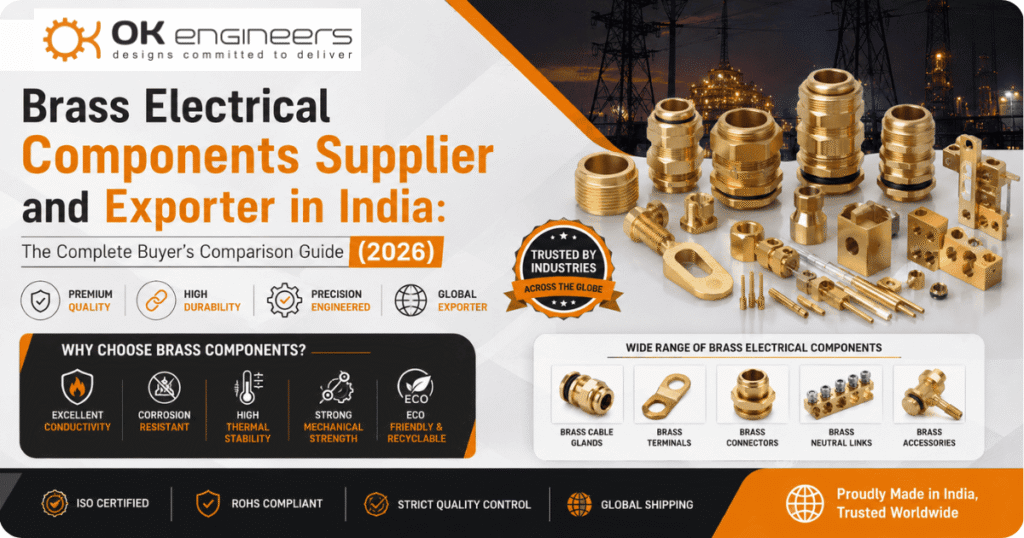
If you procure electrical hardware for panels, switchgear, connectors, or wiring accessories, choosing the right brass electrical components supplier decides whether your production line runs smoothly or stalls at customs and quality checks. India has become the world’s go-to sourcing hub for brass electrical parts, and this guide compares the top brass electrical components exporters so you can shortlist confidently. We also break down what separates a dependable brass electrical components partner from a risky one — covering conductivity standards, certifications, MOQs, lead times, and landed cost. By the end, you’ll know exactly what to check before signing a purchase order, and why OK Engineers, based in Jamnagar, Gujarat, is a strong option for buyers evaluating brass electrical components in India.
Table of Contents
- Why Brass Is the Preferred Metal for Electrical Components
- Brass Electrical Components: Product Range Explained
- India’s Brass Manufacturing Hub — Why Jamnagar Leads
- Competitor Comparison: Top Brass Electrical Components Suppliers in India
- Brass Electrical Components Supplier vs. Exporter — Key Differences
- How to Evaluate a Brass Electrical Components Exporter (Checklist)
- Brass Alloy Grades Used in Electrical Components
- Applications Across Industries
- Why OK Engineers Stands Out
- Cost Factors & MOQ Comparison
- FAQs
- Final Takeaway
Why Brass Is the Preferred Metal for Electrical Components
Brass is an alloy of copper and zinc, and it remains the material of choice for brass electrical parts because it balances electrical conductivity with mechanical strength, machinability, and corrosion resistance. Unlike pure copper, which is softer and costlier to machine, brass holds precise tolerances during CNC turning while still delivering excellent current flow. This is why a brass electrical components manufacturer can produce intricate connector pins, terminal blocks, and switchgear parts at scale without compromising long-term reliability.
Key material properties that matter to buyers:
- High electrical conductivity – efficient current transfer with minimal energy loss
- Corrosion and oxidation resistance – suited for humid, coastal, and industrial environments
- Excellent machinability – enables tight tolerances (±0.01–0.05 mm) on turned parts
- Thermal stability – performs reliably under repeated heating and cooling cycles
- Aesthetic finish – natural, nickel, or tin-plated finishes for visible fittings
Brass Electrical Components: Product Range Explained
A full-range brass electrical components supplier typically manufactures:
- Brass connectors and terminal blocks
- Brass cable glands (single/double compression, weatherproof)
- Brass switchgear and panel-board parts
- Brass neutral links and busbar fittings
- Brass pins, sockets, and plug components
- Brass contacts for relays, switches, and circuit breakers
- Custom-machined brass electronic components to drawing/sample
Buyers searching for a brass electrical components exporter usually need several of these categories bundled into a single consolidated shipment — which is why suppliers with a wide catalog and in-house tooling reduce sourcing complexity versus working with multiple single-product vendors.
India’s Brass Manufacturing Hub — Why Jamnagar Leads
Jamnagar, Gujarat, is widely referred to as “India’s Brass City” or the “Manchester of the Brass Industry,” producing a significant share of India’s brass parts exports. The region’s ecosystem of foundries, CNC job-work units, plating houses, and packing/logistics vendors means a brass electrical components in India order can move from raw billet to export-ready carton within a tightly integrated supply chain — shortening lead times compared to fragmented sourcing from scattered locations.
This concentration is precisely why most credible brass electrical components suppliers — including OK Engineers, GK Metals, Hindustan Brass Industries, Ghanshyam Industries, and Ravi Brass — operate out of Jamnagar or its GIDC industrial belt.
Top Brass Electrical Components Suppliers in India
Below is a comparison of established players buyers typically evaluate when shortlisting a brass electrical components exporter.
Certification & Quality Benchmark Comparison
| Criteria | Industry Best Practice | Why It Matters |
|---|---|---|
| ISO 9001 Certification | Mandatory for serious B2B buyers | Confirms documented quality management |
| RoHS Compliance | Required for EU/global electronics buyers | Ensures no restricted hazardous substances |
| Material Test Certificate (MTC) | Recommended per batch | Verifies alloy composition matches spec |
| In-house CNC & inspection | Preferred over outsourced job work | Reduces tolerance deviation and delays |
| Sample approval process | Standard before bulk PO | Prevents costly rework on full orders |
Brass Electrical Components Supplier vs. Exporter — Key Differences
Buyers often use “supplier” and “exporter” interchangeably, but the distinction affects your sourcing decision:
- A brass electrical components supplier may serve domestic and/or international clients, sometimes through distributors.
- A brass electrical components exporter has direct customs/export documentation experience — IEC code, export packing standards, container/LCL shipping, and Incoterms (FOB, CIF, DDP) handling.
For international procurement, always confirm the vendor is a direct exporter, not a trading intermediary reselling another manufacturer’s stock. Direct exporters typically offer better pricing transparency, faster issue resolution, and tighter quality control since production and export documentation sit under one roof.
How to Evaluate a Brass Electrical Components Exporter
Before finalizing any brass electrical components in India order, run through this checklist:
- Factory audit or virtual tour — confirm actual manufacturing capability, not just trading.
- Sample testing — check conductivity, dimensional tolerance, and finish.
- Certifications — ISO 9001, RoHS, and material test certificates.
- MOQ flexibility — especially important for new product trials.
- Lead time transparency — get committed timelines in writing.
- Export documentation experience — IEC, packing list, HS code accuracy.
- Communication responsiveness — a strong signal of post-sale support quality.
- References or past export markets — Middle East, Europe, Africa, or Asia experience adds confidence.
Brass Alloy Grades Used in Electrical Components
Different applications call for different brass grades. A knowledgeable brass electrical components manufacturer will recommend the right alloy rather than a one-size-fits-all approach:
- CuZn39Pb3 (Free-cutting brass) – ideal for high-speed CNC turning of pins and connectors
- CuZn36 / CuZn37 – balanced conductivity and formability for terminals
- Leaded brass (higher Pb%) – improved machinability for intricate switchgear parts
- Nickel/tin-plated brass – added corrosion resistance for humid or coastal deployment
Applications Across Industries
Brass electrical components are deployed across:
- Power distribution — switchgear, connectors, busbar terminals
- Electronics — circuit board connectors, switch contacts
- Automotive — wiring harness fittings, battery terminals
- Telecommunications — corrosion-resistant network hardware
- Renewable energy — solar inverter and wind-system connectors
- Building electrical — panel boards, cable glands, junction box accessories
You May Also Read – India vs China Brass Components: Quality, Price, and Why Global Buyers Are Switching to Indian Manufacturers
Why OK Engineers Stands Out
Among the brass electrical components suppliers compared above, OK Engineers (Jamnagar, Gujarat) is positioned as a manufacturer-exporter rather than a reseller — meaning production, quality control, and export documentation happen under one roof. Key strengths that matter for MOFU buyers comparing vendors:
- Direct manufacturer-exporter status — no intermediary markup, faster clarifications on drawings and tolerances.
- CNC precision turning for tight-tolerance connectors, pins, terminals, and cable glands.
- Custom machining to drawing or sample, useful for OEM buyers with proprietary specifications.
- Jamnagar-based production ecosystem, enabling shorter lead times and consolidated shipments across multiple brass part categories.
- Export experience with global OEM and industrial buyers, reducing documentation risk for first-time importers.
If you’re comparing suppliers side-by-side, requesting a sample batch and a written quote from OK Engineers is a practical way to benchmark pricing, tolerance accuracy, and responsiveness against the other names in Table 1 before committing to a bulk purchase order. OK Engineers’ Brass Electrical Components to view their current catalog and request a quote.
Cost Factors & MOQ Comparison
Landed cost for brass electrical components in India depends on more than per-piece price. Compare these factors across shortlisted vendors:
Cost & MOQ Comparison Factors
| Cost Factor | Impact on Total Landed Price |
|---|---|
| Raw brass alloy grade | Higher-grade/leaded brass costs more but machines faster |
| Plating/finish (nickel, tin, natural) | Adds 5–15% depending on finish complexity |
| Tooling/customization | One-time cost for custom dies or CNC programs |
| MOQ tier | Lower per-unit price at higher order volumes |
| Packaging (export-grade vs. standard) | Export-grade adds marginal cost but reduces damage risk |
| Freight (FOB vs. CIF vs. DDP) | Determines who bears shipping/insurance cost |
| Payment terms (LC/TT/advance) | Can affect quoted pricing and delivery priority |
Tip: Always request a like-for-like quote (same alloy grade, finish, and MOQ) from at least three shortlisted suppliers — including OK Engineers — before comparing final pricing. This avoids misleading comparisons where a “cheaper” quote actually reflects a lower-grade alloy or reduced finish quality.
Conclusion
Sourcing brass electrical components from India means choosing between dozens of suppliers clustered mainly around Jamnagar, Gujarat — but not all of them offer the same certification rigor, customization ability, or direct export experience. When comparing a brass electrical components supplier, a brass electrical components exporter, and manufacturers of brass electrical components in India side-by-side, prioritize verified certifications, sample testing, and transparent MOQ/pricing over the lowest quoted number alone.
For buyers ready to move from comparison to action, OK Engineers offers direct manufacturer-exporter status, CNC precision machining, and custom production to drawing or sample — making it a practical next step to request a quote and sample batch as you finalize your vendor shortlist. Explore OK Engineers’ full brass electrical components range or view their top brass electrical components guide to compare specifications before you order.
Frequently Asked Questions
1. What are brass electrical components used for?
They’re used in connectors, terminals, switchgear, cable glands, and panel-board fittings across power distribution, electronics, automotive, and telecom industries, thanks to brass’s conductivity and corrosion resistance.
2. Who is the best brass electrical components supplier in India?
Several established manufacturers operate from Jamnagar, Gujarat, including OK Engineers, GK Metals, and Empire Alloys. The “best” choice depends on your specific part range, certification needs, and MOQ — always compare quotes and samples before deciding.
3. What is the difference between a brass electrical components supplier and exporter?
A supplier may serve domestic or international clients, sometimes via distributors. An exporter directly handles customs documentation, IEC codes, and international shipping — offering more transparency and control for overseas buyers.
4. Why is Jamnagar known for brass electrical components manufacturing?
Jamnagar hosts a dense ecosystem of brass foundries, CNC job-work units, and plating facilities, making it India’s largest brass component manufacturing hub, often called the “Manchester of the Brass Industry.”
5. What certifications should a brass electrical components exporter have?
Look for ISO 9001 (quality management), RoHS compliance (restricted hazardous substances), and material test certificates (MTC) confirming alloy composition per batch.
6. What is the typical MOQ for brass electrical components?
MOQs vary by supplier and part complexity — some manufacturers, including OK Engineers, offer flexible MOQs depending on customization level, while others set higher minimums for standard catalog items.
7. Which brass alloy is best for electrical connectors?
Free-cutting brass (CuZn39Pb3) is commonly preferred for CNC-turned connectors and pins due to its excellent machinability combined with strong conductivity.
8. How do I verify a brass electrical components exporter is genuine?
Request a factory audit or virtual tour, ask for ISO/RoHS certificates, verify IEC registration, and order a sample batch before placing a bulk purchase order.
9. Can brass electrical components be custom manufactured to drawing?
Yes. Most established manufacturers, including OK Engineers, accept custom specifications via CAD, PDF, DWG, IGS, or STEP files and machined samples for approval before bulk production.
10. What industries use brass electrical components the most?
Power distribution, electronics, automotive wiring, telecommunications, renewable energy, and building/panel-board electrical installations are the top consuming industries.