


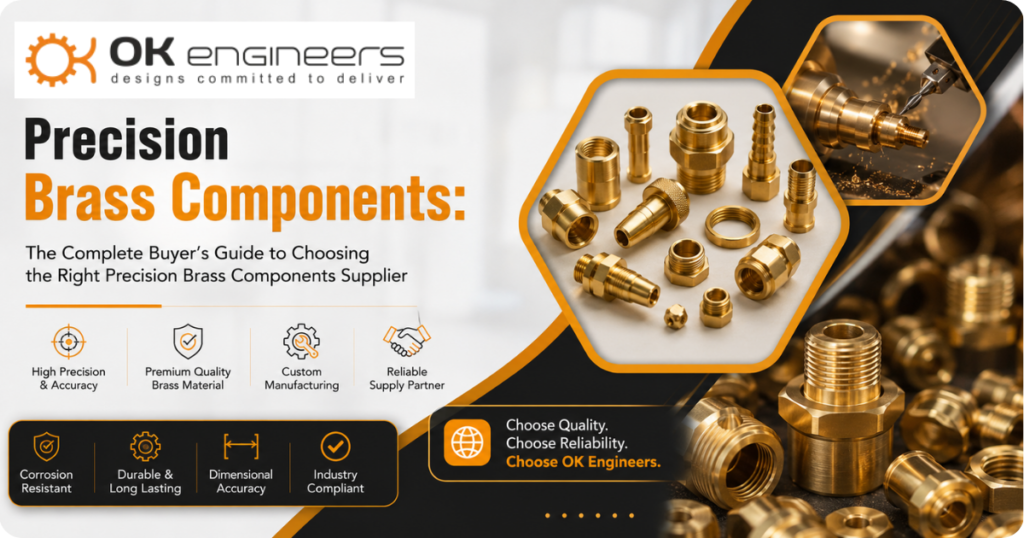
Every industry that depends on tight tolerances, corrosion resistance, and long-term reliability eventually runs into the same question: where do you find precision brass components that won’t let your production line down? Whether you’re an OEM procurement manager, a design engineer, or a purchase head sourcing for plumbing, electrical, automotive, or industrial equipment, the part you choose today decides how your assembly performs for years. That’s exactly why finding a dependable precision brass components supplier matters as much as the specification sheet itself.
Brass has earned its place as one of the most trusted engineering metals because it strikes a rare balance — excellent machinability, natural corrosion resistance, strong electrical conductivity, and a finish that holds up in demanding environments. But not every manufacturer can turn that raw potential into consistent, high-tolerance parts at scale. This guide breaks down everything you need to know about precision brass components, how they’re made, where they’re used, and how to evaluate a supplier before you place your next order.
What Are Precision Brass Components?
Precision brass components are parts machined from brass alloys — typically a copper-zinc blend — using CNC turning, milling, or multi-spindle screw machines to achieve exact dimensional accuracy. Unlike standard cast or forged brass parts, precision components are engineered to hold tight tolerances, often within a few microns, so they fit, seal, and function exactly as designed, batch after batch.
These components are used wherever engineers need a metal that machines cleanly, resists rust and corrosion, conducts electricity well, and looks good doing it. That combination has made brass a staple in:
- Plumbing and sanitary fittings
- Electrical and electronic connectors
- Automotive fuel and hydraulic systems
- Industrial couplings, valves, and inserts
- Instrumentation and measuring equipment
- Marine and outdoor hardware
Why Brass Is the Preferred Material for Precision Machining
Before choosing a supplier, it helps to understand why brass keeps winning over alternatives like steel, aluminium, or plastic for precision applications.
1. Outstanding Machinability
Brass cuts cleanly and quickly on CNC lathes and multi-spindle machines, which means tighter tolerances, better surface finish, and lower tooling wear compared to harder metals.
2. Natural Corrosion Resistance
Brass resists rust, oxidation, and most forms of chemical corrosion, making it ideal for plumbing, marine, and outdoor applications where steel would fail over time.
3. Excellent Electrical Conductivity
Because of its copper content, brass conducts electricity efficiently, which is why it’s the go-to material for terminals, connectors, and electrical fittings.
4. Durability Under Pressure
Precision brass parts hold up under repeated thermal cycling, mechanical stress, and pressure — a key reason they’re trusted in hydraulic and pneumatic systems.
5. Aesthetic and Functional Finish
Brass takes plating and polishing exceptionally well (nickel, chrome, tin, zinc), giving manufacturers flexibility for both functional coatings and visual appeal.
Common Types of Precision Brass Components
| Component Category | Typical Applications | Key Requirement |
|---|---|---|
| Brass Turned Parts | Bushes, sleeves, spacers, pins | Dimensional accuracy, surface finish |
| Brass Inserts | Plastic moulding, furniture, electronics | Thread precision, knurling quality |
| Brass Fittings & Couplings | Plumbing, hose, pneumatic lines | Leak-proof sealing, thread standards |
| Brass Electrical Components | Terminals, connectors, neutral links | Conductivity, contact reliability |
| Brass Fasteners | Nuts, bolts, screws, studs | Load-bearing strength, thread accuracy |
| Brass Valve Parts | Stems, bodies, seats | Pressure rating, corrosion resistance |
How Precision Brass Components Are Manufactured
Understanding the manufacturing journey helps you ask the right questions when evaluating a supplier. A typical production flow looks like this:
- Material Selection — Choosing the right brass grade (C36000, C37700, C26800, CW614N, and similar alloys) based on the application’s strength, machinability, and corrosion-resistance needs.
- CNC Turning and Milling — Using automatic lathes, Swiss-type machines, or multi-spindle screw machines to shape the raw brass rod into the final geometry.
- Threading and Secondary Operations — Adding threads, knurling, drilling, or slotting as per the drawing.
- Surface Finishing — Polishing, nickel plating, tin plating, zinc plating, or anodizing based on the end-use environment.
- Quality Inspection — Dimensional checks using CMM, go/no-go gauges, and visual inspection against the approved sample or drawing.
- Packaging and Dispatch — Component-specific packaging to prevent damage or corrosion during transit, especially for export orders.
Industries That Depend on Precision Brass Components
Brass components quietly power a surprising number of industries. Here’s where they show up most often:
- Plumbing and Sanitary Ware — taps, valves, connectors, and fittings that need to be leak-proof for decades
- Automotive — fuel system connectors, sensor housings, and hydraulic fittings that must survive vibration and heat
- Electrical and Electronics — terminals, neutral links, and connectors where conductivity and contact reliability are non-negotiable
- Industrial Machinery — bushings, inserts, and couplings that keep moving assemblies running smoothly
- Furniture and Moulding — threaded inserts that give plastic and wood components a durable metal thread
- Instrumentation — precision housings and fittings for measuring and control equipment
Key Factors to Evaluate Before Choosing a Precision Brass Components Supplier
Sourcing brass parts isn’t just about price. A wrong choice can mean rejected batches, delivery delays, or field failures. Here’s what experienced buyers check before finalizing a supplier.
Manufacturing Capability
Does the supplier operate CNC lathes, Swiss-type machines, and multi-spindle screw machines capable of handling your volume and tolerance requirements? High-volume orders need multi-spindle capacity; complex geometries need CNC flexibility.
Quality Certifications
Look for ISO 9001:2015 certification at minimum. It signals a documented, repeatable quality management system rather than ad-hoc production.
Material Traceability
A reliable supplier should be able to confirm the exact brass grade used — whether it’s C36000, C37700, CW614N, or a custom alloy — and provide material test certificates when required.
Tolerance and Inspection Standards
Ask how tolerances are verified — CMM reports, go/no-go gauges, or micrometer checks — and whether inspection data is shared with every batch.
Customization Flexibility
Every application is different. A good supplier should accommodate custom dimensions, threading standards (BSP, NPT, metric, UNC/UNF), and finishing options without treating your order as an afterthought.
Export and Compliance Experience
If you’re sourcing internationally, check the supplier’s track record with export documentation, packaging for long transit, and compliance with regional standards (RoHS, REACH, lead-free requirements).
Communication and Turnaround
Delays in quoting, sampling, or production updates often predict delays in delivery. Suppliers who communicate clearly during the RFQ stage tend to be more reliable partners overall.
A Practical Sourcing Checklist
Use this quick checklist the next time you’re shortlisting a precision brass components supplier:
- Verified ISO 9001:2015 certification
- Confirmed brass grade and material certificate availability
- Sample part or first-article inspection report provided
- Clear tolerance and finishing capability documented
- Realistic lead time committed in writing
- Export packaging and shipping experience confirmed
- Transparent quoting process with no hidden revisions
Why Manufacturers Choose O.K. Engineers for Precision Brass Components
Among the manufacturers supplying precision brass components to global industries, O.K. Engineers has built a reputation around one simple principle: a component is only as good as its weakest tolerance. Based in Jamnagar — India’s long-established hub for brass manufacturing — O.K. Engineers combines decades of metallurgical know-how with modern CNC machining to deliver parts that hold up under real-world conditions, not just on paper.
Here’s what sets OK Engineers apart as a precision brass components supplier:
- End-to-end CNC machining capability, producing brass fittings, connectors, inserts, and custom-designed components to exact drawings or samples
- Strict quality control at every stage, from raw material selection to final dimensional inspection, aligned with international quality standards
- Wide alloy and grade flexibility, working with standard and custom brass compositions to match specific mechanical and electrical requirements
- Established export experience, supplying precision turned brass parts to customers across Spain, Germany, the USA, France, and other international markets
- Custom finishing options, including plating, threading, and surface treatments tailored to the end application
- Reliable turnaround, built around understanding that even a small imperfection in a precision turned component can lead to costly downstream failures
For buyers specifically looking for precision brass components, O.K. Engineers offers a dedicated line of turned parts manufactured on advanced CNC and multi-spindle machines, engineered for dimensional accuracy, superior surface finish, and consistent repeatability across production runs — whether the order is a few hundred pieces or a continuous bulk supply contract.
If your business needs a brass components partner that treats precision as a standard rather than an upsell, O.K. Engineers is worth adding to your supplier evaluation list.
Precision Brass vs. Alternative Materials
| Property | Brass | Steel | Aluminium |
|---|---|---|---|
| Machinability | Excellent | Moderate | Good |
| Corrosion Resistance | High | Low (without coating) | Moderate |
| Electrical Conductivity | High | Low | Moderate |
| Weight | Medium | Heavy | Light |
| Cost-Effectiveness for Precision Parts | High | Moderate | Moderate |
| Best Suited For | Plumbing, electrical, fittings | Structural, heavy load parts | Lightweight housings |
Common Mistakes Buyers Make When Sourcing Brass Components
Even experienced procurement teams fall into a few recurring traps:
- Choosing on price alone — the cheapest quote often hides thinner quality control or inconsistent batch tolerances.
- Skipping the sample stage — approving a full production run without a verified first-article sample invites costly rejections later.
- Ignoring material certificates — without documented alloy composition, you can’t verify corrosion resistance or mechanical strength claims.
- Underestimating lead time realism — unrealistically fast quoted timelines are a common red flag for missed deliveries.
- Not clarifying finishing specifications upfront — plating type and thickness affect both function and cost, and should be locked in before production starts.
You May Also Read – Brass Electrical Components Supplier and Exporter in India: The Complete Buyer’s Comparison Guide (2026)
Surface Finishing Options for Precision Brass Components
The finish applied to a brass component isn’t just cosmetic — it directly affects corrosion resistance, conductivity, and how well the part performs in its intended environment. Here are the most common finishing options buyers should discuss with their supplier:
| Finish Type | Primary Benefit | Common Use Case |
|---|---|---|
| Natural/Polished | Cost-effective, good conductivity | General fittings, decorative hardware |
| Nickel Plating | Enhanced corrosion resistance, bright finish | Plumbing fittings, electrical connectors |
| Tin Plating | Solderability, corrosion protection | Electrical terminals, connectors |
| Zinc Plating | Budget-friendly corrosion barrier | Fasteners, general hardware |
| Chrome Plating | High-end appearance, wear resistance | Sanitary ware, visible fittings |
| Passivation/Anodizing | Additional surface protection | Marine and outdoor applications |
Choosing the right finish upfront avoids costly rework later, especially for export orders where the component may sit in transit or storage for weeks before installation.
Standard Threading and Dimensional Standards Used in Brass Components
Because precision brass components are used across global supply chains, suppliers need to work comfortably across multiple threading and dimensional standards, including:
- ISO Metric threads for European and Asian markets
- BSP/BSPT (British Standard Pipe) for plumbing and hydraulic fittings
- NPT/NPTF (National Pipe Thread) for the North American market
- UNC/UNF for general fastener applications
- ACME and BA threads for specialized industrial equipment
A supplier who can switch between these standards without re-engineering the entire production setup saves buyers significant time when serving multiple regions from a single sourcing partner.
The Role of Quality Control in Precision Brass Manufacturing
Precision is only as reliable as the inspection process behind it. Serious manufacturers build quality checks into every stage of production rather than relying on a single final inspection:
- Incoming material inspection — verifying brass rod composition and dimensions before machining begins
- In-process checks — monitoring the first few pieces of every batch to catch tooling drift early
- Dimensional inspection — using CMM machines, go/no-go gauges, and micrometers to confirm tolerances
- Visual and surface inspection — checking for burrs, tool marks, or finish inconsistencies
- Final batch sampling — statistically verifying a representative sample before packaging and dispatch
This layered approach is what separates a supplier who occasionally ships good parts from one who consistently ships good parts, batch after batch, year after year.
Benefits of Partnering with a Long-Term Precision Brass Supplier
Many buyers treat brass sourcing as a one-time transaction, but the real value shows up when you build a long-term relationship with a capable manufacturer:
- Consistency across repeat orders — the same tooling, process, and quality benchmarks every time
- Faster turnaround on reorders — no re-engineering or re-sampling needed once a part is approved
- Better pricing on volume commitments — long-term partners often unlock better rates than one-off orders
- Proactive engineering support — an experienced supplier can flag design issues before they become costly production problems
- Supply chain resilience — a trusted partner is more likely to prioritize your orders during high-demand periods
How to Place a Precision Brass Component Order
For buyers new to sourcing custom brass parts, the process typically follows these steps:
- Share your drawing, CAD file, or sample with clear tolerance and finish requirements
- Receive a detailed quotation covering material, machining, finishing, and lead time
- Approve a first-article sample before committing to full production
- Confirm the production order with agreed quantities and delivery schedule
- Review quality documentation at dispatch, including inspection reports and material certificates
- Track shipment and receive components with export-ready packaging for international orders
Conclusion
Choosing the right precision brass components supplier isn’t just a procurement decision — it’s a reliability decision that affects your entire product lifecycle. Look beyond the quoted price and evaluate manufacturing capability, certifications, material traceability, and communication before you commit. Manufacturers like O.K. Engineers demonstrate what a dependable partnership looks like: CNC-driven precision, strict quality control, and export-ready reliability built over years of serving global industries. Whether you need standard brass fittings or fully customized precision turned components, working with a supplier who understands both the metallurgy and the machining makes all the difference — explore O.K. Engineers’ precision brass components Supplier and precision brass components range to see how they can support your next production run.
Frequently Asked Questions
1. What is the difference between brass components and precision brass components?
Standard brass components are manufactured to general dimensions, while precision brass components are machined to tight, engineering-grade tolerances using CNC or multi-spindle equipment, ensuring consistent fit and function across every piece produced.
2. Which brass grade is best for precision machined parts?
It depends on the application. C36000 (free-cutting brass) is widely used for its excellent machinability, while grades like C37700 or CW614N are chosen for specific strength and corrosion-resistance requirements. A good supplier will help you select the right grade based on your end use.
3. Can precision brass components be customized to my drawing or sample?
Yes. Most established manufacturers, including O.K. Engineers, produce components based on customer drawings, CAD files, or physical samples, with flexibility on dimensions, threading standards, and surface finish.
4. What industries use precision brass components the most?
Plumbing, automotive, electrical and electronics, industrial machinery, instrumentation, and furniture/moulding industries are the largest consumers of precision brass components, thanks to brass’s machinability, conductivity, and corrosion resistance.
5. How do I verify the quality of a precision brass components supplier before ordering in bulk?
Request a sample or first-article inspection report, confirm ISO certification, ask for material test certificates, and review their export or bulk-order track record before committing to a full production run.