


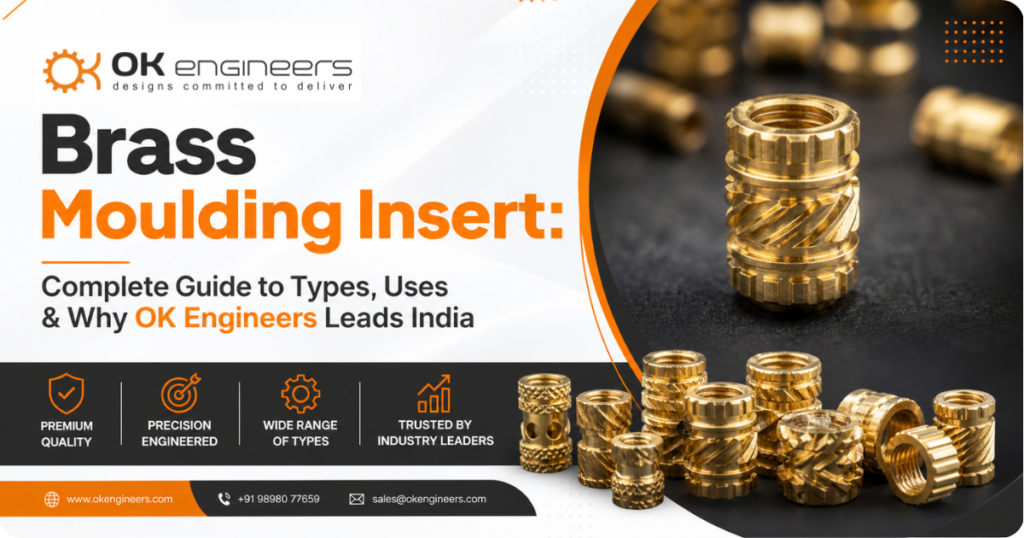
Brass moulding inserts are among the most critical yet underappreciated components in modern manufacturing. Whether you are designing plastic enclosures for electronics, building automotive assemblies, or developing consumer appliances, a brass moulding insert provides the secure, reusable threaded connection that holds it all together. This guide covers everything you need to know — from material properties and installation methods to industry applications and quality standards — and explains why OK Engineers is one of India’s most trusted Brass Moulding Insert manufacturers and exporters.
What Is a Brass Moulding Insert?
A brass moulding insert is a small, precisely engineered cylindrical or hexagonal component made from high-quality brass. It is embedded — or “moulded in” — directly into plastic, rubber, or composite materials during the injection moulding process to create a strong, permanent threaded hole. Once in place, the insert allows screws, bolts, or other fasteners to be installed and removed repeatedly without stripping or damaging the parent material.
The term “moulding insert” specifically refers to inserts designed for the mould-in installation method, where the insert is placed inside the mould tool before the plastic is injected. As the molten material fills and cools around the insert, it locks the component in place with exceptional mechanical strength.
Brass is the preferred material for these inserts because it combines:
- Excellent machinability for tight dimensional tolerances
- High corrosion resistance in humid and chemically active environments
- Superior electrical conductivity for electronic applications
- Strong tensile strength under repeated fastening cycles
- Natural antimicrobial properties suitable for medical and food-grade applications
How Are Brass Moulding Inserts Different from Other Insert Types?
Not all brass inserts are the same. Understanding the difference between installation types helps engineers select the right product for each application.
Comparison of Brass Insert Installation Methods
| Installation Type | How It Works | Best For | Relative Holding Strength |
|---|---|---|---|
| Mould-In (Moulding Insert) | Placed in mould before plastic injection | Mass production, permanent assemblies | Highest |
| Heat Set / Ultrasonic | Inserted post-moulding using heat or vibration | Prototyping, repair, low volume | High |
| Press-In | Pressed into a pre-drilled hole | Thin-wall parts, quick assembly | Medium |
| Self-Tapping | Screwed into a pre-formed hole | Wood, soft plastics | Medium-Low |
Mould-in brass inserts offer the highest pull-out resistance of any method because the surrounding plastic solidifies directly around the knurled or grooved outer surface of the insert, creating a mechanical interlock that cannot be dislodged without destroying the component.
Key Technical Specifications of Brass Moulding Inserts
When sourcing or specifying a brass moulding insert, engineers and procurement teams need to evaluate several technical parameters.
Standard Technical Specifications
| Parameter | Typical Range / Options |
|---|---|
| Material Grade | Free-cutting brass, IS 319, BS 249, CuZn39Pb3 |
| Thread Size | M2 to M12 (metric); UNC, UNF, BSP, BSPT, BA (inch) |
| Thread Standard | ISO Metric, BSW, BSP, BSPT, UNC, UNF, BA |
| Knurling Pattern | Straight, Diamond, Cross, Helical |
| Body Shape | Round, Hexagonal, Square |
| Surface Finish | Natural brass, Nickel plated, Tin plated, Chrome plated |
| Length Options | Custom per application; typically 3 mm to 30 mm |
| Tolerance Class | 6H (standard) or custom per drawing |
| Operating Temperature | Up to 200°C depending on application |
| Tensile Strength | 380–450 MPa (free-cutting brass) |
Custom thread forms, special body diameters, and non-standard lengths are available from leading manufacturers like OK Engineers on request, making them ideal for OEM and export requirements.
Industrial Applications of Brass Moulding Inserts in India
The brass moulding insert is used across virtually every sector that produces plastic-bodied products. The versatility of mould-in inserts, combined with brass’s durability, has made them a standard component in Indian and global manufacturing supply chains.
1. Electrical & Electronic Enclosures
Circuit breakers, switchgear panels, terminal boxes, and consumer electronics housings all use brass moulding inserts to provide secure mounting points for internal components. Brass’s electrical conductivity also makes it ideal for grounding applications.
2. Automotive Components
Door handles, dashboard panels, gear covers, sensor housings, and interior trim pieces frequently incorporate brass moulding inserts to allow repeated assembly and servicing without wear on the plastic.
3. Telecommunications Equipment
Routers, modems, set-top boxes, and antenna enclosures use these inserts for both structural fastening and EMI (electromagnetic interference) shielding connections.
4. Medical & Laboratory Devices
Medical equipment casings, diagnostic instruments, and laboratory apparatuses benefit from brass inserts’ corrosion resistance and ability to withstand repeated sterilisation cycles.
5. Consumer Appliances
Washing machines, air conditioners, water purifiers, and kitchen appliances use brass moulding inserts extensively for secure, long-lasting assembly of plastic panels and housings.
6. Industrial Machinery & Pumps
Pump housings, valve bodies, and sensor brackets made from engineering plastics use brass inserts to provide metal-strength thread connections in high-vibration environments.
Material Quality: Why Brass Is the Gold Standard
From a metallurgical standpoint, free-cutting brass (typically CuZn39Pb3 or IS 319 Grade) is the optimal material for moulding inserts. Here’s why it outperforms alternatives:
Material Comparison for Moulding Inserts
| Material | Corrosion Resistance | Machinability | Cost | Electrical Conductivity | Weight |
|---|---|---|---|---|---|
| Brass (CuZn39Pb3) | Excellent | Excellent | Medium | High | Medium |
| Stainless Steel (304) | Very High | Poor | High | Low | High |
| Zinc Alloy | Good | Good | Low | Medium | High |
| Aluminium | Good | Very Good | Low | Very High | Low |
| Nylon Insert | Poor | N/A | Very Low | None | Very Low |
Brass strikes the ideal balance across all performance parameters for moulding insert applications. Its machinability allows manufacturers like OK Engineers to achieve tight dimensional tolerances at scale, ensuring consistent thread quality and dimensional accuracy in every batch.
Quality Standards and Certifications for Brass Moulding Inserts
Quality is non-negotiable when sourcing brass moulding inserts for industrial or OEM applications. International buyers and Indian manufacturers alike look for the following quality benchmarks:
- ISO 9001:2015 — Quality management system certification
- IS 319 — Indian Standard for free-cutting brass
- BS 249 / BS 2874 — British Standard for brass alloy composition
- RoHS Compliance — Restriction of Hazardous Substances (required for EU exports)
- REACH Compliance — European regulation on chemicals in products
- Go/No-Go Thread Gauging — Verifying thread accuracy to international standards
- Dimensional Inspection — CMM (Coordinate Measuring Machine) or optical comparator verification
Manufacturers operating under ISO certification follow documented processes for material traceability, in-process inspection, and finished goods testing, reducing the risk of defective inserts reaching the production line.
Design Tips for Engineers: Getting the Most from Brass Moulding Inserts
Choosing the right insert is only half the battle. Correct integration into the mould design is equally important. Here are key engineering guidelines:
1. Boss Diameter: The plastic boss (the cylindrical post into which the insert is moulded) should have an outer diameter of at least 2× the insert’s outer diameter to provide adequate material support and prevent cracking.
2. Insert Placement: Inserts should be positioned away from weld lines and gate locations where the plastic material is most stressed during injection.
3. Knurling Selection: Diamond knurling offers the highest resistance to both axial pull-out and rotational torque. For purely axial loads, straight knurling is sufficient.
4. Flush vs. Recessed: Decide whether the insert should sit flush with, proud of, or recessed into the plastic surface based on fastener seating requirements.
5. Surface Finish: Specify nickel plating for corrosive environments and natural brass finish for applications where surface conductivity matters.
You May Also Read – Brass Couplings Manufacturer & Supplier in India
Why Source Brass Moulding Inserts from India?
India — particularly the Jamnagar region of Gujarat — has established itself as the global hub for precision brass component manufacturing. The reasons are compelling:
- Abundant raw material: India is one of the world’s largest producers of brass scrap and free-cutting brass rod.
- Skilled workforce: Decades of machining tradition have created a deep talent pool of CNC operators and quality engineers.
- Cost competitiveness: Indian manufacturers offer globally competitive pricing without compromising on quality.
- Export infrastructure: Major ports and logistics networks make global shipping reliable and cost-effective.
- International certifications: Leading Indian manufacturers hold ISO, RoHS, and REACH certifications, meeting the requirements of buyers in the USA, UK, Europe, and Australia.
When sourcing brass moulding inserts in India, buyers access all these advantages through manufacturers like OK Engineers, who combine traditional craftsmanship with modern precision manufacturing.
OK Engineers: India’s Trusted Brass Moulding Insert Manufacturer
OK Engineers — formally known as O.K. (Om Kailash) Engineers — is a leading manufacturer, supplier, and exporter of brass moulding inserts in India, headquartered at Plot No. 776, GIDC Phase-2, Dared, Jamnagar, Gujarat. With decades of experience in precision brass component manufacturing, OK Engineers has built a reputation for delivering consistent quality, on-time delivery, and exceptional customer service to clients across India, the USA, UK, Australia, Europe, and beyond.
What Makes OK Engineers Stand Out?
Premium Material Sourcing OK Engineers uses only certified free-cutting brass conforming to IS 319, BS 249, or international equivalent grades. Every batch of raw material undergoes chemical composition verification before entering production.
Advanced CNC & VMC Machining The company operates state-of-the-art CNC (Computer Numerical Control) and VMC (Vertical Machining Centre) equipment capable of achieving tolerances within ±0.01 mm. This precision ensures every insert fits perfectly in the mould and engages threads cleanly and consistently.
Comprehensive Thread Options OK Engineers manufactures brass moulding inserts with a wide range of thread forms:
- Metric threads: M2 through M12 and beyond
- Inch threads: UNC, UNF, BSP, BSPT, BA
- Custom threads: As per client drawing or sample
Versatile Knurling Patterns The company’s product range includes inserts with straight knurling, diamond knurling, cross knurling, and helical knurling — each offering different performance characteristics in terms of pull-out resistance and rotational stability.
Multiple Surface Finish Options Depending on the end-use environment, OK Engineers can supply inserts in:
- Natural brass finish
- Nickel plating
- Tin plating
- Chrome plating
- Custom coating as per customer specification
ISO 9001:2015 Certified Quality Management OK Engineers follows a rigorous ISO-certified quality management system. Each production run is subject to in-process dimensional checks, thread gauge verification (Go/No-Go gauges), surface inspection, and pre-dispatch sampling, ensuring zero-defect delivery.
Custom Design Capability Beyond standard catalogue sizes, OK Engineers works directly with engineers and procurement teams to develop custom brass moulding inserts. Whether you have a detailed 2D drawing, a 3D CAD model, or even a physical sample, their engineering team can replicate or improve upon the design and provide production-ready components.
Timely Delivery — Domestic & Export With a well-organised production scheduling system, OK Engineers consistently meets delivery commitments for both small sample orders and large-volume production runs. Their export experience ensures smooth documentation and logistics for international shipments.
Diverse Product Portfolio OK Engineers is not limited to moulding inserts. Their broader product range includes:
- Brass Inserts for Moulding — full range of insert types
- Brass Precision Turned Components
- Brass Electrical Components
- Brass Plumbing Fittings
- Brass Auto Parts
- Hydraulic Fittings
This breadth of capability means clients can consolidate their brass component sourcing under a single, trusted supplier — streamlining procurement and quality management.
Industries Served by OK Engineers
OK Engineers supplies brass moulding inserts and related components to clients in:
- Electrical and switchgear manufacturing
- Electronics and telecommunications
- Automotive and two-wheeler OEMs
- Plastic moulding job shops
- Consumer appliance manufacturers
- Plumbing and HVAC equipment
- Medical device manufacturers
- Defence and aerospace sub-contractors
Global Reach
While rooted in India’s premier brass manufacturing hub of Jamnagar, Gujarat, OK Engineers exports to clients worldwide — including the United States, United Kingdom, Australia, Germany, Canada, UAE, Singapore, and other markets. Their compliance with international material and quality standards ensures seamless integration into global supply chains.
How to Order Brass Moulding Inserts from OK Engineers
Getting started with OK Engineers is straightforward. Their team is experienced at handling first-time enquiries from both domestic buyers and international importers.
Step 1: Visit the OK Engineers Brass Moulding Insert product page to review available standard sizes and specifications.
Step 2: Submit your requirements via the Quick Enquiry form or contact the team directly:
- Phone / WhatsApp: +91 98985 94765
- Email: info@okengineers.com
- Address: Plot No. 776, GIDC Phase-2, Dared, Jamnagar – 361004, Gujarat, India
Step 3: Share your drawing, sample, or specification sheet. OK Engineers’ engineering team will review and provide a competitive quote, typically within 24–48 hours.
Step 4: Approve the sample or first-article inspection report before bulk production begins.
Step 5: Receive your order with complete quality documentation, including material test certificates and dimensional inspection reports.
Summary
Brass moulding inserts are precision-engineered components that bridge the gap between the strength requirements of metal fastening systems and the lightweight, design-flexible world of plastic moulding. Their ability to provide permanent, high-strength, reusable threaded connections within injection-moulded parts makes them indispensable across electrical, automotive, electronics, consumer goods, and industrial manufacturing.
When sourcing brass moulding inserts in India, the key factors to evaluate are material grade, thread accuracy, knurling design, surface finish, and the supplier’s quality management credentials. OK Engineers excels across all these dimensions — combining decades of machining expertise, ISO 9001:2015 certified quality systems, advanced CNC and VMC manufacturing infrastructure, and a flexible approach to custom orders.
Whether you are a plastic moulding job shop, an OEM assembler, or an international importer seeking a reliable, cost-competitive brass moulding insert supplier, OK Engineers offers the technical capability, quality assurance, and customer service to meet your needs. Request a quote today and experience the OK Engineers difference.
Frequently Asked Questions (FAQs) About Brass Moulding Inserts
Q1. What is the difference between a brass moulding insert and a brass threaded insert?
A brass threaded insert is a broad category that includes all brass inserts with internal threads, regardless of installation method. A brass moulding insert is a specific type within this category — one designed to be placed inside the mould before plastic injection, so the plastic material encapsulates and locks around it permanently during the moulding cycle.
Q2. Can brass moulding inserts be used with all types of plastic?
Yes, brass moulding inserts are compatible with the vast majority of thermoplastics and thermosets used in injection moulding, including ABS, PP, PC, Nylon (PA6/PA66), POM (Delrin), PBT, and glass-filled variants. The moulding temperature must, of course, be below the melting point of brass (approximately 900°C), which is never a concern in plastic processing.
Q3. What is the minimum order quantity (MOQ) for OK Engineers’ brass moulding inserts?
OK Engineers accommodates both small prototype quantities and large production volumes. Contact their team at info@okengineers.com or call +91 98985 94765 to discuss your specific volume requirements and get a tailored quote.
Q4. Do OK Engineers provide RoHS-compliant brass moulding inserts?
Yes. OK Engineers can supply brass moulding inserts manufactured from RoHS-compliant brass alloys, which is essential for products sold in the European Union, UK, and other regulated markets. Compliance documentation is available on request.
Q5. What thread standards does OK Engineers support?
OK Engineers manufactures inserts with ISO Metric threads (M2 to M12 and beyond), UNC, UNF, BSW, BSP, BSPT, and BA thread forms. Custom thread profiles per client drawings are also available.
Q6. How are brass moulding inserts held in place in the mould?
The insert is typically held on a mould core pin during injection. The outer surface of the insert features knurling (straight, diamond, or cross) or grooves that allow the molten plastic to flow around and interlock mechanically with the insert as it solidifies.
Q7. Can I get customised brass moulding inserts with specific dimensions?
Absolutely. OK Engineers specialises in custom brass moulding inserts manufactured to customer drawings, samples, or specifications. Their in-house design and machining capabilities allow rapid development of custom sizes and configurations.
Q8. What quality certifications does OK Engineers hold?
OK Engineers is an ISO 9001:2015 certified manufacturer. Their quality management system covers incoming material inspection, in-process dimensional checks, thread gauging, surface inspection, and final pre-shipment quality control.
Q9. How do brass moulding inserts prevent stripping in plastic assemblies?
Brass is significantly harder and stronger than most engineering plastics. When a fastener is driven into a brass insert, the metal threads carry the load rather than the plastic, which would be susceptible to stripping over repeated assembly cycles. This dramatically extends the service life of plastic assemblies.
Q10. Does OK Engineers export brass moulding inserts internationally?
Yes. OK Engineers actively exports to buyers in the USA, UK, Australia, UAE, Germany, Singapore, and other countries. They have the export documentation experience and logistics network to handle international shipments efficiently.