


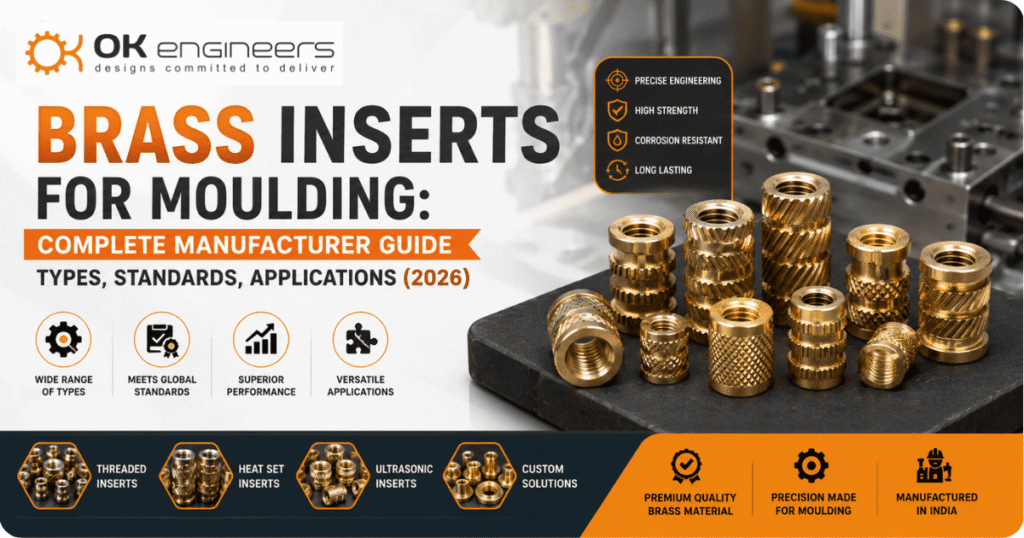
Brass inserts manufacturer — this single term encompasses one of the most technically diverse and commercially critical product categories in precision brass manufacturing. Brass Inserts for Moulding are threaded or unthreaded brass components embedded into injection-moulded, 3D-printed, or otherwise formed plastic parts to provide permanent metal threads, reinforcement points, or connection interfaces that the host plastic material cannot sustain alone. At OK. Engineers, a 4th-generation, ISO 9001:2015 certified brass inserts manufacturer and exporter based in Jamnagar, Gujarat, India — with over 60 years of precision CNC manufacturing experience — we produce the complete range of brass inserts: CPVC pipe fitting inserts, PPR pipe fitting inserts, UPVC pipe fitting inserts, hex inserts, knurled inserts, threaded inserts, heat-set inserts, ultrasonic inserts, mould-in inserts, and press-fit inserts, from M2 to M20 thread size in all alloy grades and surface finishes. We export brass inserts to customers in the UK, USA, Australia, Germany, France, Spain, Russia, UAE, and globally.
What Are Brass Inserts for Moulding and Why Is Brass the Material of Choice?
A brass insert for moulding is a precision-machined component that is embedded into a plastic part — either during injection moulding (mould-in / overmoulded) or after moulding (heat-set, ultrasonic, or press-fit) — to provide a strong, reusable metallic interface. The insert solves a fundamental limitation of plastic: plastic cannot sustain reliable metal fastener threads under repeated assembly loads, thermal cycling, or vibration. A brass insert provides the permanent metal thread, sealing interface, or connection port that the surrounding plastic structure depends upon for its mechanical integrity.
Brass inserts are used in two fundamentally different application categories in India and globally:
- Pipe fitting inserts — brass components embedded into CPVC, PPR, or UPVC pipe fittings during injection moulding to provide the threaded metal connection ports (male or female) used for pipe joints, valve connections, and plumbing assemblies
- Engineering/moulding inserts — brass components embedded into plastic parts (by heat, ultrasonic, or overmoulding) in electronics, automotive, industrial, furniture, and 3D printing applications to provide reusable metric or imperial threads
Why Brass Is the Universal Material for Moulding Inserts
| Material Property | Brass (CW614N) | Why It Matters for Inserts |
| Machinability | 100% rating (highest of all alloys) | Enables CNC production of precise internal threads, external knurls, and tight dimensional tolerances at high volume and competitive cost |
| Thermal Conductivity | 109 W/m·K (moderate-high) | Critical for heat-set installation: brass conducts heat from the tip efficiently to melt the surrounding thermoplastic for clean, low-stress insertion |
| Corrosion Resistance | Excellent in ambient, plumbing, and industrial environments | Inserts remain structurally sound in CPVC/PPR/UPVC plumbing systems (hot and cold water), electronics enclosures, and outdoor industrial assemblies |
| Mechanical Strength | Tensile strength: 350–550 MPa (CW614N) | Sufficient to resist thread strip-out under M2–M20 machine screw torque loads across all common insert applications |
| Thread Integrity | Maintains thread profile under repeated assembly/disassembly | Critical for inserts that must sustain 100–1,000+ assembly cycles in electronics and industrial maintenance applications |
| RoHS Compatibility | CW614N compliant under RoHS lead-in-brass exemption | Enables export to EU, UK, USA, and Australian markets with full environmental compliance documentation |
| Plating Adhesion | Excellent for nickel, tin, chrome, silver, gold, zinc plating | Surface finishing for enhanced corrosion protection, conductivity, aesthetics, and market-specific compliance requirements |
| Cost Efficiency | Most cost-effective precision metal for this application | Lower material and machining cost than stainless steel, with comparable performance for >95% of brass insert applications |
At O.K. Engineers, all brass inserts are manufactured from CW614N (CuZn39Pb3) free-machining brass — equivalent to IS 319 Type I (India), BS 2874 CZ121 (UK), ASTM B16/C36000 (USA), and JIS C3604 (Japan). For lead-sensitive applications (potable water in the USA, medical devices, food processing equipment), we manufacture in CW508L low-lead brass — specified as UNS C69300 in the USA — and can supply full RoHS/REACH documentation for every shipment.
Complete Classification of Brass Inserts: All Types and Sub-Types
The term ‘brass insert’ covers a wide range of precision components that differ significantly in geometry, installation method, thread specification, and end application. The following is the most comprehensive single-source classification of brass insert types available from an Indian manufacturer perspective — covering both the pipe fitting category (CPVC/PPR/UPVC) and the engineering moulding category (heat-set, ultrasonic, hex, knurled).
Complete Brass Insert Type Classification
| Insert Type | Sub-Types | Thread Configuration | Installation Method | Primary Plastic | Application Sector |
| CPVC Pipe Fitting Inserts | Male CPVC Insert (MTA) Female CPVC Insert (FTA) Double-ended CPVC Insert | BSP (G), BSPT (R), NPT, Metric — ½” to 2″ | Mould-in / Overmoulded (injection moulding) | CPVC (Chlorinated Polyvinyl Chloride) | Hot & cold plumbing systems, fire protection, chemical lines — dominant in India, Middle East, USA |
| PPR Pipe Fitting Inserts | Male PPR Insert Female PPR Insert Ring-type PPR Insert | BSP, BSPT, Metric — ½” to 2″ | Mould-in / Overmoulded (injection moulding) | PPR (Polypropylene Random Copolymer) | Residential & commercial hot/cold water systems — widely used in India, Europe, Middle East |
| UPVC / PVC Pipe Fitting Inserts | Male UPVC Insert (MTA) Female UPVC Insert (FTA) SS Ferrule + EPDM Insert | BSP, BSPT, NPT, Metric — ½” to 3″ | Mould-in / Overmoulded (injection moulding) | UPVC / PVC (Unplasticised PVC) | Cold water distribution, drainage, irrigation, industrial chemical systems — India, UK, Australia |
| Knurled Inserts (Diamond / Straight / Helical) | Diamond knurl insert Straight knurl insert Helical knurl insert Double knurl insert | Internal metric M2–M20 UNC/UNF 4-40 to 3/8-16 BSP, NPT on request | Heat-set, Ultrasonic, Press-fit, Mould-in | ABS, PC, Nylon, PETG, PLA, POM, PP | Electronics housings, enclosures, 3D printed parts, automotive interior, appliance panels |
| Hex / Hexagonal Inserts | Hex body through-thread Hex body blind-end Hex flanged insert | Internal M3–M16 External hex for anti-rotation | Mould-in (preferred) Press-in (alternative) | ABS, Nylon, PC, UPVC, thermosets | Anti-rotation applications; high-torque assemblies; electrical enclosures; industrial housings |
| Threaded Bush / Slotted Inserts | Straight threaded bush Slotted self-tapping insert Expansion insert | Internal metric or imperial External coarse thread (self-tapping) | Press-in, Expansion | Thermosets (epoxy, polyester) Softer thermoplastics | Thermoset enclosures; wood; furniture; post-mould repair; automotive trim panels |
| Heat-Set Inserts (Thermal) | Tapered body heat-set Straight body heat-set Flanged heat-set | Internal M2–M12 (M2.5, M3, M4, M5, M6 most common) | Heat-set only (soldering iron or thermal press) | ABS, PC, Nylon PA66, PETG, PLA | Electronics, 3D printing, consumer products, appliance panels |
| Ultrasonic Inserts | Straight ultrasonic Tapered ultrasonic Sonic-Lok style | Internal M3–M10 | Ultrasonic welding only (20–40 kHz horn) | ABS, Nylon, PC, glass-filled grades | High-volume automated assembly: automotive, consumer electronics, telecom, medical devices |
| Blind-End / Closed Inserts | Blind-end threaded insert Closed-bottom mould-in | Internal M2–M10 | Mould-in, Heat-set | ABS, PC, CPVC, PPR | Applications where through-threading would admit process fluid or contamination |
| Custom / OEM Inserts | Any configuration per customer drawing or sample | Any thread: ISO, BA, UNC, UNF, UNEF, BSP, BSPT, NPT | All methods | All thermoplastics and thermosets | OEM manufacturers in all sectors — produced to customer 2D/3D drawings |
Brass Alloy Material Grades and International Standards for Moulding Inserts
Material grade specification is the most critical quality decision in brass insert procurement. The alloy determines machinability, corrosion resistance, thread strength, lead content for RoHS compliance, and dimensional stability throughout the insert’s service life. The following tables provide the most complete international alloy equivalence reference available from an Indian brass inserts manufacturer.
Brass Alloy Grade International Equivalents for Moulding Inserts
| Common Name | India (IS) | UK (BS EN) | USA (ASTM/UNS) | Germany (DIN/EN) | Japan (JIS) | RoHS Status | Best Application |
| CW614N Free-Machining | IS 319 Type I | BS 2874 CZ121 BS EN 12164 CW614N | ASTM B16 UNS C36000 (C360) | DIN EN 12164 CuZn39Pb3 | JIS C3604 | Compliant (Pb exempt) | Standard insert — CPVC/PPR/UPVC fittings, knurled inserts, heat-set, all applications |
| CW508L Low-Lead | IS 319 Type II (low-Pb) | BS EN 12164 CW508L | UNS C69300 (eco-brass) | DIN EN CW508L CuZn36Pb2As | — | Fully Compliant (Pb <0.1%) | USA/EU potable water, medical device, food processing, zero-lead requirement markets |
| CW602N High-Copper | IS 319 High-Cu | BS 2874 CZ122 BS EN CW602N | ASTM B16 High-Cu UNS C35300 | DIN EN CW602N CuZn36Pb2As | JIS C3601 | Compliant | High-conductivity applications; earthing inserts; inserts requiring higher copper % for corrosion resistance |
| CuZn37 Lead-Free | IS 410 CuZn37 | BS 2870 CZ106 BS EN CW508L | ASTM B36 UNS C26000 | DIN EN CuZn37 | JIS C2600 | Fully Compliant (lead-free) | Strict zero-lead requirements; cold-pressed stamped inserts; EU RoHS strict compliance electronics |
| CW617N High-Strength | IS 319 Grade III | BS EN CW617N BS 2874 CZ122 | UNS C37700 | DIN EN CW617N CuZn40Pb2 | JIS C3771 | Compliant (Pb exempt) | High-strength applications; heavy-duty UPVC fittings; large-diameter pipe fitting inserts |
Compliance Standards for Brass Inserts by Export Market
| Standard / Regulation | What It Covers | India | UK | USA | Australia | Action for Manufacturer |
| IS 319:1989 (BIS) | Leaded free-cutting brass rod/bar alloy — composition limits for Grade I, II, III | Primary standard | Reference only | Reference only | Reference only | Specify IS 319 Type I in purchase order for Indian supply. Verify with MTC. |
| BS EN 12164 (CW614N) | European standard for free-machining brass rods and bars — replaces BS 2874 for new specifications | Reference only | Primary standard (UKCA reference) | Reference only | Reference only | For UK market: request BS EN 12164 CW614N material certificate from manufacturer. |
| ASTM B16 / UNS C36000 | USA standard for free-cutting brass rod/wire. C36000 = C360 = equivalent to CW614N | Reference only | Reference only | Primary standard | Reference only | For USA market: request ASTM B16 material certificate; confirm UNS C36000 composition. |
| RoHS 2 Directive (2011/65/EU + 2015/863/EU) | Restricts hazardous substances in electrical and electronic equipment — lead in brass exempt up to 4% Pb | Voluntary for export | Required (UK RoHS 2012) | State-level laws — generally required for electronics | Required (RCM/ACMA) | Obtain RoHS Declaration of Conformity from manufacturer. Confirm lead exemption documented. |
| REACH Regulation (EC 1907/2006) | Registration, Evaluation, Authorisation and Restriction of Chemicals — SVHC >0.1% w/w | Voluntary for export | UK REACH applies | TSCA (different but similar) | Industrial Chemicals Act | Obtain REACH SVHC Declaration from manufacturer. CW614N is compliant — confirm in writing. |
| IS 6947:2000 (BIS) | Cable glands — relevant for brass electrical inserts used in cable management applications | India electrical only | Reference only | Reference only | Reference only | For cable gland / electrical insert applications in India: ensure IS 6947 compliance. |
| DIN 40430 | Panzergewinde (PG thread) — thread form for legacy European equipment cable entry inserts | Reference only | Reference (legacy) | Not applicable | Reference (legacy) | For European equipment inserts with PG thread: specify DIN 40430 thread form on drawing. |
Industry Applications of Brass Inserts: Sector-by-Sector Guide
Brass inserts for moulding are specified across a broader range of industries and applications than any other single precision brass component category. The following section maps specific insert types to their end-use industries — covering both the traditional pipe fitting sector that dominates India’s brass insert market and the growing engineering, electronics, automotive, and emerging technology application sectors.
1. Plastic Pipe Fittings — CPVC, PPR, UPVC (Dominant Application in India)
The single largest application for brass inserts in India is the plastic pipe fittings manufacturing sector. CPVC, PPR, and UPVC pipe fittings account for the majority of India’s domestic brass insert consumption — with Jamnagar brass insert manufacturers supplying fitting producers across Gujarat, Rajasthan, Maharashtra, Punjab, and other pipe-fittings manufacturing hubs. In CPVC fittings (used for hot and cold water systems under IS 15778 and ASTM D2846), brass male adaptor inserts (MTA) and female adaptor inserts (FTA) are overmoulded into the CPVC compound during injection moulding to provide BSP or NPT threaded connection ports. PPR fittings (under DIN 8077/8078 and IS 15801) use brass ring inserts, male inserts, and female inserts overmoulded into the polypropylene random copolymer. UPVC fittings (under IS 4985 and BS 3505) incorporate brass inserts for union connections, valves, and threaded adaptor fittings. O.K. Engineers supplies CPVC, PPR, and UPVC inserts in sizes from ½” to 3″ with BSP, BSPT, NPT, and Metric thread forms.
2. Injection Moulding — Plastic Components for Electronics and Consumer Products
In electronics and consumer product manufacturing, brass inserts — primarily knurled heat-set and ultrasonic inserts from M2 to M10 — are embedded into plastic enclosures, housings, and structural parts to create the reusable metal threads required for product assembly, maintenance, and disassembly. Electronic enclosures (routers, modems, laptops, industrial controllers), power tool housings, appliance panels, and medical device enclosures all use brass inserts as the fastening system for covers, modules, and field-replaceable components. Knurled inserts with diamond or straight knurl patterns are the standard for this application — the knurl bites into the surrounding plastic (by heat reflow, ultrasonic vibration, or overmoulding) to create mechanical retention against both pull-out and torque-out forces.
3. Automotive and EV Manufacturing — Interior Trim, Structural Assemblies, Battery Systems
The automotive sector uses brass inserts in plastic interior trim panels, instrument cluster housings, electronic control unit (ECU) enclosures, connector housings, and increasingly in electric vehicle (EV) battery system housings, thermal management system plastic components, and EV charging station enclosures. For automotive applications, inserts must meet higher temperature resistance and vibration resistance requirements — typically specified with Nylon PA66 or glass-filled PA66-GF30 as the host plastic, and ultrasonic or mould-in installation for maximum retention. Automotive OEM suppliers in India who supply Tier 1 assemblers in the UK, Germany, and USA require IATF 16949-aligned quality documentation — O.K. Engineers’ ISO 9001:2015 certified process provides the quality documentation baseline required for automotive supply chain entry.
4. 3D Printing and Additive Manufacturing — Prototyping and Production Parts
Brass heat-set inserts for 3D-printed parts have grown rapidly as a specification standard in the product development, prototyping, and short-run production market. FDM (Fused Deposition Modelling) parts in PLA, PETG, ABS, and Nylon receive M2 to M6 brass heat-set inserts installed with a temperature-controlled soldering iron or dedicated heat-set press, creating permanent metal threads in prototype enclosures, robotics components, camera equipment, wearable devices, and research instruments. The 3D printing market is global — with significant demand from design firms, startups, and universities in the UK, USA, Australia, and India — and is increasingly shifting from prototype-only to short-run production quantities of 100–10,000 parts.
5. Furniture and Woodworking — Brass Inserts for Wood and Composite Boards
Brass threaded inserts for wood — typically self-tapping or expansion-type inserts — are used in flat-pack furniture, cabinetry, and composite board assemblies to provide reusable metal threads for assembly screws and bolts. The wood furniture insert market is significant in India (for domestic and export furniture manufacturers), the UK (flat-pack furniture assembly), and Australia (outdoor furniture and marine applications). O.K. Engineers manufactures brass wood inserts with coarse external threads for self-installation and smooth-body expansion inserts for pre-drilled holes.
6. Industry 4.0, Robotics, and New Energy Applications
Emerging applications for brass inserts include: collaborative robot (cobot) structural assemblies using injection-moulded structural plastic frames with heavy-duty brass inserts for joint fastening; solar panel mounting system plastic components with brass inserts for mounting bolt interfaces; and smart grid electrical enclosure plastics with brass earthing inserts and neutral terminal inserts. These Industry 4.0 and new energy applications are growing rapidly in India (Solar Mission), the UK (Net Zero target), USA (IRA clean energy funding), and Australia (renewable energy expansion), and represent the next generation of brass insert demand beyond the traditional CPVC/PPR/electronics markets.
You May Also Read – How to Choose the Right Brass Moulding Insert: Size, Thread Type and Pull-Out Strength Guide
Brass Inserts Dimensional Reference: Size Range, Thread Standards and Tolerance Specifications
The following dimensional reference covers the standard size range for brass moulding inserts manufactured by O.K. Engineers. All specifications are subject to individual product datasheet confirmation — contact our technical team for dimensions outside the standard range or for custom insert specifications.
Brass Moulding Inserts — Standard Size Range and Thread Reference
| Application Type | Thread Range | OD Range | Length Range | Thread Standards Available | Tolerance Class | Surface Finish Options |
| CPVC Pipe Fitting Inserts | ½” to 2″ (BSP/BSPT/NPT) Metric M20–M63 | 12mm–65mm OD (per fitting specification) | 15mm–80mm (per fitting type and size) | BSP (ISO 228), BSPT (ISO 7), NPT (ASME B1.20.1), Metric (ISO 261) | IS 319 / BS 249 Type I (DIN 40430 for PG thread) | Natural, nickel-plated, chrome-plated |
| PPR Pipe Fitting Inserts | ½” to 2″ (BSP/BSPT/Metric) M15–M63 | 10mm–63mm OD | 12mm–70mm | BSP (ISO 228), BSPT (ISO 7), Metric (ISO 261) | IS 319 Type I BS 2874 CZ121 | Natural, nickel-plated |
| UPVC / PVC Pipe Fitting Inserts | ½” to 3″ (BSP/BSPT/NPT/Metric) | 12mm–90mm OD | 15mm–90mm | BSP, BSPT, NPT, Metric + SS Ferrule variants | IS 319 Type I BS 249 Type I | Natural, nickel-plated, with SS ferrule |
| Knurled / Heat-Set / Ultrasonic Inserts | M2 to M20 (UNC 4-40 to 3/8-16 on request) | 3.2mm–26mm OD (per M-size) | 3.5mm–35mm (short and long variants) | ISO Metric (ISO 261), UNC/UNF (ASME B1.1), BA (legacy UK), BSP (ISO 228) | Thread: ±0.05mm OD: ±0.05mm | Natural, nickel-plated, tin-plated, zinc-plated |
| Hex / Hexagonal Inserts | M3 to M16 (per application) | Hex: 5mm AF–22mm AF | 8mm–30mm | Metric only (standard) Custom thread on request | Hex size: ±0.05mm | Natural, nickel-plated |
| Custom / OEM Inserts | Any thread as per customer drawing | Any OD per drawing (within CNC capacity) | Any per drawing | All international thread standards (ISO, BA, UNC, UNF, UNEF, BSP, BSPT, NPT, JIS) | Per customer drawing (typically ±0.05mm) | All plating options available |
How to Specify Brass Inserts from a Manufacturer in India: 6-Point Buyer Checklist
Whether you are sourcing brass inserts for CPVC pipe fittings in India, heat-set inserts for electronics assemblies in the UK, mould-in inserts for automotive plastics in Germany, or ultrasonic inserts for consumer products in the USA, the following six-point checklist ensures you receive the correct product with the right quality documentation.
1. Specify the Correct Insert Type and Application
Clearly identify whether you need a pipe fitting insert (CPVC/PPR/UPVC — mould-in) or an engineering moulding insert (heat-set/ultrasonic/press-fit/mould-in for plastic moulding). These are manufactured differently, use different knurl geometries, and have different dimensional tolerance requirements. Provide the host plastic type, fitting size or thread size, and pipe standard (IS/BS/DIN/ASTM) on your enquiry.
2. Specify the Thread Standard and Size
For pipe fitting inserts: specify BSP (ISO 228), BSPT (ISO 7), NPT (ASME B1.20.1), or Metric thread — and the size in imperial (½”, ¾”, 1″) or metric (M20, M25) as applicable to your pipe standard. For engineering inserts: specify the ISO Metric thread (M2, M3, M4, M5, M6, M8, M10, M12, M16, M20) or unified thread (UNC/UNF) for USA market. Always state whether you need a through-thread (both ends open) or blind-end (one end closed) insert.
3. Specify the Alloy Grade and Compliance Requirement
For standard applications: specify CW614N (IS 319 Type I / BS 2874 CZ121 / ASTM B16). For potable water contact in the USA: specify CW508L (UNS C69300 eco-brass). For EU/UK electronics: confirm RoHS 2 compliance documentation is required. For food/pharma: confirm REACH SVHC declaration required. State the required documentation on your purchase order — MTC, RoHS declaration, REACH declaration, COO.
4. Specify the Surface Finish
Natural (clean machined) brass is standard unless otherwise specified. Nickel plating is the most common finish for export — it enhances corrosion resistance and gives a silver appearance. Tin plating is used for soldering applications and RoHS-sensitive electronics. Chrome plating is used for decorative/visible applications. Zinc plating offers cost-effective corrosion protection for industrial applications. Always specify the plating thickness (e.g. 5μm, 8μm) for critical applications.
5. Specify MOQ, Lead Time, and Packaging
State your required quantity — O.K. Engineers’ standard MOQ is 1,000 pieces for catalogue products and 500 pieces for custom specifications. For CPVC/PPR/UPVC inserts in large pipe fitting runs, 10,000–100,000+ piece orders are normal. Specify whether you need polybag, cardboard box, or export carton packaging. For export orders, specify the required shipping terms (EXW, FOB, CIF) and destination port or city.
6. Request Quality Documentation Package
As standard for all export orders, O.K. Engineers provides: ISO 9001:2015 certificate, material test certificate (MTC) with spectrometer alloy verification, RoHS declaration of conformity, REACH SVHC declaration, Certificate of Origin (COO), commercial invoice, and packing list. For CPVC/PPR/UPVC pipe fitting insert buyers in India: dimensional inspection reports and go/no-go gauge verification certificates are available on request. Thread accuracy is verified against ISO 1 (Metric thread) or BS 21 (BSP thread) go/no-go gauge standards on every production batch.
For our complete brass inserts product range — including all sizes, thread specifications, and plating options — visit our Brass Inserts for Moulding product page. For detailed selection guidance on which insert type and size to use for your specific plastic and application, see our Brass Moulding Insert Selection Guide.
O.K. Engineers: Brass Inserts Manufacturer and Exporter from Jamnagar, India
O.K. Engineers is a 4th-generation, ISO 9001:2015 certified brass inserts manufacturer and exporter established in Jamnagar, Gujarat, India over 60 years ago. We manufacture the complete range of brass inserts for moulding — CPVC, PPR, and UPVC pipe fitting inserts, knurled inserts, hex inserts, heat-set inserts, ultrasonic inserts, threaded bushes, and custom OEM inserts — from our CNC precision manufacturing facility in Jamnagar, India’s brass manufacturing capital.
We supply brass inserts to pipe fitting manufacturers, injection moulding companies, electronics OEMs, automotive component suppliers, furniture manufacturers, and export trading companies across India, the UK, USA, Australia, Germany, France, Spain, Russia, UAE, and globally. Our product range covers over 2,000 variants — all manufactured from spectrometer-verified CW614N brass to dimensional tolerances of ±0.05mm, with 100% go/no-go gauge thread inspection on every batch.
Frequently Asked Questions
Q1: What are brass inserts for moulding used for?
Brass inserts for moulding are precision-machined components embedded into plastic parts to provide strong, reusable metal threads that the host plastic material cannot sustain alone. They are used in two major application categories: pipe fitting inserts — embedded into CPVC, PPR, and UPVC pipe fittings during injection moulding to provide threaded connection ports for plumbing assemblies; and engineering moulding inserts — embedded into plastic enclosures, housings, and structural parts in electronics, automotive, furniture, and 3D printing applications to create metric or imperial threads for machine screws. Without brass inserts, plastic threads strip under repeated assembly loads; with brass inserts, the assembly can withstand 100 to 1,000+ assembly cycles without thread degradation.
Q2: What is the difference between CPVC, PPR, and UPVC brass inserts?
CPVC brass inserts are designed for Chlorinated Polyvinyl Chloride pipe fittings used in hot and cold water systems (IS 15778 / ASTM D2846) — they are overmoulded into the CPVC compound during injection moulding with BSP, BSPT, or NPT thread forms. PPR brass inserts are designed for Polypropylene Random Copolymer pipe fittings (DIN 8077/8078 / IS 15801) used in residential and commercial hot and cold water systems — they use ring, male, or female insert designs overmoulded into the PPR compound. UPVC brass inserts are designed for Unplasticised PVC pipe fittings (IS 4985 / BS 3505) used in cold water distribution, drainage, and irrigation — they are available with stainless steel ferrule and EPDM seal variants for union connections. The key difference is the plastic host compound: CPVC has higher temperature resistance, PPR is used for potable hot water, and UPVC is the most widely used cold water and drainage material.
Q3: What alloy grade should I specify for brass inserts exported to the UK?
For brass inserts exported to the UK market, specify CW614N (CuZn39Pb3) per BS EN 12164 — this is the UK standard equivalent to IS 319 Type I (India) and ASTM B16 C36000 (USA). CW614N is compliant with the UK RoHS 2012 Regulations under the lead-in-brass exemption (Pb content permitted up to 4% by weight), and the manufacturer should provide a UK RoHS Declaration of Conformity and REACH SVHC Declaration with every shipment. For potable water applications in the UK (subject to ACS or WRAS approval requirements), specify CW508L low-lead brass (Pb <0.25%) to meet the UK Drinking Water Inspectorate requirements for lead content in plumbing components.
Q4: What quality checks should I request from a brass inserts manufacturer in India?
From any brass inserts manufacturer in India, request a Material Test Certificate (MTC) with spectrometer (XRF) alloy analysis confirming the composition falls within the specified grade limits (CW614N: Cu 57–59%, Zn 39–40%, Pb 2.5–3.5%); a dimensional inspection report confirming thread accuracy measured against go/no-go gauges to the applicable thread standard (ISO 1 for Metric, BS 21 for BSP, ASME B1.20.1 for NPT); and a RoHS Declaration of Conformity if the inserts will be used in electrical or electronic equipment exported to the UK, EU, or Australia. For CPVC/PPR/UPVC pipe fitting inserts, also request proof that the insert OD dimensions match the pipe fitting manufacturer’s injection mould core pin specifications. O.K. Engineers provides all of these documents as standard with every export order.
Q5: What is the minimum order quantity for brass inserts from India and what is the lead time?
The standard minimum order quantity (MOQ) for brass inserts from an established Indian manufacturer is 1,000 pieces for catalogue standard products, with a lead time of 15–20 working days from order confirmation and raw material availability. For custom brass inserts manufactured to customer drawings, the MOQ is typically 500 pieces with a lead time of 25–30 working days from drawing approval and first article sample sign-off. Sample quantities (50–200 pieces) are available for approval prior to production orders — sample lead time is typically 7–10 working days. For large-volume pipe fitting insert orders (10,000–500,000 pieces), negotiate lead time and delivery schedule at the time of order placement — most Jamnagar manufacturers can quote committed delivery schedules for repeat volumes.
Conclusion
Brass inserts for moulding — from CPVC, PPR, and UPVC pipe fitting inserts to knurled heat-set inserts for electronics, hex inserts for high-torque assemblies, and custom OEM inserts to customer drawings — are precision components where dimensional accuracy, alloy purity, thread compliance, and documentation quality directly determine the performance and regulatory compliance of the plastic assemblies they are built into. Whether you are a pipe fitting manufacturer in India sourcing CPVC inserts in bulk, an OEM electronics assembler in the UK specifying M3 heat-set inserts, an automotive Tier 1 supplier in Germany qualifying ultrasonic inserts for PA66-GF30 trim panels, or a 3D printing service bureau in Australia specifying M4 heat-set inserts for customer projects — the quality of the brass inserts you source is a direct engineering decision, not just a procurement choice.
At OK. Engineers, we manufacture the complete range of brass inserts for moulding — 2,000+ product variations in CPVC, PPR, UPVC, knurled, hex, heat-set, ultrasonic, press-fit, and custom OEM configurations — from our ISO 9001:2015 certified CNC facility in Jamnagar, Gujarat, India, drawing on over 60 years of 4th-generation family manufacturing expertise. All inserts are manufactured from spectrometer-verified CW614N brass to ±0.05mm dimensional tolerances, with 100% go/no-go gauge thread inspection, and shipped with complete RoHS, REACH, MTC, and COO documentation for every export market.