


Brass inserts in India are the small, precision-turned metal components that create permanent, reusable threads inside plastic pipe fittings — and choosing the wrong type for CPVC, PPR, or UPVC systems is one of the most common (and costly) procurement mistakes we see. At OK. Engineers, a 4th-generation family-run, ISO 9001:2015 certified manufacturer based in Jamnagar, Gujarat, since our founding decades ago, we produce CPVC brass inserts, PPR brass inserts, and UPVC brass inserts for domestic buyers and exporters across India, the UK, the USA, Australia, Germany, and Spain. This guide breaks down exactly how these three insert types differ in material compatibility, temperature tolerance, thread specification, and pull-out strength — so you can specify the right part the first time.
What Are Brass Inserts and Why Pipe Material Matters
A brass insert (also called a threaded insert, insert nut, or metal-to-plastic insert) is a machined brass component embedded into a plastic fitting during moulding to give it a durable, reusable metal thread. Without it, plastic threads strip, crack, and leak under repeated tightening — especially in plumbing systems that face thermal cycling and mechanical torque during installation.
The pipe material the insert is moulded into — CPVC, PPR, or UPVC — is not interchangeable. Each plastic has a different softening point, thermal expansion rate, and surface chemistry, which changes how the brass insert must be designed: knurl depth, groove profile, wall thickness allowance, and even the brass alloy grade all shift depending on the host material. Buying “generic” brass inserts in India without matching them to the plastic type leads to pull-out failure, thread stripping during moulding, or leaks after a few heating-cooling cycles.
CPVC Brass Inserts: Built for Hot Water Systems
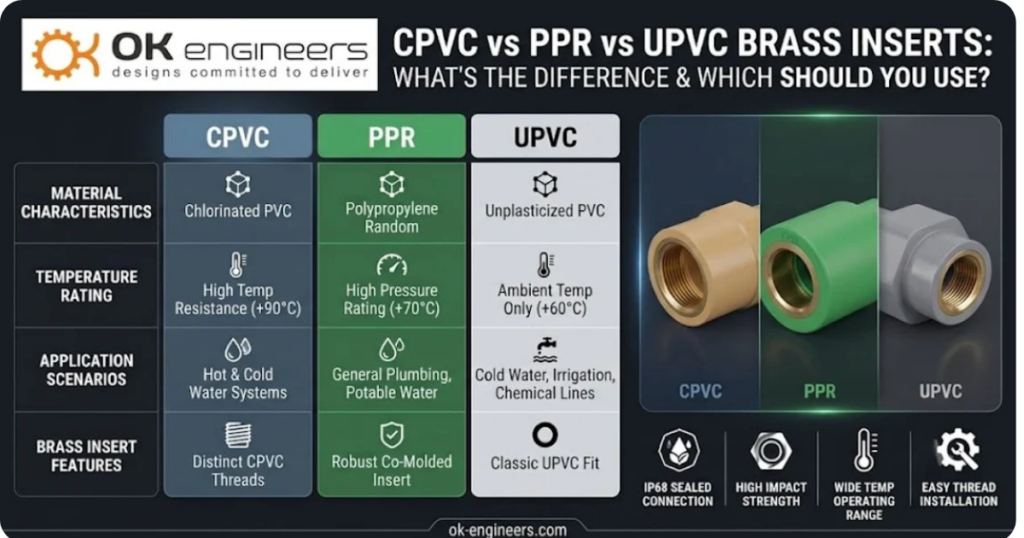
CPVC (Chlorinated Polyvinyl Chloride) fittings are used for hot and cold water supply lines in residential and commercial buildings, with continuous operating temperatures up to 93°C. CPVC brass inserts are designed with a deep knurl and reinforced flange to remain locked in place as the CPVC softens slightly under sustained heat.
Key specifications for CPVC brass inserts:
- Standard alloy: C36000 free-cutting brass (lead-free C69300 for potable water)
- Knurl pattern: diamond or straight knurl, moderate depth
- Thread standards: BSP, NPT, or ISO metric as per fitting drawing
- Typical use: hot water risers, solvent-welded CPVC tees, elbows, and unions
PPR Brass Inserts: Engineered for Thermal Cycling
PPR (Polypropylene Random Copolymer) pipe systems are widely used across India, Europe, and the Middle East for both hot and cold water lines, typically rated from -5°C to 95°C. Because PPR has a higher coefficient of thermal expansion than CPVC or UPVC, PPR brass inserts need a deeper, more aggressive knurl pattern and a longer barrel length so the insert stays anchored as the surrounding polypropylene expands and contracts during heat-fusion welding and daily hot/cold cycling.
Key specifications for PPR brass inserts:
- Standard alloy: C36000 brass, sometimes with nickel plating for corrosion resistance
- Knurl pattern: deep diamond or cross-knurl for maximum grip
- Thread standards: BSP (most common in India/UK/Australia), NPT for US-spec exports
- Typical use: male/female threaded transitions in PPR fittings joined by hot-melt fusion
UPVC Brass Inserts: Suited to Cold Water and Drainage
UPVC (Unplasticized PVC) is used mainly for cold water supply, drainage, and industrial piping where operating temperatures stay well below CPVC or PPR ranges. UPVC brass inserts don’t need the same thermal-expansion allowance as PPR inserts, but they still require a precise groove profile to resist pull-out under water pressure and repeated fixture connection.
Key specifications for UPVC brass inserts:
- Standard alloy: C36000 free-cutting brass
- Knurl pattern: straight or diamond knurl, shallower than PPR requirement
- Thread standards: ISO metric, BSP, BSPT, BSW, UNC, UNF (as per customer drawing)
- Typical use: UPVC-to-metal transitions, taps, valves, ball valve adapters
You May Also Read – Brass Electrical Fittings Manufacturer in India: What to Check Before You Buy (Quality, Certifications & Standards)
CPVC vs PPR vs UPVC Brass Inserts: Full Comparison Table
| Parameter | CPVC Brass Insert | PPR Brass Insert | UPVC Brass Insert |
|---|---|---|---|
| Host material | Chlorinated PVC | Polypropylene Random Copolymer | Unplasticized PVC |
| Operating temp. range | Up to 93°C | -5°C to 95°C | Up to ~60°C (cold water/drainage) |
| Knurl depth required | Moderate | Deep (highest thermal expansion) | Shallow to moderate |
| Joining method of host pipe | Solvent cement | Heat fusion welding | Solvent cement |
| Typical application | Hot & cold water supply | Hot & cold water, premium builds | Cold water, drainage, industrial |
| Common export markets | USA, UK, Middle East | Europe, Middle East, Asia | India, UK, Australia |
Thread Specification & Tolerance Table
| Insert Type | Thread Standards Available | Tolerance Class | Surface Finish Options |
|---|---|---|---|
| CPVC Brass Insert | BSP, NPT, ISO Metric | ±0.02 mm | Natural, nickel-plated, tin-plated |
| PPR Brass Insert | BSP, ISO Metric | ±0.02 mm | Natural, nickel-plated |
| UPVC Brass Insert | ISO Metric, BSP, BSPT, BSW, UNC, UNF | ±0.02 mm (customizable) | Natural, nickel, chrome, tin |
Pull-Out Strength & Installation Method Table
| Insert Type | Recommended Installation | Relative Pull-Out Strength | Notes |
|---|---|---|---|
| CPVC Brass Insert | Mould-in during injection moulding | High | Deep groove resists axial pull-out under thermal cycling |
| PPR Brass Insert | Mould-in during injection moulding | Highest | Deepest knurl compensates for PPR’s higher thermal expansion |
| UPVC Brass Insert | Mould-in or press-in | Moderate-High | Sufficient for cold-water pressure ratings |
Pull-out performance depends on final part design, wall thickness, and moulding parameters — our technical team validates each design against the customer’s drawing before tooling.
How to Choose the Right Brass Insert for Your Project
- Identify the host pipe material first — CPVC, PPR, or UPVC — since this determines the required knurl depth and alloy grade.
- Confirm the operating temperature range of the application; hot water lines demand CPVC or PPR-grade inserts, not UPVC.
- Specify the thread standard your fittings require (BSP, NPT, ISO Metric, or export-market equivalents like UNC/UNF).
- Check lead-free compliance if the fitting carries potable drinking water — request C69300 or equivalent lead-free brass.
- Ask for pull-out and torque test data from your brass inserts supplier before committing to a tooling run.
Why Procurement Teams Choose O.K. Engineers for Brass Inserts in India
At O.K. Engineers, we manufacture CPVC, PPR, and UPVC brass inserts as a 4th-generation, ISO 9001:2015 certified family business based in Jamnagar, Gujarat — a region globally recognised for brass component manufacturing. We supply actual tolerances, alloy certifications, and test-standard documentation with every order, and our components are exported to Spain, Germany, the USA, France, Russia, and the UK. Every insert we produce is manufactured and tested in-house, giving procurement engineers verifiable, batch-level traceability rather than generic catalogue claims.
If your project needs CPVC, PPR, or UPVC brass inserts manufactured to your exact drawing and thread specification, our technical team can review your requirement and share test data before you commit to a production run. See our related resources on brass inserts for moulding and our e-gland range for adjacent plastic-to-metal fastening solutions.
Frequently Asked Questions
1. What is the main difference between CPVC, PPR, and UPVC brass inserts?
The core difference is thermal design. CPVC and PPR brass inserts are engineered for hot water systems with deeper knurl patterns to handle thermal expansion, while UPVC brass inserts are built for cold water and drainage applications with a shallower knurl profile.
2. Can I use the same brass insert for CPVC and UPVC fittings?
Not recommended. CPVC operates at much higher temperatures than UPVC, so a CPVC-rated insert has deeper knurling and different groove geometry that a UPVC fitting doesn’t need — using the wrong type can cause loosening or leaks over time.
3. Which brass insert has the highest pull-out strength: CPVC, PPR, or UPVC?
PPR brass inserts typically have the highest pull-out strength because PPR pipe expands and contracts the most under thermal cycling, requiring the deepest knurl and longest barrel design to stay anchored.
4. What alloy grade is used in brass inserts in India for potable water?
For potable water applications, lead-free brass such as C69300 (or equivalent) is required to meet drinking-water safety regulations, while standard C36000 free-cutting brass is used for non-potable industrial and drainage applications.
5. Do brass inserts for CPVC, PPR, and UPVC fittings use the same thread standards?
Not always — BSP and ISO Metric threads are common across all three, but UPVC inserts are also frequently supplied in BSPT, BSW, UNC, and UNF to match export-market fitting standards, so always confirm thread type against the customer’s drawing.
Conclusion
Choosing between CPVC, PPR, and UPVC brass inserts comes down to one question: what temperature and pressure conditions will the fitting face in service? CPVC and PPR brass inserts are built for hot water systems, with PPR requiring the deepest knurl to handle thermal expansion, while UPVC brass inserts suit cold water and drainage lines where thermal stress is minimal. Getting this match right at the specification stage — thread standard, alloy grade, and knurl design — prevents pull-out failures and costly field returns. As an ISO 9001:2015 certified manufacturer of brass inserts in India with decades of Jamnagar-based manufacturing experience, O.K. Engineers can help you specify, test, and produce the correct CPVC, PPR, or UPVC brass insert for your next project — request a quote from our technical team today.