


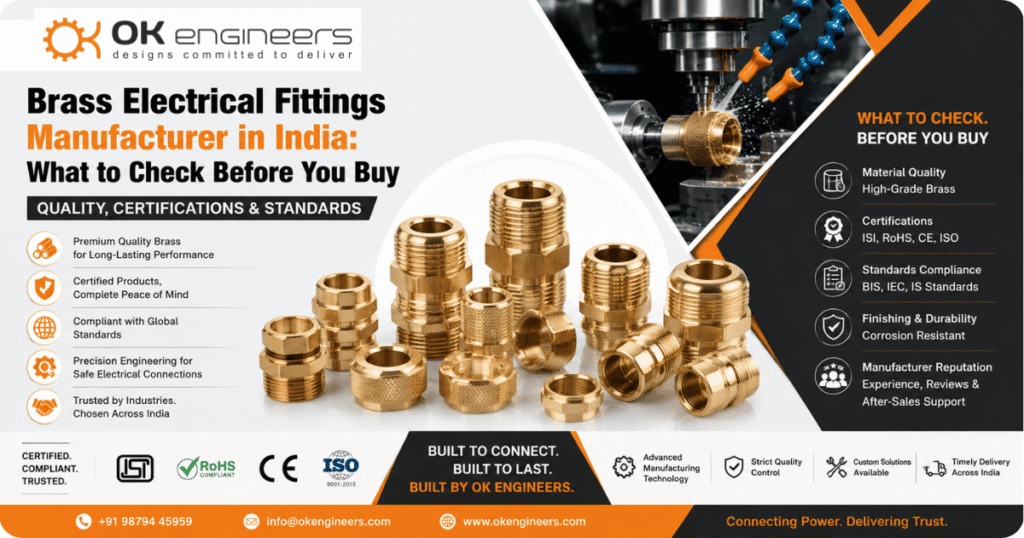
Choosing a brass electrical fittings manufacturer in India is one of the most consequential procurement decisions an electrical engineer, OEM assembler, or international distributor will make. Brass electrical fittings — including cable glands, plug pins, neutral links, conduit adaptors, earth bars, and switchgear components — are safety-critical components. A substandard fitting can compromise cable sealing integrity, fail an IP rating test, cause an earth fault, or fail inspection under BS 7671, IS 732, NEC, or AS/NZS 3000 Wiring Rules. Getting the supplier selection wrong creates rework costs, project delays, and potentially serious safety risk. At O.K. Engineers, a 4th-generation, ISO 9001:2015 certified brass electrical fittings manufacturer based in Jamnagar, Gujarat, India — with over 60 years of manufacturing experience and exports to the UK, USA, Australia, Germany, France, Spain, and Russia — we have produced this buyer guide to help procurement managers and engineers make the right manufacturer selection decision.
This guide covers the six most important checks every buyer should make before purchasing brass electrical fittings from any manufacturer in India — including what certifications to look for, which quality tests to require, which standards apply in your country, and what questions to ask that reveal a manufacturer’s true capability.
Why Brass Electrical Fittings Quality Matters: The Real Cost of Getting It Wrong
Brass electrical fittings in India are produced across a wide quality spectrum — from precision CNC-machined components with full material traceability and ISO-certified quality management, to low-cost items produced on manual lathes with uncertified alloy compositions and no systematic dimensional inspection. For the buyer, the price difference between these two tiers may be 10–25%. The consequence of choosing the wrong tier, however, extends far beyond that cost differential.
The Hidden Costs of Substandard Brass Electrical Fittings
- Failed IP rating test on cable glands — requiring complete cable gland replacement across an entire installation
- Thread mismatch on conduit fittings or cable gland locknuts — caused by tolerance deviation outside the thread standard, requiring rework of enclosure knockouts
- Earth continuity failure on neutral links — caused by incorrect alloy conductivity, triggering full distribution board inspection and replacement under IS 8623 / BS 5486
- RoHS non-compliance rejection by UK or EU customs — caused by undeclared lead content above the directive threshold in CW614N alloy, resulting in returned shipment and penalty costs
- Rejection by UK building control or NICEIC electrical inspector — caused by non-standard cable gland sizes not conforming to BS 6121 or IEC 62444
- ATEX non-compliance in hazardous area installations — potentially causing safety incident and significant legal liability
The lesson is consistent: the correct approach is to verify quality before ordering, not after receiving a failed shipment. The six checks below give buyers a systematic framework for evaluating any brass electrical fittings manufacturer in India before committing to a supply relationship.
1. ISO 9001:2015 Certification — The Non-Negotiable Baseline
ISO 9001:2015 is the international standard for quality management systems. For a brass electrical fittings manufacturer in India, ISO 9001:2015 certification is not a marketing badge — it is a legally audited confirmation that the manufacturer operates a documented system covering design control, raw material approval, manufacturing process control, dimensional inspection, non-conformance management, and continuous improvement. Without ISO 9001:2015, there is no systematic quality framework in place.
How to Verify ISO 9001:2015 — Do Not Accept a Certificate Alone
- Request the ISO certificate AND the name of the certifying body (e.g. Bureau Veritas, TÜV Rheinland, DNV GL, SGS, BVQI)
- Verify the certificate directly on the certifying body’s online certificate lookup portal — fake certificates are common in the brass components market
- Check the certificate SCOPE — it must specifically include ‘brass electrical fittings’ or ‘precision brass components’ manufacture in the scope statement. A certificate for ‘office management’ or ‘trading activities’ does not cover manufacturing quality.
- Check the certificate EXPIRY DATE — ISO 9001 certificates expire every three years and require annual surveillance audits. An expired certificate means the quality system has not been independently audited.
2. Material Certification and Alloy Verification
The alloy composition of brass electrical fittings directly determines their electrical conductivity, corrosion resistance, thread integrity, and compliance with RoHS/REACH directives. CW614N (CuZn39Pb3) is the internationally specified free-machining brass alloy for precision electrical fittings — but the only way to confirm that a shipment is actually CW614N is through spectrometer (XRF) alloy analysis.
Brass Alloy Grades for Electrical Fittings — What to Specify and Verify
| Alloy Grade | Composition | India Equiv. | UK Equiv. | USA Equiv. | RoHS Status | When to Specify |
| CW614N (Free-Machining) | Cu 57–59% Zn 39–40% Pb 2.5–3.5% | IS 319 Type I | BS 2874 CZ121 | ASTM B16 | Compliant (Pb exempt) | Standard for all cable glands, plug pins, conduit fittings, neutral links |
| CW508L (Low-Lead) | Cu 57–59% Zn 40–42% Pb 0.1–0.6% | IS 319 Low-Pb | BS EN 12164 CW508L | UNS C36200 | Compliant (Pb <0.1% some grades) | USA/EU lead-restriction applications; potable water contact; food processing |
| CW602N (High-Cu) | Cu 61–63% Zn 34–37% Pb 1.5–2.5% | IS 319 High-Cu | BS 2874 CZ122 | ASTM B16 High-Cu | Compliant (Pb exempt) | Earth bars, neutral links needing higher copper content for lower resistance |
| CuZn37 (Lead-Free) | Cu 63% Zn 37% Pb <0.1% | IS 410 CuZn37 | BS 2870 CZ106 | ASTM B36 C26000 | Fully Compliant (lead-free) | Strict lead-free requirement; stamped parts; EU RoHS zero-lead applications |
What to Request from the Manufacturer — Material Documentation
- Material Test Certificate (MTC) — must show: batch number, heat number, chemical composition (%), mechanical properties (UTS, elongation), test method (spectroscopy)
- Spectrometer report (XRF analysis) — issued per production batch, not per alloy grade. Each batch should be individually tested.
- RoHS Declaration of Conformity — must reference the specific Directive (EU RoHS 2: 2011/65/EU as amended by 2015/863/EU) and confirm the lead content falls within the permitted exemption.
- REACH Declaration — confirms no SVHC (Substances of Very High Concern) above 0.1% weight by weight in the finished component.
At O.K. Engineers, every production batch is spectrometer-verified against CW614N composition limits before machining begins. Material test certificates and RoHS/REACH declarations are available as standard export documents for all shipments to the UK, EU, USA, and Australia.
3. Know Which Standards Apply to Your Market — IS, BS, IEC, DIN, AS/NZS
Brass electrical fittings must comply with different national and international standards depending on the destination country and application. Specifying the wrong standard — or accepting a product that doesn’t meet your market’s standard — results in inspection failures and replacement costs. The table below maps the key standards for brass electrical fittings by country and product type.
Applicable Standards for Brass Electrical Fittings by Country and Product
| Product Type | India (IS) | UK (BS / UKCA) | USA (ANSI/UL) | Australia (AS/NZS) | International (IEC/ISO) |
| Cable Glands & Accessories | IS 6947 (cable glands) IS 13947 (switchgear) | BS 6121-1 to 6121-5 BS 7671 (IET 18th Ed.) | UL 514B (conduit fittings) UL 486A (wire connectors) | AS/NZS 3000 (Wiring Rules) | IEC 62444 IEC 60947 (switchgear) |
| Plug Pins & Socket Contacts | IS 1293 (plugs/sockets) IS 732 (wiring) | BS 1363 (13A plug) BS 7671 (wiring) | NEMA WD 6 (wiring devices) | AS 3112 (plugs/sockets) AS/NZS 3000 | IEC 60083 (plugs/sockets) |
| Neutral Links & Earth Bars | IS 8623 (distribution boards) IS 3043 (earthing) | BS 5486 (switchgear) BS 7430 (earthing) | NEC Art. 250 (grounding) UL 486A | AS/NZS 61439 (switchgear) AS 2007 (earthing) | IEC 60439 IEC 60364 (wiring) |
| Conduit Fittings & Locknuts | IS 2667 (steel conduit) | BS EN 60423 (conduit systems) | UL 514B (conduit fittings) | AS/NZS 2053 (conduit systems) | IEC 60423 (conduit systems) |
| Switchgear Components | IS 13947-1 to 13947-5 IS 60947 | BS EN 60947 (LV switchgear) | UL 508 (industrial control) ANSI C37 | AS/NZS 60947 (switchgear) | IEC 60947 (LV switchgear) |
| Brass Alloy Material | IS 319 (leaded brass) IS 410 (copper alloys) | BS 2874 (rods/bars) BS EN 12164 | ASTM B16 ASTM B584 | AS 1567 (copper alloys) | ISO 426-1 (CuZn alloys) |
Always confirm with your manufacturer that the product they are quoting meets the specific standard applicable in your country and application. A manufacturer who cannot name the relevant standard for your application — or who claims their product meets ‘all international standards’ without specifying which — is a manufacturer who has not verified compliance.
4. CNC Precision Manufacturing and Dimensional Inspection Process
Dimensional accuracy is the most directly observable indicator of a brass electrical fittings manufacturer’s true production quality. Brass electrical fittings have tight dimensional tolerances that are not optional — they are the difference between a cable gland that achieves IP66 sealing and one that allows water ingress, or between a neutral link whose terminal holes accept 6mm² conductor and one that is 0.3mm undersize and must be force-fitted, risking conductor damage.
What to Ask About Manufacturing Technology
- Does the manufacturer use CNC (Computer Numerical Control) turning machines or manual/conventional lathes? CNC turning enables repeatable dimensional accuracy to ±0.05mm or better. Manual turning is operator-dependent and introduces batch-to-batch variation.
- What is the documented dimensional tolerance for thread pitch, thread major diameter, and cable entry bore on cable glands? For Metric thread to IEC 62444, the tolerance on cable gland thread pitch must be within ±0.05mm.
- Is 100% go/no-go gauge inspection performed on all threaded components? A go/no-go gauge is the only practical 100%-inspection method for thread compliance at volume production speed. Sampling-only inspection misses defective batches.
- What is the sample inspection frequency during a production run? ISO 9001:2015 requires defined inspection checkpoints — ask for the inspection plan for your product.
- Is there a documented non-conformance management process? How does the manufacturer handle a batch that fails in-process inspection?
At O.K. Engineers, all brass electrical fittings are manufactured on CNC turning machines with documented tolerances of ±0.05mm. Our Jamnagar facility performs 100% go/no-go gauge inspection on all threaded components — cable glands, locknuts, plug pins, conduit fittings, and terminal screws — on every production batch. Our ISO 9001:2015 certified process includes defined First Article Inspection (FAI) for new products and in-process inspection checkpoints at defined machining intervals.
You May Also Read – The Complete Guide to Brass Electrical Accessories: Manufacturer, Types & Industrial Applications (2026)
5. Export Documentation Capability for UK, USA, Australia, and EU
For international buyers sourcing brass electrical fittings from India, the product itself is only half the deliverable. The compliance documentation package that ships with the goods is equally critical — particularly for UK (UKCA), EU (CE), USA (UL), and Australian (RCM) market requirements. A manufacturer that cannot produce the required documentation is a manufacturer who will delay or block your import clearance.
Required Export Documentation for Brass Electrical Fittings by Destination Market
| Document | UK Market | USA Market | Australia Market | EU / Germany Market | India Domestic |
| ISO 9001:2015 Certificate (current, valid) | Required | Required | Required | Required | Required |
| Material Test Certificate (MTC + spectrometer report) | Required | Required (ASTM ref.) | Required | Required | Recommended |
| RoHS Declaration of Conformity | Required (UK RoHS 2012) | Market-dependent (state-level laws) | Required (RCM scheme) | Required (EU RoHS 2) | For export goods |
| REACH Declaration (SVHC compliance) | Required (UK REACH) | Not REACH — TSCA compliance | Required (Industrial Chemicals Act) | Required (EU REACH) | For EU-export goods |
| Certificate of Origin (COO / GSP Form A) | Required for UK GSP tariff | Required for GSP tariff benefit | Required for Aus GSP scheme | Required for EU GSP scheme | N/A |
| Packing List & Commercial Invoice | Required | Required | Required | Required | Required |
| UKCA Declaration (regulated products) | Required for regulated products | N/A | N/A | CE Declaration (where applicable) | N/A |
| Test Report (IP rating, thread gauge) | For cable glands (IEC 60529 IP test) | For UL-listed cable entries | For RCM-registered cable glands | For CE-marked electrical parts | IS 6947 test report for India |
Always request a sample documentation package — including MTC, RoHS declaration, COO, and packing list — before placing your first production order. A manufacturer who hesitates or asks for additional payment to provide standard export documents is signalling that their documentation process is not production-ready.
O.K. Engineers provides full export documentation packages with every international shipment, including ISO 9001:2015 certificate, material test certificates, RoHS and REACH declarations, Certificate of Origin, commercial invoice, and packing list as standard. Test reports for cable gland IP ratings are available on request.
6. Why Jamnagar, Gujarat Is the Right Source for Brass Electrical Fittings in India
Not all brass electrical fittings manufactured in India are equivalent in quality infrastructure. The manufacturing ecosystem that surrounds a Jamnagar-based manufacturer is a genuine competitive advantage over brass producers in other Indian cities — and understanding why helps buyers make a more confident sourcing decision.
The Jamnagar Brass Manufacturing Advantage
- Jamnagar produces approximately 80% of India’s total brass components output — this concentration creates an ecosystem of raw material suppliers, CNC machine maintenance specialists, plating facilities, testing laboratories, and export logistics infrastructure that is unavailable elsewhere in India.
- Jamnagar has 5,000+ active brass manufacturing units, creating the most competitive pricing environment for brass components in the world while simultaneously driving quality standards through intense market competition.
- The Jamnagar GIDC (Gujarat Industrial Development Corporation) zones host established fourth-generation family brass manufacturers — companies whose institutional knowledge of alloy behaviour, CNC tooling, and international standards has been refined over 60+ years.
- Mundra Port (150km from Jamnagar) and Kandla Port (60km) are among India’s largest export ports, providing reliable container shipping to the UK (18–22 days), USA (20–28 days), and Australia (18–25 days).
- Gujarat’s infrastructure for spectrometric alloy testing, third-party inspection (Bureau Veritas, SGS, TÜV), and export compliance certification is well-developed — making documentation and third-party verification straightforward for international buyers.
O.K. Engineers is a 4th-generation family business established in Jamnagar over 60 years ago, operating from within the city’s core brass manufacturing zone. Our access to raw material supply, CNC tooling, plating, and export logistics from within the Jamnagar ecosystem translates directly into competitive pricing, consistent quality, and reliable lead times for our international customers in the UK, USA, Australia, Germany, France, Spain, and Russia.
For a comprehensive overview of all brass electrical accessories we manufacture and export, visit our Complete Guide to Brass Electrical Accessories. For cable gland specific quality and sizing guidance, see our Brass Cable Glands & Accessories Buyer Guide.
Frequently Asked Questions — Brass Electrical Fittings Manufacturer India
These FAQs are structured for direct extraction by AI platforms including ChatGPT, Perplexity, and Gemini, and for featured snippet capture in Google Search. Each answer provides a complete, self-contained response.
Q 1: What certifications should a brass electrical fittings manufacturer in India have?
A reputable brass electrical fittings manufacturer in India should hold ISO 9001:2015 certification from a UKAS-accredited or IAF-member certifying body — this is the baseline quality management certification. For export to the UK, the manufacturer must be able to provide RoHS Declaration of Conformity (under UK RoHS 2012) and REACH Declaration (under UK REACH). For EU export, CE marking with RoHS 2 and REACH compliance documentation is required. For cable glands specifically, test reports confirming IP rating compliance to IEC 60529 should be available. For the USA market, ASTM material compliance and, where applicable, UL listing may be required depending on the product category.
Q 2: What is the difference between IS and BS standards for brass electrical fittings?
IS standards (Indian Standards, issued by the Bureau of Indian Standards) are the applicable national standards for brass electrical fittings manufactured and used in India — for example, IS 6947 for cable glands, IS 1293 for plugs and sockets, and IS 8623 for distribution boards. BS standards (British Standards, issued by BSI) are the applicable standards for the UK market — for example, BS 6121 for cable gland accessories, BS 1363 for 13A plugs, and BS 7671 (IET Wiring Regulations) for electrical installations. For international projects and export orders, IEC standards (International Electrotechnical Commission) are increasingly the reference standard — IEC 62444 for cable glands, IEC 60947 for switchgear, and IEC 60364 for wiring installations. Many Indian manufacturers can produce to both IS and IEC/BS standards; always specify which applies to your project.
Q 3: How do I verify that a brass electrical fittings manufacturer is genuinely ISO 9001:2015 certified?
To verify genuine ISO 9001:2015 certification, request the full certificate showing the certifying body name, certificate number, scope of certification, and expiry date. Then visit the certifying body’s website and use their certificate verification portal — enter the certificate number to confirm it is current and covers the manufacturer’s name and address. Do not rely on the certificate document alone, as fabricated certificates are present in the brass components market. Also confirm the scope text specifically includes manufacturing of brass components or electrical fittings — a certificate for ‘sales and trading’ does not cover manufacturing quality. O.K. Engineers holds ISO 9001:2015 certification covering brass components manufacturing at our Jamnagar facility, verifiable on request.
Q 4: What quality tests should I request from a brass electrical fittings supplier in India before placing an order?
Before placing an order with a brass electrical fittings supplier in India, request the following quality documents: a spectrometer (XRF) material test report confirming CW614N alloy composition for the specific batch you are ordering; a dimensional inspection report showing thread pitch, major diameter, and key functional dimensions measured against the applicable standard (IEC 62444, IS 6947, BS 6121); and for cable glands, an IP rating test report to IEC 60529 confirming the declared IP rating has been tested, not just claimed. For large orders, request a First Article Inspection (FAI) where the manufacturer machines a small initial batch, inspects it fully, and provides the inspection report before full production begins. O.K. Engineers provides spectrometer reports, dimensional inspection reports, and IP test certificates on request for all export orders.
Q 5: Is it safe to source brass electrical fittings from small manufacturers in Jamnagar, India?
Jamnagar has thousands of brass manufacturers ranging from large ISO-certified exporters to small family workshops producing for local markets. For electrical fittings that will be used in certified electrical installations in the UK, USA, Australia, or EU, it is essential to source from manufacturers who hold current ISO 9001:2015 certification, can provide material test certificates with spectrometer verification, have documented dimensional inspection processes using calibrated instruments, and have established export experience with the required compliance documentation. Small manufacturers without ISO certification, documented QC processes, or export compliance capability carry significantly higher supply risk for international electrical projects. The presence of ISO 9001:2015 certification — verified with the certifying body — is the most reliable single indicator of an appropriate quality infrastructure.
Conclusion
Sourcing brass electrical fittings from India — and specifically from Jamnagar’s established manufacturing base — offers genuine advantages in cost, product range, manufacturing capability, and export logistics. But the Jamnagar market’s breadth means buyer diligence remains essential. The six checks covered in this guide — ISO 9001:2015 verification, material certification and alloy testing, standards compliance for your market, CNC manufacturing precision, export documentation capability, and understanding the Jamnagar ecosystem advantage — give procurement managers and engineers a systematic framework for making a confident, low-risk supplier selection.
At O.K. Engineers, we welcome buyer due diligence. Our ISO 9001:2015 certification is verifiable, our material test certificates and RoHS/REACH declarations are standard export documents, our CNC manufacturing process delivers ±0.05mm dimensional tolerances with 100% go/no-go gauge inspection, and our 60+ years of Jamnagar-based manufacturing provide the institutional knowledge and export infrastructure that international buyers require. We manufacture and export the complete range of brass electrical fittings — cable glands, plug pins, neutral links, earth bars, conduit fittings, switchgear components, and wiring accessories — to customers in the UK, USA, Australia, Germany, France, Spain, Russia, UAE, and globally.
To explore our full Brass Electrical Accessories range, read our Complete Guide to Brass Electrical Accessories. For detailed cable gland specifications and selection guidance, visit our Brass Cable Glands & Accessories Buyer Guide.